Key Takeaways
- A content marketing plan translates your strategy into actionable tasks, timelines, and resource allocation.
- Businesses with a documented content marketing plan are more effective and allocate budget more efficiently.
- The 10-step framework from the Digital Marketing Institute provides a proven foundation for execution.
- Future-proofing for AI overviews and voice search is essential as of 2026.
- Mapping content to micro-moment data dramatically increases relevance and engagement.
- Regular measurement and iterative optimization are critical for long-term success.
What Is a Content Marketing Plan?

A content marketing plan is a detailed roadmap that specifies what content you will create, when and where you will publish it, and how each piece supports your business goals.
It goes well beyond a broad content marketing strategy and drills into the tactical specifics: editorial calendars, topic clusters, distribution channels, KPIs, and resource assignments. While a strategy defines your “why” and “who,” a content marketing plan defines the “what,” “when,” and “how.” Without a clear plan, even the best strategy stays an abstract idea collecting digital dust.
“Think of a content marketing strategy as an outline of your key business and customer needs, plus a detailed plan for how you will use content to address them.” — Content Marketing Institute
The Difference Between Strategy and Plan
Many marketers confuse content marketing strategy with a content marketing plan, and the confusion costs them real time and money. A content marketing strategy is your high-level “why”: it identifies your audience, your unique value proposition, and the business outcomes you want to achieve. A content marketing plan is the execution layer. It typically includes at least 7 core components: goals, audience personas, topic clusters, an editorial calendar, a distribution plan, a measurement framework, and a budget. Getting this separation right means you do the foundational strategic thinking before anyone writes a single word.
Why Businesses Need a Content Marketing Plan in 2026
As of 2026, the digital environment demands more precision than ever before. With AI-generated overviews, voice search, and frequent algorithm updates, content cannot succeed on spontaneity alone. A documented content marketing plan lets your team maintain consistency, align content with buyer-journey stages, and adapt quickly to changes like Google’s E-E-A-T guidelines. According to the Content Marketing Institute, only 40% of B2B marketers have a documented strategy. Those who do consistently report higher effectiveness and stronger content marketing ROI than their undocumented peers.
Step-by-Step Process to Create a Content Marketing Plan

Creating a content marketing plan does not have to be overwhelming. Following a proven, step-by-step process turns a daunting task into a manageable project. Below we break it down into 10 actionable steps, inspired by the framework from the Digital Marketing Institute.
Step 1: Define Your Goals and KPIs
Every content marketing plan starts with clear objectives tied to business outcomes. Map your goals across the full funnel: brand awareness, consideration, conversion, and advocacy. For each goal, set 2-3 specific KPIs. For example, increase organic traffic by 20% in six months, or grow email subscribers by 15% quarter-over-quarter. Aligning content efforts with measurable metrics creates accountability and makes it far easier to demonstrate ROI to leadership.
Step 2: Understand Your Audience (Buyer Personas)
You cannot create effective content without knowing exactly who you are talking to. Build 3-5 detailed buyer personas based on real data: pull from Google Analytics, CRM insights, customer surveys, and social listening. Identify their need states. Are they driven by emotion (desire, fear), social factors (FOMO, peer pressure), or logic (financial gain)? The Digital Marketing Institute notes that value-driven buyers require a fundamentally different messaging approach, so your content marketing plan must reflect these distinctions at the topic level.
Step 3: Perform a Content Audit
Before creating new content, evaluate what you already have. Audit your top 50 to 100 pages to identify gaps, outdated information, and top performers. Use tools like Google Analytics and SEMrush to measure organic traffic, bounce rate, and conversions per piece. This step prevents duplicated effort and surfaces high-performing assets you can repurpose, making your overall content marketing plan far more efficient from day one.
Step 4: Establish Your Content Pillars
Content pillars are the 3-5 core themes that everything you publish revolves around. They should align directly with your product categories or your customers’ most pressing pain points. A project-management SaaS, for instance, might use pillars like “team collaboration,” “time management,” and “agile methodology.” Inside your content marketing plan, assign specific topic clusters to each pillar to ensure consistent, authoritative coverage that reinforces SEO performance over time.
Step 5: Create an Editorial Calendar
An editorial calendar is the backbone of your content marketing plan. It schedules every piece of content, from blog posts and videos to email newsletters and social updates. Use a tool like Airtable (free plan supports 1,200 records per base) or CoSchedule (starting at $29/month) to map out a full quarter or year. Include publication dates, assigned authors, target keywords, and promotion channels. A well-structured calendar prevents last-minute scrambles and ensures a balanced content mix across formats and funnel stages.
Step 6: Develop a Distribution Strategy
Creating great content is only half the battle. Your content marketing plan must detail how you will distribute each piece across owned, earned, and paid channels. A push-and-pull approach works best: pull tactics (SEO, organic search) capture audiences actively looking for answers, while push tactics (email newsletters, social media, paid retargeting) deliver content to audiences who may not yet be searching. For blog posts, outline organic social shares, email inclusion, and whether you will repurpose them into video snippets or infographics. This multi-channel thinking is what separates a real plan from a simple publishing schedule.
Step 7: Set a Realistic Budget
Allocate resources wisely. A small business content marketing plan might run on $500-$2,000 per month, while enterprise plans can exceed $20,000 monthly. Factor in costs for freelancers, tools, paid promotion, and design. Even zero-budget teams should document time commitments on the editorial calendar so that overwork becomes visible and manageable before it becomes a crisis.
Step 8: Assign Roles and Responsibilities
Clarity prevents chaos. In your content marketing plan, specify who writes, edits, designs, approves, and publishes each piece. RACI matrices (Responsible, Accountable, Consulted, Informed) work well for larger teams. For small teams, a simple assignee column in a shared spreadsheet or project management tool is enough. Do not forget to loop in subject-matter experts who need to provide input before content goes live.
Step 9: Implement a Measurement Framework
Decide in advance which metrics you will track and at what cadence. Link every KPI to a specific tool: Google Analytics for traffic and conversions, SEMrush for keyword rankings, and native social analytics for engagement. Schedule monthly check-ins to compare performance against targets, and be prepared to pivot tactics that are not delivering. According to Content Marketing Institute research, 72% of top-performing marketers consistently measure content ROI, which is the single habit that most separates high-performing plans from the rest.
Step 10: Iterate and Optimize Continuously
A content marketing plan is a living document, not a one-time deliverable. Plan at least quarterly reviews to refresh buyer personas, update keyword targets, and retire underperforming content. Use data from your measurement framework to double down on what resonates. The most successful plans evolve alongside market changes and audience needs, not against them.
How to Align Your Content Marketing Plan with the Buyer Journey
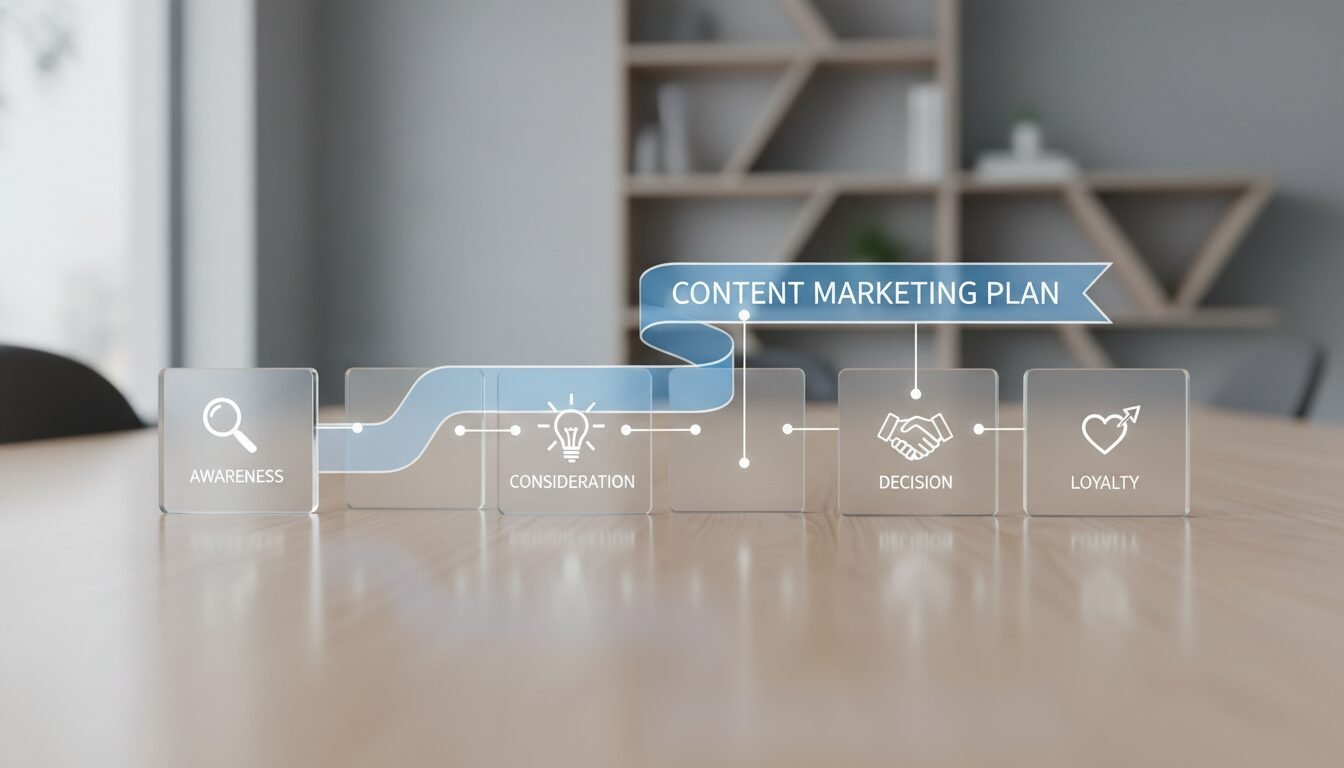
A high-impact content marketing plan maps every asset to a specific stage in the customer decision-making process. The McKinsey customer journey model identifies four key moments: initial consideration, active evaluation, closure, and post-purchase. By aligning content to these stages, you guide prospects from awareness to advocacy without relying on a sales team to do all the heavy lifting.
Awareness Stage Content
At the top of the funnel, your audience is problem-aware but not yet solution-aware. Content here should educate, not sell. Effective formats include blog posts answering common industry questions, beginner-friendly how-to videos, and infographics that visualize complex data. According to the Demand Gen Report, 47% of buyers consumed 3-5 pieces of content before contacting sales, which means a strong awareness library is not optional.
Consideration Stage Content
At this stage, prospects are actively comparing solutions. Your content marketing plan should include comparison guides, expert webinars, case studies, and detailed product demos. Use retargeting ads to serve this content to visitors who engaged with your awareness pieces but did not convert. Content here must build trust and clearly differentiate your solution from the alternatives.
Decision Stage Content
Bottom-of-funnel content removes final objections. Include customer testimonials, free trial offers, ROI calculators, and implementation walkthroughs. A well-planned content marketing plan schedules these assets to be ready the moment a lead signals high intent, such as visiting a pricing page. This reduces friction and accelerates deal closure without requiring a pushy sales call.
Hub-and-Spoke Content Model: Organizing Your Plan for SEO Authority
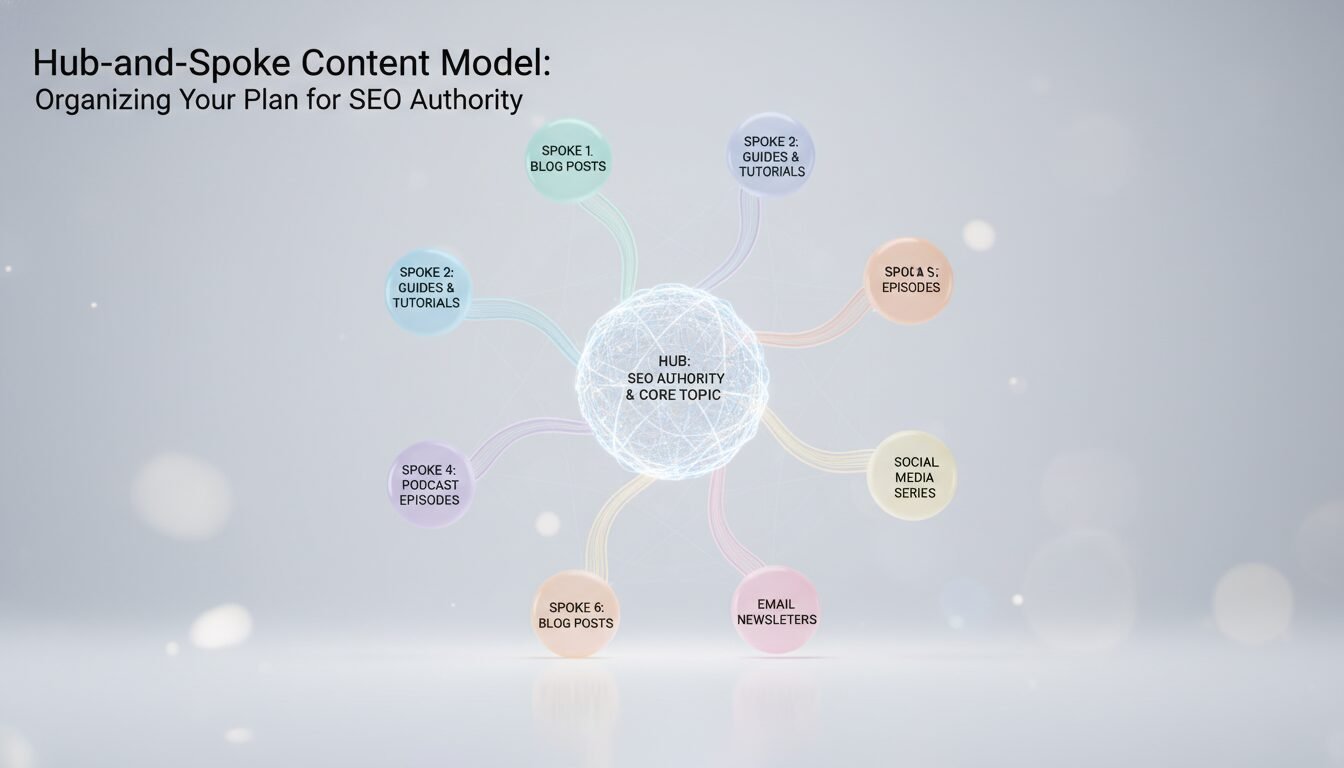
The hub-and-spoke model is one of the most effective ways to structure a content marketing plan for both SEO performance and audience clarity. A central “hub” page covers a broad topic in depth, while multiple “spoke” articles explore specific subtopics and link back to the hub. This internal linking structure signals topical authority to search engines and keeps readers engaged longer.
For a dental practice, the hub might be a comprehensive guide to cosmetic dentistry, with spokes covering teeth whitening, veneers, and smile makeovers individually. For an HVAC company, the hub could be a seasonal maintenance guide, with spokes addressing furnace tune-ups, AC filter replacements, and thermostat upgrades. Each spoke article feeds traffic back to the hub, compounding your SEO value over time. Build this architecture directly into your editorial calendar so the hub publishes first and spokes follow in a logical sequence over 4-8 weeks.
Data-Capture Tactics: Building Lead Magnets Into Your Plan
A content marketing plan that only publishes and never captures leads is leaving real revenue on the table. Gated content and lead magnets convert passive readers into identifiable prospects your sales team can actually follow up with.
Effective lead magnets include downloadable templates (like a content calendar spreadsheet), checklists, industry benchmark reports, and free assessment tools. A MedSpa, for example, might offer a free “Skin Treatment Selector” quiz that captures email addresses while delivering genuine value. An HVAC company could gate a seasonal maintenance checklist behind a simple opt-in form. The key is that the lead magnet must be directly relevant to the content piece it lives on. Map each lead magnet to a specific content pillar inside your content marketing plan so every major topic cluster has at least 1 dedicated data-capture asset.
“The best lead magnets solve one specific problem for one specific audience. Generic content upgrades rarely convert because they feel like an afterthought rather than a genuine offer.” — HubSpot State of Marketing Report
Leveraging Micro-Moments for Hyper-Relevant Content Planning
Consumer behavior today is fragmented into intent-rich micro-moments: those split-second instances when a user turns to a device to know, go, do, or buy. A modern content marketing plan must incorporate these moments to deliver the right content at the exact time of need.
“Micro-moments are intent-driven moments when consumers turn to a device to act on a need.” — Google’s Micro-Moments Guide
What Are Micro-Moments?
Google categorizes micro-moments into four types: I-want-to-know, I-want-to-go, I-want-to-do, and I-want-to-buy. Each represents a different user intent. “I-want-to-know” typically triggers informational queries like “how to reduce churn,” while “I-want-to-buy” signals commercial intent. Your content marketing plan should include dedicated content tailored to each type, mapped to the corresponding buyer-journey stage.
Integrating Micro-Moment Data into Your Plan
Start by identifying the most-searched questions in your niche using tools like AnswerThePublic. For each micro-moment, create a dedicated piece of content optimized for mobile and voice search. Then slot those pieces into your editorial calendar under the relevant buyer-journey stage. This expands a traditional content marketing plan from a simple publishing schedule into an intent-driven engagement system.
Real-World Examples
A home-improvement retailer might create a quick “how to fix a leaky faucet” video for the “I-want-to-do” moment, while a SaaS company could produce a comparison chart for “I-want-to-buy” searches. Both assets live in the same content marketing plan but serve completely different roles. Monitoring performance by micro-moment type also reveals where your audience’s intent is strongest, so you can allocate resources more effectively each quarter.
Future-Proofing Your Content Marketing Plan for AI and Voice Search
The way users search and consume content is shifting fast. AI-generated overviews and voice assistants are redefining what it means to rank. Any content marketing plan built in 2026 must account for these changes to stay visible and useful.
Optimizing for AI Answer Engines
AI-powered search engines like Google’s Search Generative Experience pull answers from well-structured, authoritative content. According to SEMrush, 12.29% of search queries trigger a featured snippet, which is the format most commonly read aloud by voice assistants. Your content marketing plan should therefore prioritize concise, definition-style paragraphs early in every article, and use clear H2/H3 headings to help AI systems extract answers accurately.
Voice Search Content Considerations
Voice searches are typically longer and more conversational than typed queries. Incorporate natural-language question-and-answer formats into your editorial calendar. Instead of targeting only “content marketing plan template,” also include spoke queries like “How do I create a content marketing plan for a small business?” This long-tail approach future-proofs your content marketing plan for the growing share of browsing sessions that happen on voice-first devices.
Tools to Adapt Your Content
Use AI-powered optimization tools like MarketMuse or Clearscope to analyze top-ranking content and identify semantic gaps. These tools generate a content brief that feeds directly into your content marketing plan. Integrating AI insights ensures your content is both human-friendly and machine-readable, increasing your chances of being cited by AI overviews and voice assistants alike.
Essential Tools and Templates for Your Content Marketing Plan
No one builds a content marketing plan from scratch. Proven templates and tools save time and enforce best practices from the start. Below is a comparison of popular options used by marketing teams worldwide.
| Tool / Template | Key Feature | Best For | Pricing |
|---|---|---|---|
| HubSpot Content Planning Kit | Over 12 editable templates including editorial calendars, persona worksheets, and content audits | Small to mid-size businesses wanting an all-in-one package | Free |
| Airtable | Relational database views, 1,200 records per base free tier, 100M records on Scale plan | Teams needing flexible, collaborative editorial calendars | Free – $20/seat/month |
| CoSchedule Marketing Calendar | Centralized drag-and-drop calendar, social scheduling, campaign management | Marketing agencies and mid-market companies | From $29/month |
| Google Sheets / Excel | Completely customizable, zero cost, easy sharing | Budget-conscious teams or solo marketers | Free |
| Trello | Kanban-board style content workflows with power-ups for calendars | Visual planners using agile or scrum methods | Free – $17.50/seat/month |
Pick the tool that best matches your team size and workflow. Ideally, integrate it with your project management suite so your content marketing plan lives in the same environment as your daily tasks.
Pros and Cons of Building a Formal Content Marketing Plan
Pros
- Clarity and alignment: Everyone on the team knows what to create, when to publish, and why it matters.
- Better ROI tracking: Documented plans make it far easier to tie content output to revenue outcomes.
- Consistent publishing cadence: An editorial calendar prevents the feast-or-famine publishing cycle that kills audience growth.
- Smarter budget allocation: Written plans surface where money is being spent and where it is being wasted.
- Faster onboarding: New team members can get up to speed in days rather than weeks when a clear plan exists.
Cons
- Upfront time investment: Building a thorough plan takes real hours before a single piece of content gets written.
- Risk of rigidity: Teams that treat the plan as a fixed contract can miss opportunities that emerge mid-quarter.
- Maintenance overhead: A plan that is not updated regularly becomes outdated and misleading rather than helpful.
- Tool sprawl: Managing multiple platforms (calendar, analytics, CMS) adds complexity for small teams.
Measuring Success: KPIs and Analytics for Content Plans
A content marketing plan is not complete without a measurement framework. Tracking the right metrics lets you prove ROI and make data-driven improvements instead of guessing.
Key Metrics to Track
Monitor at least five core KPIs: organic traffic (volume and growth rate), engagement (time on page, scroll depth), conversion rate (newsletter sign-ups, demo requests), backlinks acquired, and social shares. According to Content Marketing Institute research, 72% of top-performing marketers measure content ROI consistently, a habit that separates successful plans from the rest. For each KPI, set a target and a reporting cadence: weekly for social metrics, monthly for traffic, quarterly for backlinks.
Using Data to Iterate Your Plan
Your content marketing plan should include scheduled review meetings. During these sessions, analyze which topics and formats are outperforming others. If how-to videos generate a significantly higher conversion rate than text-based posts, shift resources accordingly. The plan is a dynamic guide, not a contract set in stone.
Reporting Frameworks
Use dashboards in Google Looker Studio (formerly Google Data Studio) or your analytics platform to keep performance visible across the team. Report on content’s contribution to the bottom line by assigning monetary values to different conversion actions. This transforms your content marketing plan from a cost center into a revenue driver in the eyes of leadership.
Common Content Marketing Plan Mistakes and How to Avoid Them
Even well-intentioned teams fall into traps that undermine their content marketing plan. Recognizing these pitfalls early keeps yours on track.
Mistake 1: Lack of Documentation
Verbal agreements and loose email threads do not count as a plan. The Content Marketing Institute reports that only 40% of B2B marketers have a documented strategy, yet those who do consistently outperform their peers. Write down every element of your content marketing plan in a shared, accessible location and update it on a regular schedule.
Mistake 2: Ignoring Audience Research
Publishing what you want to talk about instead of what your audience needs is the fastest route to irrelevance. Use surveys, social listening, and on-site search data to validate every topic before it goes into the editorial calendar. A content marketing plan built on assumptions rarely delivers meaningful engagement, and the data will tell you that within the first 90 days.
Mistake 3: Inconsistent Publishing
Search engines and audiences both reward consistency. Gaps in your publishing schedule signal unreliability. Use your editorial calendar to maintain a steady cadence, even if that means just one high-quality article per week. Consistency beats volume every time: a well-researched weekly post almost always outperforms a rushed daily one.
How DigiMe Helps Local Businesses Execute Their Content Marketing Plan
Most local service businesses, whether dental practices, MedSpas, or HVAC companies, have the right instincts about content but lack the time and systems to execute consistently. That is exactly where DigiMe’s AI-powered platform steps in.
Our platform automates the most time-consuming parts of a content marketing plan: topic research, content brief generation, publishing schedules, and performance reporting. A dental front desk team should not be spending hours writing blog posts. An HVAC dispatcher should not be manually tracking which social posts drove the most service calls. DigiMe handles the operational layer so your team can focus on delivering great service. Businesses using our platform typically reclaim 10-15 hours per week that were previously spent on manual content tasks. To see how it works for your specific industry, explore our dental marketing solutions or our MedSpa marketing platform.
Want to see the full picture of how AI fits into a local business content strategy? Read our guide on AI marketing for local service businesses for a practical breakdown.
Book a free demo at digimeapp.com to see how AI can transform your practice’s content output without adding to your team’s workload.
Frequently Asked Questions
What is a content marketing plan?
A content marketing plan is a detailed document that outlines the specific types of content you will create, the publishing schedule, distribution channels, and performance metrics, all aligned to your overall marketing strategy. It is the execution layer that turns a high-level strategy into daily, weekly, and monthly action.
How is a content plan different from a content strategy?
A content strategy defines your long-term goals, target audience, and value proposition. A content marketing plan is the tactical execution roadmap with editorial calendars, role assignments, and KPIs. You need both: strategy without a plan stays theoretical, and a plan without strategy lacks direction.
What should a content marketing plan include?
It should include clear objectives, target personas, content pillars, an editorial calendar, a distribution plan, a budget, assigned roles, and a measurement framework. Most effective plans also include a content audit of existing assets and a lead magnet strategy tied to each major content pillar.
Do small businesses need a content marketing plan?
Absolutely. A content marketing plan helps small teams stay focused, avoid random acts of content, and compete effectively with larger brands by being strategic with limited resources. Even a one-page plan with a simple editorial calendar is significantly better than no plan at all.
How often should I update my content marketing plan?
Review and update your content marketing plan at least quarterly to reflect changes in audience behavior, business goals, and content performance data. Major shifts, like a new product launch or a significant algorithm update, should trigger an immediate review outside the regular schedule.
What tools are best for creating a content marketing plan?
Free options like HubSpot’s Content Planning Kit and Google Sheets work well for beginners and solo marketers. Scalable tools like Airtable and CoSchedule offer advanced collaboration and automation features for growing teams. The best tool is the one your team will actually use consistently.