Digital Marketing Services for Small Business: 2026 Guide
Digital marketing services for small business are specialized online strategies that help budget-conscious companies attract, engage, and convert customers. They include SEO, PPC, social media, email, and web optimization, all scaled to fit lean teams and real-world budgets.
Key Takeaways
- Between 70-80% of customers research a company online before buying, making digital presence non-negotiable.
- A sequenced approach, starting with SEO and layering in PPC and email, stretches limited budgets further.
- Email marketing is one of the highest-ROI channels available, with over half of consumers making a purchase from a marketing email monthly.
- Local SEO and Google Business Profile optimization deliver outsized returns for service-area businesses.
- AI tools are now affordable enough for small businesses to use for email personalization, ad copy, and lead scoring.
- Tracking cost per lead and customer acquisition cost matters far more than vanity metrics like page views.
What Are Digital Marketing Services for Small Business?
Defining the Core Components
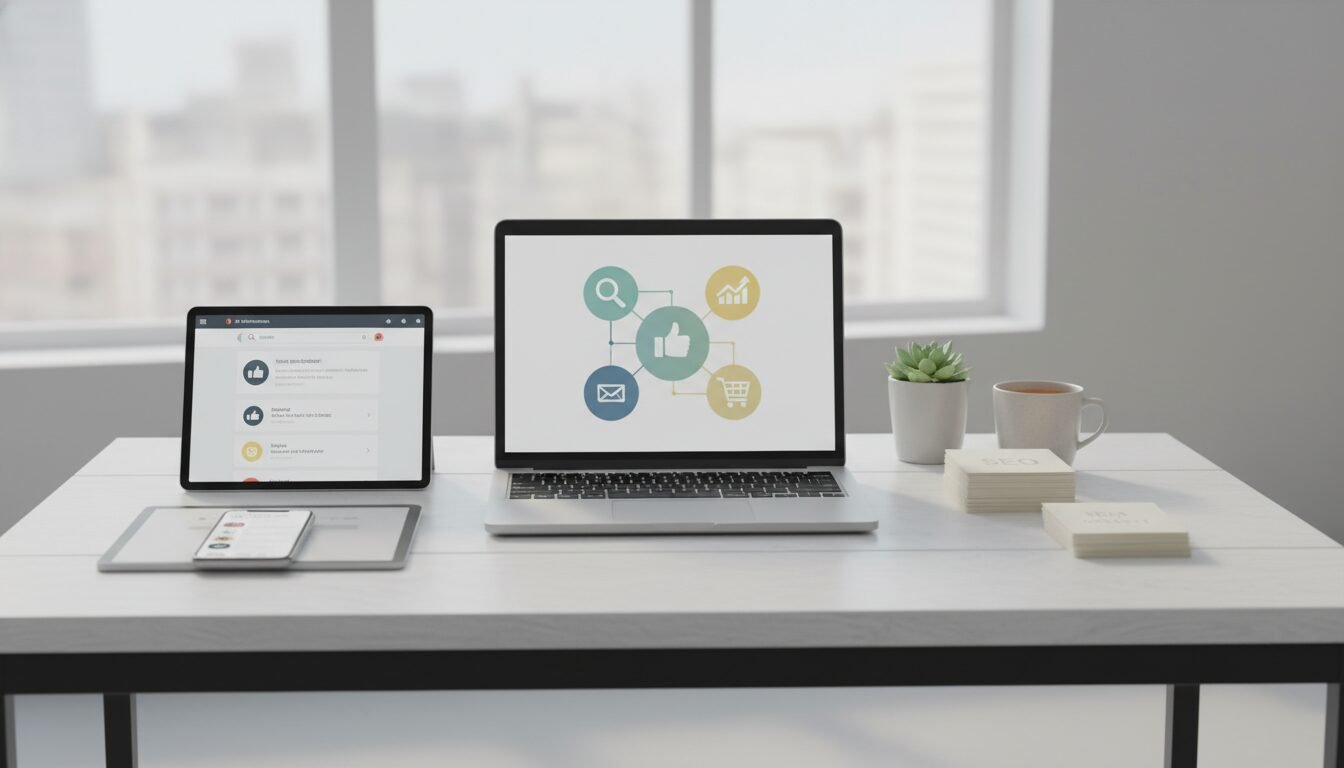
Digital marketing services for small business cover a range of online tactics designed to increase visibility, drive traffic, and generate leads or sales. Unlike enterprise-level campaigns, these services are scaled to fit modest budgets and lean teams. The most common services include search engine optimization (SEO), pay-per-click (PPC) advertising, social media management, email marketing, and conversion rate optimization (CRO). Each works best when aligned with your specific customer journey, from awareness through to purchase and retention.
Why Small Businesses Need a Digital-First Approach
Customer behavior has shifted decisively online, and the numbers back that up.
“Between 70-80% of people research a company online before they conduct any business with them.” — LYFE Marketing
That single reality makes a strong digital presence non-negotiable for any small business. Without one, you’re invisible to the vast majority of potential customers before they ever pick up the phone. A digital-first approach also lets you compete with larger players by targeting niche keywords and local audiences, where big brands routinely underinvest.
Core Digital Marketing Services for Small Business

The right mix of digital marketing services for small business depends on your industry, goals, and budget. Most small businesses benefit from these four pillars, and the table below gives you a realistic sense of what each costs and how fast it delivers.
| Service | Average Monthly Cost | Time to First Results | Primary Benefit |
|---|---|---|---|
| SEO | $500–$2,000 | 3–6 months | Long-term organic traffic |
| PPC (Google Ads) | $300–$5,000+ | 24–48 hours | Immediate targeted traffic |
| Social Media Management | $400–$2,000 | 1–3 months | Brand awareness and engagement |
| Email Marketing | $100–$1,000 | 2–4 weeks | High-ROI direct communication |
| Web Design and CRO | $2,000–$10,000 (project) | 1–2 months | Improved conversion rates |
Search Engine Optimization (SEO)
SEO is the practice of optimizing your website to rank higher in Google for queries your customers are already typing. For small businesses, this usually means targeting long-tail keywords with local intent, like “emergency plumber in Austin” rather than just “plumber.”
“Google says 15% of searches it sees every day are entirely new.” — OuterBox
That 15% figure reveals a real opportunity. You can capture untapped demand simply by creating content that directly answers specific, novel questions your competitors haven’t thought to address yet.
Pay-Per-Click Advertising (PPC)
PPC lets you bid for ad placement in search results and pay only when someone clicks. Platforms like Google Ads and Meta Ads offer tight budget controls and near-immediate visibility, which makes them ideal for testing. A typical small business might start with $500–$1,000 a month on Google Ads to identify which keywords convert, then fold those learnings into its organic SEO strategy. That feedback loop alone is worth the early spend.
Social Media Marketing and Management
Social media puts your brand where your customers already spend hours every day, on Instagram, Facebook, LinkedIn, and TikTok. For small businesses, the goal isn’t going viral. It’s consistent, value-driven posting that builds trust and generates word-of-mouth referrals. Even with a modest budget of $400–$800 per month, you can grow an engaged following and funnel that audience to your website or storefront.
Email Marketing and Automation
Email marketing remains one of the highest-ROI channels available, especially when automated sequences do the heavy lifting.
“Over 50% of consumers say they make a purchase from a marketing email at least once a month.” — Pursuit Lending
For a small business, an automated welcome series, abandoned cart reminders, and post-purchase follow-ups can drive repeat sales without constant manual effort. Platforms like Mailchimp and Klaviyo offer free or low-cost tiers that make this accessible from day one.
Pros and Cons of Digital Marketing Services for Small Business
Pros
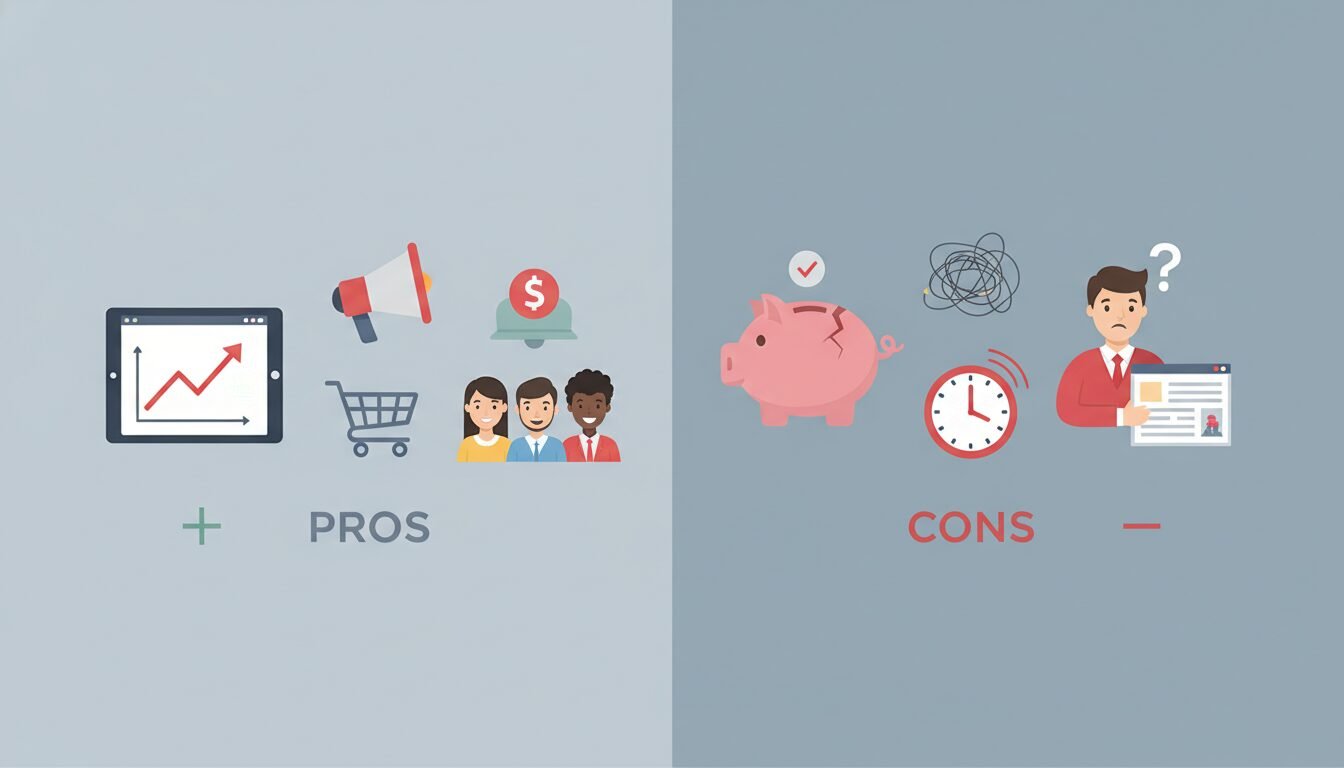
- Cost-effective reach: Digital channels let you reach thousands of targeted prospects for a fraction of what traditional advertising costs.
- Measurable results: Every dollar spent can be tracked through tools like Google Analytics and Google Ads, so you know exactly what’s working.
- Scalable investment: You can start with $100/month in email marketing and scale to a full multi-channel strategy as revenue grows.
- Levels the playing field: A well-optimized local SEO strategy can put a small dental practice or HVAC company ahead of much larger competitors in local search results.
- 24/7 lead generation: Automated email sequences and SEO-driven content work while you sleep, generating leads without additional staff hours.
Cons
- Takes time to build momentum: SEO typically requires 3–6 months before you see meaningful organic traffic growth. Patience is required.
- Requires consistent effort: Social media and content marketing demand regular attention. Sporadic posting produces sporadic results.
- Learning curve: Tools like Google Ads and Search Console have real complexity. Mismanaged PPC campaigns can burn budget quickly without proper oversight.
- Agency quality varies widely: Not every agency delivers what it promises. Vetting partners carefully and demanding transparent reporting is essential.
How to Sequence Digital Marketing Services for Maximum ROI
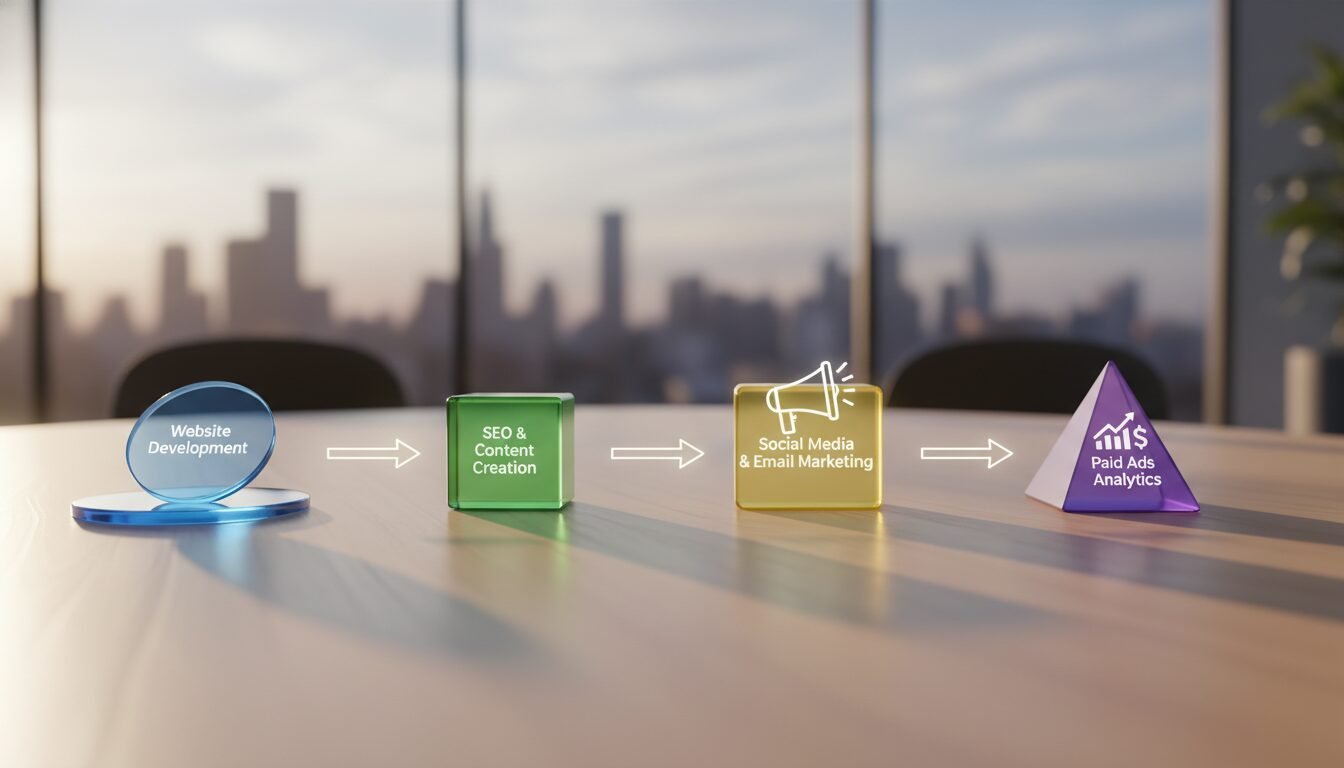
Step-by-Step Implementation Plan
Not every service should launch at once. Follow this sequence to build a solid foundation first, then layer on more advanced tactics as each channel gains traction.
- Audit and fix your website: Ensure fast loading, mobile responsiveness, and clear calls-to-action. More traffic won’t help if your site can’t convert visitors.
- Claim and optimize Google Business Profile: For local businesses, this is essential. Fill out every field, add photos, and actively encourage reviews.
- Implement basic on-page SEO: Optimize title tags, meta descriptions, and headers for your core service pages. Start blogging with real customer questions in mind.
- Launch a small PPC campaign: Use a modest budget to test your messaging and identify high-converting keywords before scaling spend.
- Build a focused social media presence: Choose one or two platforms where your audience is active and post consistently rather than spreading thin across every channel.
- Set up email capture and automation: Add a sign-up form to your site and create a simple welcome sequence to nurture new leads over time.
- Analyze and iterate: Use data from PPC, social, and email to refine your SEO content and website layout every 30–60 days.
Real Example: Intent-Based Content in Action
A sequenced, content-first approach can produce dramatic results. In one OuterBox case study, implementing B-SMART product content led to a 216% traffic increase and a 155% lift in conversion events, generating 54 new business opportunities. The key was fixing content quality before driving paid traffic, which prevented wasted spend and maximized every dollar invested.
Budget-Friendly Digital Marketing Tactics That Deliver Results
Free and Low-Cost Tools for Getting Started
You don’t need a five-figure budget to start seeing results from digital marketing services for small business. Google Business Profile, organic social media, and Canva for design are all free. Mailchimp offers a free tier for lists under 500 contacts. Nextdoor, a hyper-local social platform, connects you directly with neighbors in your service area and is particularly effective for home services businesses like HVAC and landscaping. These tools alone can generate real leads before you spend a dollar on ads.
Maximizing Local SEO on a Shoestring Budget
Local SEO offers the highest ROI for businesses with a physical location or defined service area. Start by ensuring your Name, Address, and Phone (NAP) are consistent across all online directories, including Yelp, Angi, and your Google Business Profile. Post regular updates and offers directly to your Google Business Profile. Actively ask satisfied customers to leave reviews. According to research cited by Harvard Business Review, even a modest improvement in star rating on review platforms correlates with measurable revenue increases. For dental practices, MedSpas, and HVAC companies, local visibility translates directly into booked appointments and service calls.
CRM Integration: Connecting Marketing to Revenue
One area many small businesses overlook is connecting their digital marketing efforts to a CRM (customer relationship management) system. Tools like HubSpot’s free CRM, Salesforce Essentials, or industry-specific platforms let you track every lead from first click to closed sale. When your email marketing, PPC campaigns, and website forms all feed into one CRM, you can see exactly which digital marketing services for small business are generating actual revenue, not just traffic. That visibility is what separates businesses that scale from those that stay stuck guessing.
Measuring Success: KPIs and Analytics for Small Business Marketing
Key Performance Indicators That Matter
Vanity metrics like raw page views mean little without context. For a small business, focus on these KPIs that tie directly to revenue.
- Conversion rate: The percentage of visitors who take a desired action, whether that’s a purchase, form fill, or phone call.
- Cost per lead (CPL): Total marketing spend divided by leads generated. Critical for budgeting and channel comparison.
- Customer acquisition cost (CAC): Total sales and marketing spend divided by new customers acquired in a given period.
- Return on ad spend (ROAS): Revenue generated divided by ad spend. A ROAS of 3x or higher is a common benchmark for healthy paid campaigns.
- Email click-through rate: Indicates content relevance and audience engagement. Industry benchmarks from Mailchimp suggest rates vary by sector, with service businesses typically seeing 2-5%.
Using Analytics to Optimize Your Spend
Google Analytics and Google Search Console are free and essential starting points. They reveal which channels drive the most traffic, where visitors drop off, and which pages convert best. In the OuterBox case study referenced earlier, analytics-driven content refinements turned a struggling product category into a 54-opportunity pipeline. The practical takeaway: review your data monthly and reallocate budget toward high-performing channels. Even a 10-15% budget shift toward your best-performing channel can produce noticeable improvements within a single quarter.
Choosing the Right Digital Marketing Partner
What to Look for in an Agency
The right agency acts as an extension of your team, not just a vendor who sends monthly reports. When evaluating digital marketing services for small business providers, look for these attributes.
- Small business focus: Agencies like Succeeding Small and OuterBox specialize in smaller budgets and real-world constraints, which matters more than you’d think.
- Proven results: Ask for case studies with specific numbers. The OuterBox client example above, with a 216% traffic increase and 155% conversion lift, is the kind of evidence worth demanding.
- Transparent reporting: You should receive regular, clear reports on the KPIs that matter to your business, not just a dashboard full of impressions.
- Service flexibility: The best agencies offer modular services so you can start with one channel and add others as your budget grows.
Red Flags to Avoid
Be cautious of any agency promising “guaranteed #1 rankings in 30 days” or offering vague contract terms with no access to your own performance data. A credible partner diagnoses your business first, assessing existing demand and identifying site conversion leaks before proposing any campaigns. One-size-fits-all packages are almost always a sign that the agency isn’t thinking about your specific situation.
At DigiMe, we work specifically with local service businesses in dental, MedSpa, and HVAC. Our AI-powered platform connects your marketing channels, automates follow-up, and gives you a clear view of which efforts are driving booked appointments. See how it works for dental practices or explore our MedSpa marketing solutions.
Future Trends in Small Business Digital Marketing (2026 Outlook)
AI-Assisted Optimization
Artificial intelligence is no longer an enterprise-only tool. As of 2026, AI-powered features are built into platforms like Google Ads, Mailchimp, and HubSpot at price points small businesses can actually afford. You can use AI to personalize email send times, generate ad copy variations, and even predict which leads are most likely to convert. The right way to think about AI is as a capable assistant that handles repetitive optimization tasks while you focus on strategy and relationships.
Voice and Visual Search Growth
With 15% of daily Google searches being entirely new queries, and voice-based searches continuing to grow, small businesses need to optimize for conversational, long-tail keywords. A dental practice might target “best family dentist open Saturday near me” rather than just “dentist.” Visual search tools like Google Lens are also making product and service images searchable, which is another reason to keep your website’s visual content high-quality and properly tagged with descriptive alt text.
Crisis and Reputation Marketing
This year, reputation management has become a core component of digital marketing services for small business, not an afterthought. A single negative review left unaddressed can suppress your Google Business Profile ranking and deter potential customers. Proactive reputation strategies include automated review request sequences sent after service completion, prompt public responses to negative feedback, and regular monitoring through tools like Google Alerts or BrightLocal. According to BrightLocal’s annual consumer research, the vast majority of consumers read online reviews before choosing a local service provider, making reputation management as important as any paid campaign.
Frequently Asked Questions
What are the most affordable digital marketing services for a small business?
Email marketing and social media management are among the most affordable options, often starting at $100–$400 per month. Free tools like Google Business Profile and organic social posting can also build real presence without upfront costs, making them ideal starting points for businesses with tight budgets.
How much does digital marketing cost for a small business?
Costs vary by channel and scope. A basic SEO package typically runs $500–$2,000 per month, PPC ranges from $300–$5,000 depending on competition, and email marketing starts as low as $100 per month. Most small businesses allocate roughly 7–10% of their revenue to total marketing spend.
Which digital marketing service is best for my small business?
It depends on your goals and timeline. If you need leads within days, PPC delivers fast. For sustainable long-term growth, SEO is essential. Local service businesses, including dental practices, MedSpas, and HVAC companies, typically see the strongest early returns from local SEO and Google Business Profile optimization.
How long does it take to see results from digital marketing?
PPC can generate traffic within 24–48 hours of launching a campaign. SEO typically takes 3–6 months to show significant organic results. Email campaigns can yield measurable responses within 2–4 weeks. Consistency across all channels is what compounds results over time.
Can I do digital marketing on my own, or should I hire an agency?
DIY is possible using free tools, and many small business owners start that way. An agency brings expertise, saves 10–15 hours per week of your time, and typically delivers stronger ROI through experience and tooling. If you lack in-house skills or bandwidth, a focused agency partnership is usually worth the investment.
What is local SEO and do I need it?
Local SEO optimizes your online presence for location-based searches like “plumber near me” or “dental clinic in [city].” If you serve a defined geographic area, local SEO is one of the highest-ROI digital marketing services for small business available. It drives direct phone calls, foot traffic, and booked appointments from people actively searching for what you offer.
Ready to put these strategies to work? Book a free demo at digimeapp.com to see how AI can transform your practice’s marketing results without adding to your team’s workload.