A content marketing agency creates and promotes content that attracts customers and drives measurable business growth. They handle strategy, writing, and distribution so you can focus on running your business.
- Key Takeaways
- Content marketing agencies provide specialized expertise to scale your content efforts without hiring full-time staff.
- Success depends on clear goal alignment, industry expertise, and post-publishing promotion strategies.
- Most small business owners handle marketing alone, agencies free up time and deliver professional results.
- Top platforms list thousands of agencies; evaluate case studies and client outcomes carefully.
- Ask about AEO strategies as AI answer engines reshape how customers find information.
What Is a Content Marketing Agency?

A content marketing agency is a specialized firm that develops strategy, creates content, and manages distribution to attract your ideal customers and drive profitable actions. Unlike general marketing agencies, these specialists focus exclusively on content as the primary driver of business growth. According to industry data, established agencies have been helping SaaS, B2B, and local service companies with content strategy, SEO optimization, and audience engagement for over a decade.
The Core Functions of Content Marketing Agencies
Most agencies handle three essential areas: strategy development, defining your audience, content themes, and distribution channels; content creation, producing blog posts, videos, guides, and social media assets; and performance tracking, measuring traffic, leads, and conversions to refine the approach. These functions ensure every piece of content aligns with your business objectives.
How Agencies Drive Business Growth
By maintaining consistent publishing schedules and optimizing for search engines, agencies build organic traffic that compounds over time. They also establish topical authority, which boosts brand credibility with both search engines and potential customers. Well-executed SEO-focused content strategies typically yield significant traffic increases within 12 months when properly implemented.
Key Services Offered by Content Marketing Agencies
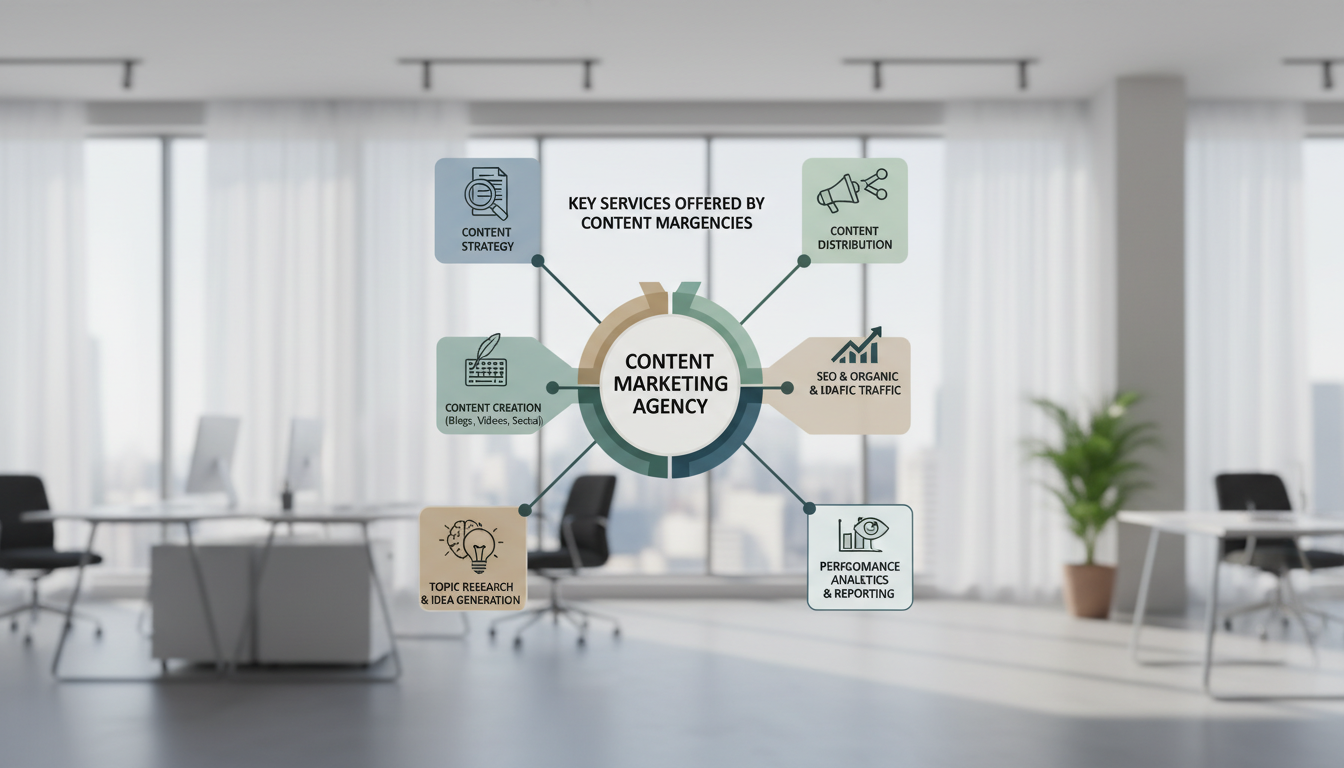
Professional agencies deliver comprehensive services from initial research through post-publication promotion. The most effective providers tailor these offerings based on your industry and growth stage. Here are the primary services you can expect:
Content Strategy and Planning
Strategy forms the foundation of successful content programs. Agencies begin with thorough audience research, competitive analysis, and keyword mapping. They define content pillars, editorial calendars, and key performance indicators (KPIs). This phase often involves tools like Semrush or Ahrefs to identify high-opportunity topics that your competitors might be missing.
Content Creation and Optimization
Writing, design, and video production fall under this category. Agencies employ specialist writers and editors who adapt to your brand voice and industry requirements. They also optimize content for answer engine optimization (AEO) and generative engine optimization (GEO), ensuring your content appears in AI platforms like ChatGPT and Google’s AI-powered search results.
Performance Tracking and Analytics
Data-driven agencies track metrics like organic traffic, time on page, bounce rate, and conversion rates. They use Google Analytics, Search Console, and proprietary dashboards to report on progress. This transparency allows you to see clear ROI from your content marketing investment and make informed decisions about future strategy.
Benefits of Working With Professional Content Creators

Outsourcing to a content marketing agency provides access to a diverse skill set, writers, SEO experts, designers, and strategists, without the overhead of full-time hires. It also brings an objective perspective, helping you articulate your value proposition more effectively. Professional agencies can scale content production rapidly, launching 8-12 high-quality pieces per month while you focus on core business operations.
Access to Specialized Expertise
Top agencies have worked across dozens of industries, giving them breadth of experience that in-house teams often lack. They understand what works for B2B lead generation versus local service businesses. Industry research shows that businesses most often need leads and sales, not just traffic, and agencies optimizing for these goals require distinct strategies and proven methodologies.
Consistent and High-Quality Content Output
In-house teams often struggle with bandwidth, leading to sporadic publishing that search engines don’t reward. Professional agencies ensure steady content cadence, which builds authority over time. Research indicates that roughly half of small business owners handle marketing entirely on their own, making agencies valuable for eliminating that strain while providing professional consistency.
Measurable Return on Investment
With clear attribution models, agencies can demonstrate how content efforts lead to actual business results. They track assisted conversions, email signups, and demo requests, tying them back to specific articles. This data proves that content is a long-term asset that continues generating leads months after publication.
How to Choose the Right Content Marketing Agency

Selecting from thousands of available options can feel overwhelming. Major platforms list thousands of agencies with verified reviews and expert curation. To narrow down your search and find the right partner, follow this systematic evaluation process:
Step 1: Define Your Primary Goal
Are you aiming for website traffic, email list growth, or direct leads and sales? Most companies want measurable ROI, but many agencies are built primarily to grow traffic metrics. Be explicit about your objectives. The right content marketing agency will design a strategy that funnels readers toward conversion pages, not just blog engagement.
Step 2: Evaluate Their Process for Understanding Your Business
The best agencies have structured onboarding processes to absorb your product details, customer pain points, and industry terminology. Ask how they interview stakeholders, review existing analytics, and train their writers on your specific market. Without this foundation, content will sound generic and fail to convert prospects.
Step 3: Review Case Studies and Client Results
Dig into detailed case studies that show revenue impact, not just traffic graphs. Credible agencies share specific before-and-after metrics, client testimonials, and retention rates. Be wary of providers that only showcase vanity metrics like page views without connecting them to business outcomes.
Step 4: Understand Their Promotion and Distribution Strategy
Content that isn’t promoted rarely reaches its target audience. Ask about their approach to email outreach, social media amplification, link building, and AI-driven distribution. Leading agencies offer integrated SEO and content promotion to maximize the reach and impact of every piece they create.
Types of Content Marketing Agencies
Not every content marketing agency operates the same way. Based on their primary focus and expertise, they fall into distinct categories. Choosing the right type ensures you get specialized support that matches your specific needs:
| Agency Type | Focus | Best For | Example Providers |
|---|---|---|---|
| Full-Service Digital Marketing Agency | End-to-end marketing, including SEO, PPC, social, content | Businesses seeking a single partner for all marketing needs | WebFX, Thrive Agency |
| SEO-Focused Content Agency | Organic traffic growth through keyword-optimized content and link building | Companies aiming to dominate search rankings in their niche | Siege Media, Animalz |
| B2B/SaaS Content Specialist | Deep industry knowledge, lead generation, technical content | SaaS and B2B companies needing high-intent, conversion-focused content | Grow and Convert, Omniscient |
| Creative/Visual Storytelling Agency | Video, photography, interactive content, brand narratives | Brands that rely heavily on visual content for customer engagement | Crafted, Column Five |
Full-Service Digital Marketing Agencies
These providers offer comprehensive services beyond content, often including PPC management, web design, and CRM integration. They suit businesses that lack internal marketing infrastructure and want a single point of contact. However, their content depth may not match specialist agencies that focus exclusively on content strategy and creation.
SEO-Focused Content Agencies
If organic search is your primary customer acquisition channel, an SEO-first approach makes sense. These agencies prioritize keyword research, search intent analysis, and technical optimization. Providers like Siege Media have built reputations for driving substantial traffic gains through data-driven content strategies.
B2B and SaaS Content Specialists
For complex solutions requiring technical expertise, specialist agencies bring valuable domain knowledge. They excel at creating bottom-of-funnel content, detailed comparisons, implementation guides, and case studies, that converts decision-makers. These agencies understand the longer sales cycles and multiple stakeholders involved in B2B purchasing decisions.
Pricing and Investment for Content Services
One of the first questions businesses ask is about cost structure and expected investment. Pricing varies significantly based on scope, expertise level, and deliverables included. Most agencies charge between $3,000 and $20,000 per month for mid-tier services, though enterprise retainers can exceed $50,000. Key factors include content volume, research complexity, and additional services like design or link building.
Factors That Influence Pricing
Several variables affect what you’ll pay: content type (blog posts versus interactive tools), research depth (original data versus curated insights), and distribution scope (organic-only versus paid amplification). Agencies with proven expertise in specific industries or advanced capabilities like AEO often command premium pricing.
Common Pricing Models
Most agencies use monthly retainers that include a set number of articles, revisions, and performance reviews. Some offer project-based pricing for specific campaigns, such as a 12-week content sprint, or performance-based fees tied to lead generation targets. Always clarify what’s included in the base price to avoid unexpected costs later.
In-House Team vs Agency: Making the Right Choice
Deciding between building an internal content team and hiring an agency is a strategic choice with long-term implications. An in-house content manager costs $70,000-$120,000 in salary alone, plus benefits, tools, and training. A content marketing agency provides a complete team for similar investment, often with faster implementation and broader expertise.
Cost Comparison and Trade-offs
In-house teams offer deep brand alignment and institutional knowledge but limited scalability. Agencies bring fresh perspectives, established workflows, and on-demand capacity, crucial for seasonal campaigns or rapid market testing. However, agencies may lack the intimate product knowledge that internal team members develop over time, making thorough onboarding essential.
Scalability and Efficiency
When content demands increase, agencies can accelerate delivery from 4 posts to 12 posts per month without hiring delays or training periods. In contrast, internal teams would need weeks to recruit and onboard new talent. Agencies also provide built-in quality assurance through editors and SEO specialists, reducing time spent on revisions and optimization.
Common Mistakes When Selecting a Content Partner
Many companies stumble when hiring agencies because they overlook fundamental alignment issues. The most common mistake is choosing based on price alone, leading to generic, low-value content that fails to convert prospects. Another frequent error is ignoring post-publishing promotion, content that sits unshared never builds the traction needed for business impact.
Not Defining Clear Success Metrics
Without explicit objectives, agencies may default to chasing traffic rather than sales.
“A good content marketing agency should do three things well: turn your expertise into clear messaging, ship content consistently, and make it easy for the right people to find and trust that content.” , Digital Elevator Insight, 2026
This insight underscores the need for outcome-focused collaboration from day one.
Overlooking Post-Publishing Promotion
Even exceptional content needs active distribution to reach its intended audience. Ask potential agencies about their promotion playbook, including email outreach, social media amplification, and AI search optimization. Many agencies focus solely on creation without addressing the distribution gap that limits content performance.
Ignoring Measurement and Attribution
If an agency can’t demonstrate how blog content influences sales conversations, its value becomes difficult to justify. Demand clear attribution models, first-touch, last-touch, or multi-touch, and regular reporting that connects content performance to pipeline development. Leading agencies emphasize accountability to measurable revenue results.
Future Trends Shaping Content Marketing Agencies
As 2026 progresses, agencies are evolving to stay ahead of AI-driven search and changing customer behavior. Two trends are reshaping the industry: answer engine optimization (AEO) and data-driven funnel integration. Forward-thinking agencies now optimize for how people ask questions through voice and AI chat, not just traditional typed keywords.
AI and AEO Integration
With conversational search becoming dominant, content must be structured for machine comprehension and citation. Modern agencies create glossary pages, FAQ schemas, and direct-answer formats that win citations from Google AI and ChatGPT. This AEO-forward approach helps brands compete to be the authoritative source inside AI-generated answers.
Data-Driven Funnel Optimization
Leading agencies now connect every article to specific revenue events. They map keyword-to-conversion journeys using CRM data to identify which topics attract high-intent visitors. This approach shifts content from brand awareness to demand capture, aligning with businesses that require clear ROI. Integration with tools like HubSpot and Salesforce enables closed-loop reporting.
Frequently Asked Questions
What Does a Content Marketing Agency Do?
A content marketing agency plans, creates, and distributes content such as blogs, videos, and social media posts to attract and convert customers. They align this content with your business goals and measure its impact on leads and sales.
How Much Does a Content Marketing Agency Cost?
Costs typically range from $3,000 to $20,000+ per month depending on scope and expertise level. Monthly retainers usually cover strategy, writing, editing, and basic SEO; advanced services like link building or AEO optimization may cost extra.
Who Are the Big 6 Marketing Agencies?
The “big 6” traditionally refers to holding companies like WPP, Omnicom, and Publicis. For content-specific work, top mid-market firms include Animalz, Siege Media, and Brafton, known for deep B2B and SaaS expertise.
How Do I Hire the Best Content Marketing Agency?
Start by defining your primary goal (traffic vs. leads vs. sales). Review detailed case studies showing revenue impact, ask about their process for learning your business, and ensure their promotion strategy matches your distribution needs.
Can a Content Marketing Agency Help With AI Search Optimization?
Yes, leading agencies now offer AEO services that structure your content to appear in AI-generated answers. This includes creating direct-response snippets, FAQ sections, and citing authoritative sources that AI systems prefer.
Conclusion
Choosing the right content marketing agency in 2026 requires clarity on your objectives, careful evaluation of expertise, and understanding of modern search dynamics. Whether you need a full-service provider or industry specialist, focus on agencies that connect content directly to revenue outcomes. As AI answer engines become dominant, prioritize providers that master AEO and data-driven funnel optimization. Evaluate case studies thoroughly, ask detailed questions about their process, and you’ll find a partner that transforms your content into a measurable growth engine. Book a free demo at digimeapp.com to see how AI can transform your practice.