Internet Marketing Course: Costs, Types & Career Impact
An internet marketing course is a structured educational program that teaches strategies for promoting businesses through search engines, social media, email, and other online channels. These programs range from free introductory classes to accredited university credentials.
Key Takeaways
- Prices for an internet marketing course range from free (Google and HubSpot) to $6,500+ (Harvard university credentials).
- According to the Digital Marketing Institute (DMI), 92% of graduates report a positive career impact from their certification.
- Industry research shows 49% of senior executives identify AI strategy development as the top missing skill, driving demand for AI-focused training.
- Programs like the University of Utah’s AI-Powered Certified Digital Marketer combine university certification with vendor credentials from Google and HubSpot.
- DMI data shows 79% promotion rates and 88% of graduates working at senior levels after completing a professional program.
What Is an Internet Marketing Course?

An internet marketing course is a focused training program covering the digital channels, tools, and strategies businesses use to attract and convert customers online. It’s built for practical application, not just theory.
Core Components
Most programs cover the full spectrum of digital marketing disciplines. You can expect modules on search engine optimization (SEO), pay-per-click (PPC) advertising, social media marketing, email marketing, content marketing, and marketing analytics. Many programs now emphasize AI-driven tools like ChatGPT and predictive analytics. The University of Utah’s program, for example, specifically trains students on Google Analytics 4 (GA4), Google Ads, and HubSpot, ensuring hands-on experience with the real platforms employers expect you to know.
How It Differs from Traditional Marketing Education
Unlike a traditional marketing degree focused on broad theories, an internet marketing course is built around practical, digital-first strategies. Courses update frequently to reflect algorithm changes on Google and Meta platforms, whereas degree curricula can take years to evolve. As of 2026, the rapid adoption of generative AI has made continuous skill refresh a necessity. Programs now include training on ChatGPT and automated bidding strategies that simply didn’t exist five years ago.
In-Person vs. Online Delivery
Most internet marketing courses run fully online, but delivery formats vary more than people expect. Harvard Business School Online operates asynchronously, meaning no scheduled class times. The University of Utah ProEd program includes optional live sessions and mentorship alongside self-paced content. Wharton Executive Education offers select in-person intensives for executives who prefer face-to-face cohort learning. For most working professionals, online delivery wins on flexibility. For those who value networking and accountability, hybrid or in-person formats are worth the added cost.
Types of Internet Marketing Courses

Internet marketing courses fall into several distinct categories, each suited to different goals, budgets, and time commitments.
Free vs. Paid Courses
At one end, Google’s Digital Marketing & E-commerce Certificate on Coursera is free to audit, providing roughly six months of flexible, beginner-friendly training. HubSpot Academy also offers a free digital marketing certification with no cost to complete. At the other end, Harvard Business School Online charges $1,850 for its 7-week Digital Marketing Strategy course, and its multi-course Credential of Digital Innovation and Strategy costs $6,500. The value of a paid course typically comes from the credential’s prestige, instructor access, and career support services.
Certification Programs vs. Degree Programs
A professional certification from an internet marketing course can be completed in weeks or months, while a master’s degree in marketing typically requires one to two years and costs tens of thousands of dollars. Certifications are project- and skill-based, making them ideal for rapid upskilling. According to the Digital Marketing Institute, 79% of its graduates were promoted after completing a certification. That’s a direct, measurable career outcome that a two-year degree program rarely promises.
Self-Paced vs. Instructor-Led
Most platforms like Udemy and Coursera offer self-paced learning, allowing completion in as little as 30 hours (DMI’s program) or spread over six months. Instructor-led options like the University of Utah’s course include live sessions and mentorship, providing networking opportunities that fully self-paced learners miss. Your choice here depends on whether you need structure or flexibility more.
Key Skills You Learn in an Internet Marketing Course

The skills covered in a quality internet marketing course map directly to what employers are hiring for right now.
AI and Automation in Modern Marketing
The most critical skill gap in 2026 is AI marketing strategy. According to The State of Digital Skills & Corporate Training report, 49% of senior executives see AI strategy development as their team’s most important missing skill. Top internet marketing courses now include modules on ChatGPT for copywriting, predictive analytics for customer targeting, and marketing automation with HubSpot. The University of Utah even brands its program as “AI-Powered,” reflecting how central this has become.
Analytics and Data-Driven Decision Making
Understanding Google Analytics 4 (GA4) is no longer optional for any serious marketer. Courses teach how to track conversions, analyze user behavior, and calculate ROI using real data. Harvard’s Digital Marketing Strategy course dedicates significant time to interpreting marketing data to inform strategy. This skill directly correlates with the fact that 88% of DMI-certified professionals now work at senior or management levels, per DMI’s own alumni research.
Content and Social Media Strategy
Beyond analytics, you’ll learn to craft brand-aligned content and manage paid social campaigns. With HubSpot’s content marketing tools and Google Ads search campaigns as common project work, students build portfolios that resonate with employers looking for platform-specific expertise. This is the difference between saying you know digital marketing and being able to prove it.
Pros and Cons of Taking an Internet Marketing Course
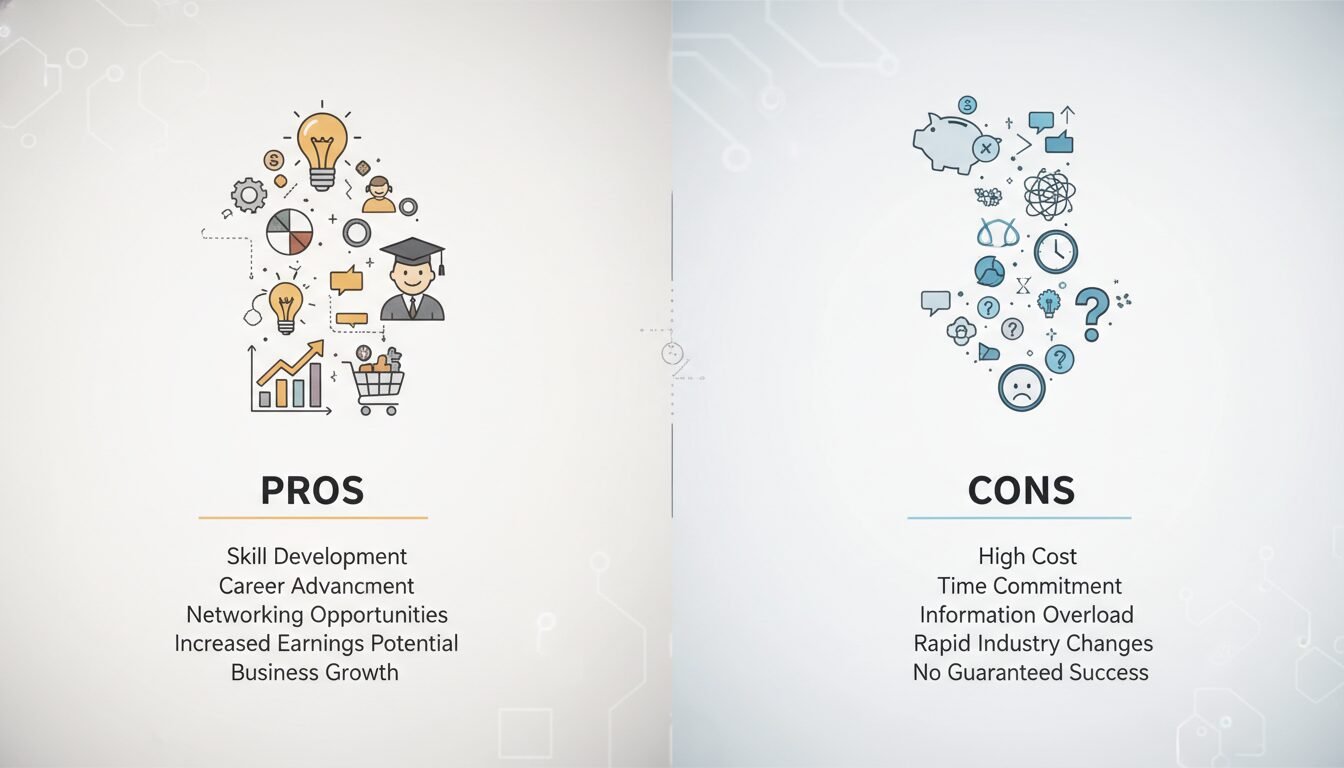
Before you commit time and money, it’s worth weighing both sides honestly.
Pros
- Fast results: Certifications can be completed in 30 hours to 10 weeks, far faster than a traditional degree.
- Verified career outcomes: DMI data shows 79% of graduates earn promotions, and 92% report positive career impact.
- Affordable entry points: Free options from Google and HubSpot remove financial barriers entirely.
- Employer recognition: Vendor certifications from Google and HubSpot are widely recognized by hiring managers.
- Practical tool exposure: Programs include hands-on work with GA4, Google Ads, HubSpot, and ChatGPT.
Cons
- Credential saturation: As more people earn certifications, standing out requires stacking multiple credentials or pairing them with real experience.
- Self-discipline required: Self-paced formats work only if you actually complete them. Many learners start free courses and never finish.
- Rapid obsolescence: Digital marketing evolves fast. A certification earned in 2023 may not reflect 2026 best practices without refresher training.
- Cost at the premium end: University-backed programs at $1,850 to $6,500 are a real investment that not every budget can absorb.
How Much Does an Internet Marketing Course Cost?
Costs vary widely, from zero to several thousand dollars, depending on the provider, credential type, and level of support included.
Price Ranges and What They Include
Below is a comparison of five recognized offerings as of 2026:
| Provider | Course Name | Price | Duration | Certification |
|---|---|---|---|---|
| Google (via Coursera) | Digital Marketing & E-commerce Certificate | Free to audit; optional certificate fee | 6 months (flexible) | Google Career Certificate |
| HubSpot Academy | Digital Marketing Certification | Free | Self-paced | HubSpot Certification |
| Harvard Business School Online | Digital Marketing Strategy | $1,850 | 7 weeks | HBS Online Certificate |
| University of Utah ProEd | AI-Powered Certified Digital Marketer | $2,250 (sale price) | 10 weeks | U of U Certificate + Google & HubSpot certs |
| AMA / Digital Marketing Institute | Digital Marketing Pro | Contact provider | 30 hours self-paced | PCM® Digital Marketing & CDMP |
Free courses offer a zero-risk entry point. Premium options provide structured mentorship and dual credentials that accelerate career transitions. The right choice depends on where you are now and where you need to be.
Return on Investment: Career and Salary Impact
“92% of DMI graduates agree that our digital marketing course positively impacted their career, and 79% have been promoted after completing one of our digital marketing programs.” Digital Marketing Institute alumni research
This data from the American Marketing Association (AMA) and DMI partnership underscores the tangible ROI. For a mid-level marketer moving into a specialist role, salary increases in the range of $10,000 to $20,000 are common in U.S. markets, which means a $2,000 course fee pays for itself quickly.
Choosing the Right Internet Marketing Course: A Step-by-Step Process
Choosing the right internet marketing course comes down to matching your career goals, budget, and learning style to the right program structure.
Step 1: Define Your Career Objectives
Are you aiming for a junior digital marketing role, a specialist position in SEO or PPC, or a management track? This determines the depth you need. A $100 Udemy course may suffice for entry-level skills, but a $1,850 Harvard certificate signals strategic capability to employers in U.S. and European markets.
Step 2: Evaluate Curriculum and Tool Exposure
Prioritize courses that provide hands-on work with industry-standard tools like GA4, Google Ads, HubSpot, and ChatGPT. The University of Utah’s program includes actual certification exams from technology vendors, which gives graduates a competitive edge that a purely theoretical course cannot match.
Step 3: Check Accreditation and Industry Recognition
Look for programs backed by reputable organizations. Accreditations from AMA, DMI, or a major university carry real weight with hiring managers. On Coursera, the Google certificate is recognized by employers including Deloitte and Verizon, which matters when your resume lands in a recruiter’s inbox.
Step 4: Consider Cost and Time Commitment
Balance your budget and schedule honestly. Harvard’s 7-week commitment at $1,850 is intensive and structured. The University of Utah’s 10-week program at $2,250 offers more tool certifications for a slightly higher investment. Free options like HubSpot require only your time, which is still a real cost.
Step 5: Read Reviews and Alumni Outcomes
Platforms like Reddit’s r/AskMarketing and Coursera reviews provide unfiltered feedback from real learners. Many cite Google’s 6-month program as solid for beginners. Look for verifiable outcome data: DMI’s 79% promotion rate is the kind of benchmark that separates credible programs from marketing fluff.
Top Internet Marketing Course Providers in 2026
The best internet marketing course providers combine recognized credentials, current curriculum, and measurable career outcomes.
University-Backed Programs
Harvard Business School Online offers Digital Marketing Strategy at $1,850 and a comprehensive Digital Innovation & Strategy credential at $6,500. The University of Utah ProEd provides a uniquely integrated program that bundles vendor certifications and career coaching at $2,250. Wharton Executive Education also offers digital marketing certificates, with formats that include in-person intensives for senior professionals.
Industry Certification Bodies
The AMA and Digital Marketing Institute jointly offer the Digital Marketing Pro program, resulting in dual certifications: the PCM® Digital Marketing credential and the CDMP. This 30-hour course is continuously updated and reports the highest career advancement rates among its alumni. HubSpot Academy and Google provide free, platform-specific certifications that employers actively seek when hiring for tool-specific roles.
Online Learning Platforms
Simplilearn delivers a 24-hour Digital Marketing Specialist course that’s frequently recommended for its hands-on approach. Udemy offers hundreds of courses, with bestsellers covering SEO and social media marketing for under $100. Coursera aggregates university and corporate partners, including the popular Google certificate, which has enrolled over 1 million learners globally. For learners outside the U.S., Simplilearn also offers region-specific programs, including India-focused tracks with local market context.
The Future of Internet Marketing Education
The next generation of internet marketing courses will look meaningfully different from what’s available today.
AI and Machine Learning Integration
With 49% of executives flagging AI as a critical skill gap, the next wave of internet marketing courses will embed AI modules as core requirements, not optional add-ons. Expect proactive training in generative AI tools and automated campaign optimization to become standard across every tier of program, from free certifications to university credentials.
The Shift to Stackable Credentials and Micro-Certifications
“According to The State of Digital Skills & Corporate Training report, 49% of senior executives see artificial intelligence strategy development as the most important missing skill currently.” State of Digital Skills & Corporate Training
In response, providers are unbundling large programs into micro-credentials. A learner might stack a HubSpot Email Marketing certification with a Google Ads Search certification and a university-issued AI in Marketing badge. This modular approach lets professionals customize their learning path and gives organizations a way to verify very specific skills without requiring a full program completion.
Frequently Asked Questions
Is a 3-month digital marketing course worth it?
A three-month internet marketing course can be more than enough to build foundational skills and earn a recognized certification. The return on investment is strong: according to DMI, 92% of professionals report career benefits from completing a digital marketing program, with promotions often following within a year.
How do I learn internet marketing?
The most practical path is enrolling in an internet marketing course through platforms like Coursera, Udemy, or a direct university program. Start with free resources from Google or HubSpot to build baseline knowledge, then consider a paid certification for deeper skill validation and employer credibility.
What are the 5 P’s of internet marketing?
While traditional marketing uses the 4 P’s, digital marketing often extends to five: Product, Price, Place, Promotion, and People. A quality internet marketing course will teach how each applies specifically to online channels and customer behavior.
Which internet marketing course is best for beginners?
Google’s Digital Marketing & E-commerce Certificate is widely praised for its beginner-friendly structure and zero cost to audit. HubSpot Academy’s free certification is also an excellent starting point, particularly for those who want to learn content and email marketing fundamentals.
Do employers recognize online marketing certifications?
Yes, especially vendor-issued certifications from Google and HubSpot, and university-backed credentials from institutions like Harvard or the University of Utah. DMI research shows 88% of certification holders work at senior levels, which reflects strong employer trust in these credentials.
Can I get a job after completing an internet marketing course?
Absolutely. With 79% of DMI graduates earning promotions and digital marketing roles consistently appearing on high-demand job lists, completing a reputable internet marketing course significantly improves your employability. Pairing a certification with a real portfolio project makes an even stronger case to employers.