RPA in Finance: 2026 Guide to Automation, Benefits & Use Cases
RPA in finance is the use of software robots to automate repetitive, rule-based tasks such as data entry, reconciliation, and report generation, cutting costs by 20-30% and reducing human error across financial workflows.
Key Takeaways
- in finance automates high-volume tasks like reconciliation, AP/AR, and compliance reporting, freeing finance teams for strategic work.
- The global financial RPA market is projected to reach $12.5 billion by 2033, with adoption accelerating across banking and insurance.
- According to IBM, AI-powered automation reduces accounts payable cost per invoice by up to 25%.
- Agentic automation, which combines RPA with AI agents, delivers 40% faster financial close and cuts data-crunching time by 20-30%.
- Successful RPA programs require process discovery, a governance framework, and a clear change management plan.
- Top platforms include UiPath, IBM Robotic Process Automation, Microsoft Power Automate, and Automation Anywhere.
What Is RPA in Finance?

this type of finance is an umbrella term for software systems that execute predefined, high-volume financial processes without human intervention. According to Gartner, finance RPA eliminates repetitive tasks and serves as a foundational step toward hyperautomation. Unlike traditional automation that runs inside a single application, RPA bots operate across multiple systems, mimicking human actions: logging into applications, copying data, performing calculations, and generating outputs through a user-interface layer. This non-invasive approach means bots deploy on top of legacy ERPs, spreadsheets, and web portals without modifying underlying code.
Definition and Core Functions
Finance robotic process automation is a low-cost, scalable method to improve speed, efficiency, and accuracy across rule-based financial tasks. Core functions include data extraction from invoices and bank statements, journal entry creation, transaction matching across ledgers, and scheduled report distribution. Because bots follow strict business rules, they eliminate keystroke errors and ensure every step is audit-ready. The Institute for Robotic Process Automation compares traditional automation to cruise control, while this kind of finance behaves more like a self-driving car: it adjusts to different conditions based on programmed rules rather than just maintaining a fixed speed.
How RPA Differs from Traditional Automation
Traditional automation requires deep IT integration and is rigid. rpa in is lighter, faster to deploy, and configurable by business analysts with minimal coding. A Gartner analysis highlights that RPA runs separately from applications and can be altered relatively easily, whereas traditional automation is embedded in the application layer. RPA bots can also be combined with AI and machine learning to handle exceptions. For example, an RPA bot in accounts payable might extract invoice data, and if it encounters a new vendor format, an AI agent classifies the document and feeds correct data back to the bot. This hybrid approach is often called intelligent automation or agentic automation, pushing finance teams beyond simple task execution into autonomous decision-making.
Key Benefits of RPA in Finance
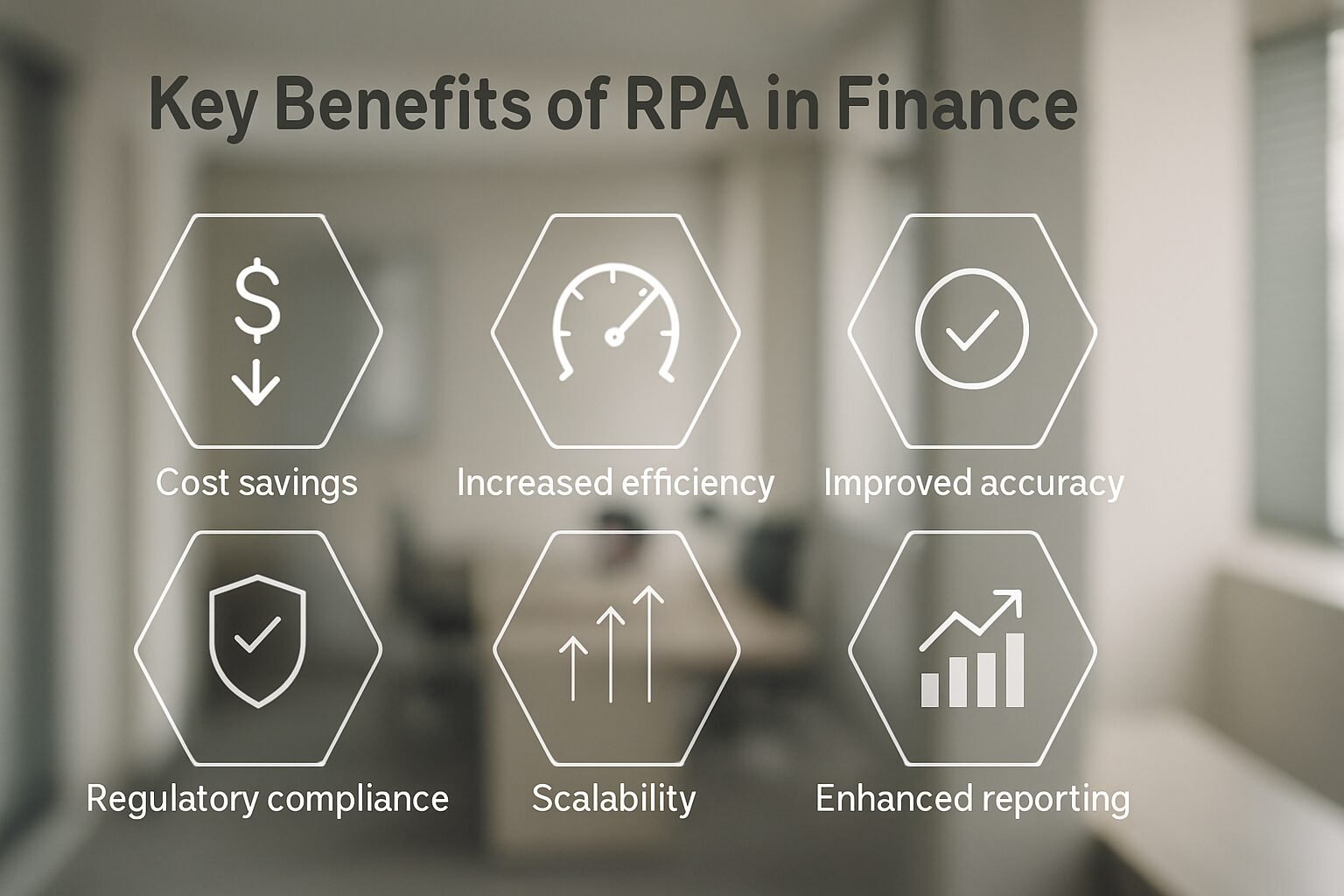
in finance delivers measurable outcomes across cost, speed, accuracy, and compliance. IBM reports a 25% reduction in annual accounts payable cost per invoice through AI-powered automation. McKinsey & Company finds that agentic automation cuts time spent on data crunching by 20-30%, freeing finance professionals for strategic analysis. And data from Karbon shows 40% faster completion of financial close processes when agentic automation is applied. These results stem from three core mechanisms: elimination of manual work, 24/7 bot operation, and consistent rule enforcement.
“Finance automation is no longer about replacing headcount. It’s about giving your best people back their time so they can focus on decisions that actually move the business forward.” – Industry perspective, aligned with McKinsey & Company research on agentic automation in finance.
Cost Reduction and Productivity Gains
Manual financial tasks consume thousands of employee hours annually. UiPath case studies show that companies like Canon save 6,000 hours per year by automating document processing. By redirecting highly paid finance staff away from data entry, this type of finance reduces processing costs while allowing teams to focus on higher-value activities such as financial planning and analysis. For most mid-size finance departments, that translates to the equivalent of 3-4 full-time positions redirected toward strategic work.
Error Minimization and Compliance
Human error in reconciliation or reporting can lead to material financial misstatements. RPA bots achieve near-zero error rates because they follow rules rigorously. Every action is logged, creating an immutable audit trail that simplifies compliance with SOX, IFRS, and GAAP. In tax reporting, this kind of finance ensures data from multiple systems is automatically classified and cross-checked, reducing filing mistakes and the risk of regulatory penalties.
Scalability and Flexibility
As transaction volumes grow, rpa in scales elastically. Additional bots can be deployed within days without hiring. Bots handle peak periods like month-end close and tax season without fatigue. RPA’s non-invasive integration means it layers on top of existing ERP systems like SAP S/4HANA, Oracle NetSuite, or Workday, avoiding costly rip-and-replace projects.
Pros and Cons of RPA in Finance

in finance offers compelling advantages, but it also comes with real implementation considerations every finance leader should weigh before committing budget.
Pros
- Significant cost savings: AI-powered AP automation reduces cost per invoice by up to 25%, according to IBM.
- Faster financial close: Agentic automation delivers 40% faster completion of reporting and balance sheet creation.
- Near-zero error rates: Bots follow rules consistently, eliminating the keystroke errors that plague manual processes.
- Audit-ready by default: Every bot action is logged, creating a complete trail for SOX, IFRS, and GAAP compliance.
- No rip-and-replace required: RPA operates at the UI level, so it works on top of legacy ERPs without costly system overhauls.
- Elastic scalability: Deploy additional bots within days to handle month-end peaks or rapid business growth.
Cons
- Process drift risk: When underlying applications update, bots can break, requiring ongoing maintenance and a dedicated operations team.
- Limited to rule-based tasks: Traditional RPA struggles with unstructured data or processes that require judgment, without AI augmentation.
- Change management overhead: Staff resistance and fear of job displacement can slow adoption if executive sponsorship and communication are weak.
- Upfront investment: Platform licensing, process discovery, and governance setup require meaningful time and budget before ROI materializes.
- Security exposure: Bots handle sensitive financial data, so misconfigured access controls or unencrypted credentials create real compliance risk.
Top Use Cases for RPA in Finance

this type of finance excels in rule-heavy, repetitive processes that span multiple systems. Below are the highest-impact use cases, backed by real-world deployments and industry research.
1. P&L Reporting
Profit and loss reporting demands data from the general ledger, cost centers, and sales systems. RPA bots collect revenue, COGS, and expense data, cross-check it for completeness, identify discrepancies, and classify transactions. They then populate templates and distribute final reports to stakeholders on a schedule. This eliminates manual aggregation and ensures faster, more accurate monthly close cycles.
2. Reconciliation
Bank reconciliation and inter-company reconciliation involve matching thousands of transactions across disparate statements. RPA bots merge and standardize data from different bank feeds and ledger entries, matching on date, amount, and reference number. When exceptions arise, bots apply predefined rules or route items to human accountants for review. The result is a reconciled ledger in hours rather than days, with a full audit trail.
3. Accounts Payable (AP)
AP processes, including invoice capture, two-way and three-way matching, approval routing, and payment scheduling, are prime territory for this kind of finance. Bots extract invoice data from PDFs, emails, and supplier portals using optical character recognition (OCR), normalize the data, and match it against purchase orders and goods receipts. They then schedule payments in the ERP and send remittance advices. According to IBM, AI-enhanced AP automation reduces cost per invoice by up to 25%.
4. Accounts Receivable (AR)
RPA in finance automates invoice generation, delivery, and collections follow-up. Bots match incoming payments against open invoices, update customer accounts, and send automated reminders for overdue balances. Advanced agentic solutions also identify high-risk customers based on aging data and credit scores, enabling proactive collections management before accounts go delinquent.
5. Tax and Compliance Reporting
Tax reporting requires precision to avoid penalties. RPA bots gather data from tax engines and financial systems, interpret tax notices from jurisdictions, classify transactions for taxation, and prepare trial balances. They can also monitor regulatory updates, such as new SEC or FINRA rules, and alert compliance officers, ensuring timely adjustments without manual tracking.
6. Fraud Detection and AML
By monitoring real-time transaction streams and system logs, RPA bots flag anomalies such as unusual payment patterns or unauthorized access for investigation. When combined with machine learning models, these bots assign risk scores and block transactions autonomously. In know-your-customer (KYC) and anti-money laundering (AML) checks, RPA in finance accelerates identity verification by pulling data from external databases and government registries.
How Agentic Automation Enhances Financial RPA
Agentic automation is the fusion of RPA bots with AI agents capable of independent decision-making, context understanding, and adaptive learning. While traditional RPA handles deterministic tasks, agentic automation addresses semi-structured processes, such as interpreting a non-standard vendor invoice, understanding its content, and mapping it to the correct GL codes without human intervention. This represents the next evolution of RPA in finance, moving from task automation to autonomous process orchestration.
Autonomous Exception Handling
In a typical AP bot, an unrecognized invoice format causes an exception that lands in a human queue. An agentic bot uses natural language processing (NLP) to read the document, compare it against historical patterns, and decide on the correct action, reducing human intervention by over 70 percent. This capability is critical for global finance departments dealing with thousands of supplier formats across dozens of countries.
Predictive Analytics and Decision Support
Agentic automation systems analyze historical financial data to predict outcomes, such as forecasting cash flow based on payment patterns and market trends. Bots then trigger actions like initiating early payment discounts or hedging currency exposure. McKinsey & Company notes that this kind of integration can shift 20-30 percent of a finance team’s time from data crunching to strategic execution.
End-to-End Workflow Orchestration
Platforms like UiPath and IBM‘s automation offering combine RPA, AI agents, and process mining into a single orchestration layer. This allows finance leaders to design, monitor, and optimize entire processes such as order-to-cash or procure-to-pay as one unified flow, rather than a patchwork of isolated automations.
“The organizations seeing the biggest returns from RPA in finance aren’t just automating individual tasks. They’re redesigning entire workflows around what bots do best, and letting people handle what requires judgment.” – Perspective aligned with Gartner’s hyperautomation research framework.
RPA Implementation: Step-by-Step Strategy
A structured approach is essential to maximize ROI from RPA in finance. Below is a proven five-step methodology drawn from real-world deployments and Gartner best practices.
- Process Discovery and Assessment: Map each finance process end-to-end, documenting steps, systems, and volumes. Use process mining tools to identify bottlenecks and manual handoffs. Prioritize processes that are rule-based, high-volume, and span multiple systems.
- Define Automation Objectives: Align RPA goals with business KPIs, not just hours saved. For early programs, focus on throughput gains and error reduction. For mature programs, target working capital improvements and compliance outcomes.
- Select the Right RPA Platform: Evaluate solutions like UiPath, IBM Robotic Process Automation, Microsoft Power Automate, or Automation Anywhere against criteria including ease of integration, AI and agentic capabilities, scalability, and governance features.
- Build a Governance Framework: Establish a center of excellence (CoE) with clear roles for business analysts, IT, and compliance. Define bot access controls, data security protocols, and audit logging. Scale automation gradually, validating each bot in production before expanding.
- Continual Monitoring and Optimization: Track bot performance metrics including exception rates, processing time, and accuracy, then refine processes. Retrain AI models with new data to handle evolving document formats. Reassess the automation pipeline quarterly to adjust to changing business needs.
Comparison: RPA vs. Traditional Automation in Finance
Choosing the right automation approach for RPA in finance depends on process complexity, integration requirements, and desired intelligence level. The table below contrasts traditional RPA, intelligent automation (RPA + AI), and agentic automation to help finance leaders decide.
| Feature | Traditional RPA | Intelligent Automation (RPA+AI) | Agentic Automation |
|---|---|---|---|
| Task Complexity | Rule-based, structured data | Structured + semi-structured data | Unstructured data, complex decisions |
| Integration | UI-level, non-invasive | UI + API + AI services | Deep orchestration with multi-agent systems |
| Learning Capability | None; requires manual updates | Limited, via supervised ML models | Continuous learning, adapts autonomously |
| Best for | Data entry, reconciliation, report generation | Invoice processing with OCR, KYC checks, basic fraud flags | End-to-end order-to-cash, dynamic cash forecasting, AML monitoring |
| Typical Time Savings | Up to 40 percent faster process execution | 50-70 percent reduction in manual effort | 70-90 percent end-to-end automation |
Sources: Gartner, UiPath case studies, IBM.
Overcoming Common RPA Adoption Challenges
RPA in finance offers clear ROI, but organizations often face real hurdles when scaling. Addressing these proactively is the difference between a successful program and an expensive pilot that never grows.
Legacy System Integration
Many finance departments run on decades-old mainframes or homegrown systems that lack APIs. RPA bridges this gap by operating at the user interface level, but maintaining bots when those systems receive updates requires close collaboration between IT and the CoE. Employing screen scraping adapters and OCR-based data extraction can reduce brittleness and keep bots running through system changes.
Data Security and Compliance
Bots handle sensitive financial data including bank account numbers, customer PII, and internal reports. All RPA platforms must enforce role-based access, encrypt credentials, and log every action. Compliance with GDPR, PCI DSS, and SOC 2 is non-negotiable. Finance teams should work with security teams to conduct regular vulnerability assessments on bot configurations, particularly after platform updates.
Workforce Resistance and Change Management
Staff often fear job displacement. Successful programs communicate clearly that RPA in finance eliminates drudgery, not jobs, and invest in upskilling. Canon’s 6,000-hour annual saving, for example, translated into reassigning staff to customer-facing analysis roles, not layoffs. A structured change management plan with executive sponsorship is critical to sustaining momentum past the first deployment.
Maintaining Bot Performance
Process drift occurs when underlying applications change and break bots. This requires continuous monitoring. Implementing a bot operations dashboard and scheduling regular process recertifications prevents performance degradation. Most organizations adopt a “hypercare” phase of 4-6 weeks after each bot deployment to stabilize operations before scaling further.
Real-World Examples of RPA in Financial Institutions
Leading enterprises have demonstrated the practical power of RPA in finance. Two well-documented cases show what’s possible at scale.
Canon: Document Processing at Scale
By combining AI with RPA, Canon automated invoice and purchase order processing across its shared services center. The bots handle data extraction, validation, and ERP entry, saving approximately 6,000 labor hours annually. This allowed the finance team to reallocate resources toward strategic procurement analytics rather than manual data work, as reported by UiPath.
Thermo Fisher: Global Invoice Automation
Thermo Fisher deployed a hybrid RPA-AI solution to streamline accounts payable operations spanning dozens of countries. The system processes invoices in multiple languages and formats, matches them against purchase orders and receipts, and automatically routes exceptions. The outcome was a significant reduction in processing time and improved accuracy, enabling the company to capture more early payment discounts across its global supplier base.
The RPA in Finance Market: 2026 Outlook
As of 2026, adoption of RPA in finance is accelerating across banking, insurance, and corporate finance functions. The global financial RPA market is projected to reach $12.5 billion by 2033, according to industry research. Industry data indicates that roughly 44 percent of financial service providers now use AI-powered process automation, and the banking sector is among the fastest-growing adopters. This growth is driven by pressure to reduce operational costs, meet tighter compliance requirements, and compete with fintech challengers that are built on automation from day one. For finance leaders evaluating RPA this year, the question is no longer whether to automate but which processes to prioritize first.
Frequently Asked Questions
What does RPA stand for in finance?
RPA stands for Robotic Process Automation. In finance, it refers to software robots that automate repetitive, rule-based tasks like data entry, reconciliation, and reporting, boosting efficiency and accuracy across financial workflows.
What are the benefits of RPA in finance?
Key benefits include cost reduction (up to 25 percent lower AP costs per IBM), faster processing (40 percent quicker financial close), improved accuracy through consistent rule enforcement, enhanced compliance via complete audit trails, and the ability to scale during peak periods without additional headcount.
How does RPA improve financial reconciliation?
RPA bots merge and standardize data from bank statements and internal ledgers, automatically match transactions, flag discrepancies, and route exceptions to human reviewers. What used to take a team several days can be completed in hours, with a full audit trail attached.
Can RPA help with fraud detection?
Yes. RPA bots monitor real-time transactions and system logs for anomalies based on predefined rules. When combined with AI, they assign risk scores and can block suspicious payments before they clear, making them a practical first line of defense in AML programs.
What is the difference between RPA and traditional automation?
Traditional automation is embedded in an application and hard-coded, while RPA in finance operates across multiple systems via the user interface, requires less IT involvement, and is easier to modify. RPA can also incorporate AI for exception handling and decision-making that traditional automation cannot support.
How do you implement RPA in a finance department?
Start with process discovery and prioritization, define clear objectives tied to business KPIs, choose an RPA platform aligned to your needs, establish a governance structure with a center of excellence, deploy bots iteratively, and monitor performance continuously to optimize over time.