Key Takeaways
- AI automation extends traditional robotic process automation by processing unstructured data, enabling intelligent decisions, and learning from patterns.
- Organizations report efficiency gains and up to 99% accuracy in document processing with AI-enhanced workflows.
- Core technologies include machine learning, natural language processing, and computer vision.
- Successful implementation requires a unified platform, data readiness, and a strategic governance framework.
- By 2032, the intelligent document processing segment alone is projected to reach significant market value, driven by broader adoption.
What Is AI Automation?
 What Is AI Automation? – AI Automation | DigiMe” class=”wp-image-856″ loading=”lazy” width=”1792″ height=”1024″ />
AI automation combines artificial intelligence technologies like machine learning and natural language processing with automation software to handle complex, data-driven tasks that traditionally required human judgment. This approach enables organizations to automate not just repetitive, rule-based actions but also processes that involve unstructured data, decision-making, and continuous learning.
Definition and Core Components
This technology integrates AI capabilities, such as predictive analytics, language understanding, and visual recognition, into business process automation tools. It goes beyond traditional robotic process automation (RPA) by handling semi-structured and unstructured content like emails, scanned documents, and voice interactions. According to UiPath, these systems achieve up to 95–99% accuracy in complex workflows such as email processing and medical record summarization. The technology stack typically includes machine learning models for pattern detection, natural language processing (NLP) for text and speech, and computer vision for image analysis, all orchestrated within a single automation platform.
How It Differs from Traditional Automation
Traditional automation relies on predefined, rule-based instructions and works only with structured data in fixed formats. When exceptions or variations occur, the process breaks and requires manual intervention. In contrast, intelligent automation uses machine learning to adapt to variability, it can read a PDF invoice with a new layout, understand an email with informal language, or detect defects in product images without being explicitly programmed for each case. This adaptability is critical because industry research shows that most business data remains trapped in unstructured formats. By bridging the gap between rigid RPA and human cognition, these solutions enable enterprises to scale operations that were previously impossible to automate.
The Business Impact of Intelligent Automation

Enterprises adopting these technologies consistently report measurable improvements in speed, cost, and accuracy. The intelligent document processing (IDP) market, a direct beneficiary, has experienced significant growth and is projected to continue expanding through 2032. A survey from SS&C Blue Prism found that 84% of business leaders recognize the potential to transform operations and create new ways of working.
Efficiency Gains and Cost Savings
One of the most immediate impacts is faster processing. Organizations implementing these solutions experience substantial reductions in document processing time and efficiency gains in invoice processing. In manufacturing, quality control workflows powered by intelligent systems have cut costs by 35%, freeing engineers for higher-value tasks. These improvements translate directly to bottom-line savings and allow businesses to reallocate human effort toward innovation rather than manual data handling.
Improving Accuracy and Decision-Making
This technology dramatically reduces errors. For instance, in healthcare, AI-generated medical summaries have achieved a 99% approval rate from clinicians, minimizing rework and ensuring compliance. In finance, automated analysis of loan applications can flag risks that rule-based systems miss. By providing real-time insights and recommendations, intelligent automation not only speeds up operations but also enhances the quality of decisions. As Cisco notes, these algorithms can analyze large datasets quickly to draw conclusions and predict outcomes, leading to better resource allocation and customer service.
Key Technologies Powering Intelligent Automation

These solutions leverage several foundational AI technologies. Understanding each component helps organizations design effective solutions.
Machine Learning and Predictive Analytics
Machine learning is a subset of AI that enables systems to learn from data and improve over time without explicit programming. In an intelligent automation context, ML models classify documents, predict process outcomes, and detect anomalies. For example, an accounts payable system can learn to recognize invoice patterns and predict which line items require additional approval, continuously improving as it processes more data.
Natural Language Processing (NLP)
Natural language processing is the technology that allows machines to understand, interpret, and generate human language. With NLP, intelligent systems can read emails, extract key details from contracts, and even respond to customer inquiries intelligently. The emergence of generative AI has further enhanced NLP’s capabilities, enabling summarization of lengthy documents and generation of human-like responses in chatbots. According to UiPath, many current IDP solutions now incorporate advanced NLP to handle complex documents like legal filings.
Computer Vision and Intelligent Document Processing
Computer vision is the field of AI that enables machines to derive meaningful information from visual inputs, scanned images, PDFs, photos, and videos. When combined with RPA, computer vision automates the extraction of data from forms, IDs, and even handwritten notes. This is the core of intelligent document processing (IDP), which has become one of the fastest-growing segments. The global IDP market is projected to reach substantial value by 2032, driven by the need to digitize and process billions of unstructured documents.
AI Automation vs. Traditional RPA: A Comparison
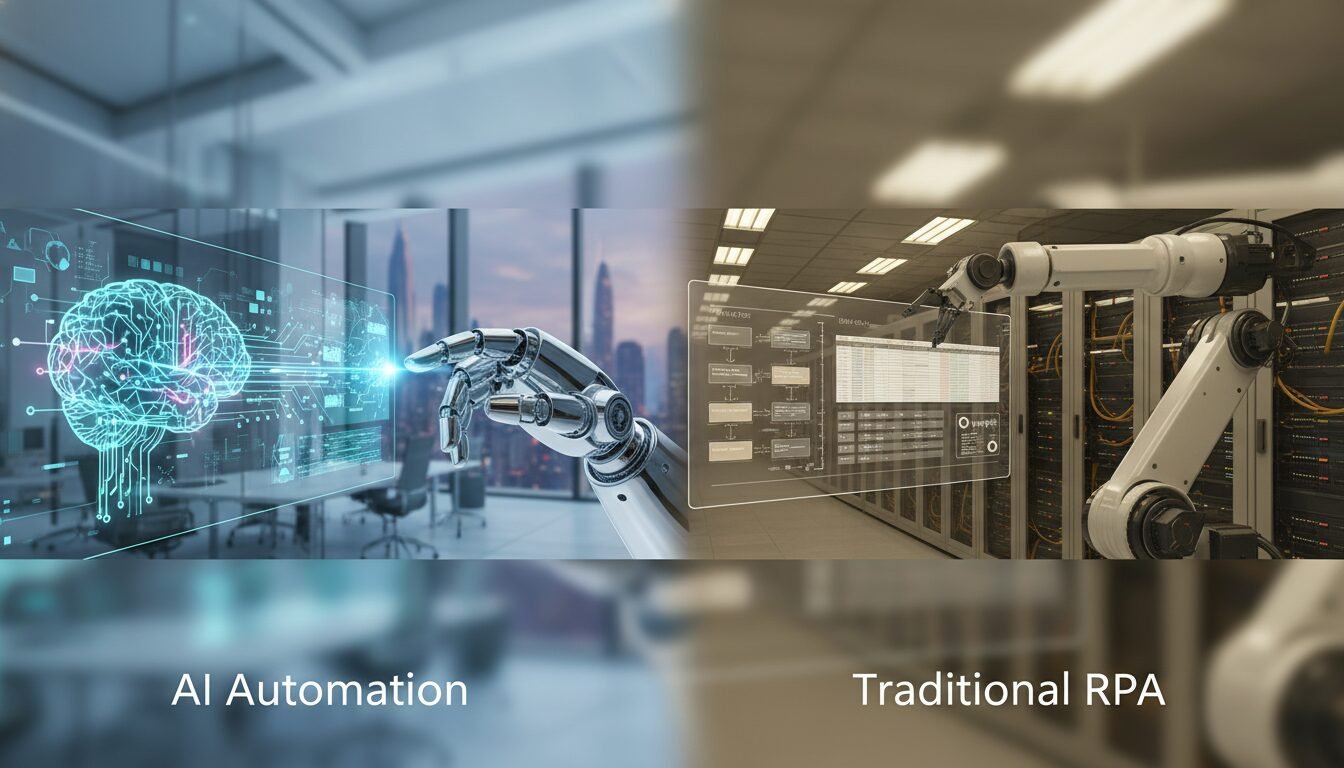
Deciding between traditional RPA and intelligent automation depends on the nature of your tasks. The table below compares them across key dimensions.
Capabilities Head-to-Head
| Feature | Traditional RPA | AI Automation |
|---|---|---|
| Data Handling | Structured data only (spreadsheets, databases) | Structured and unstructured data (documents, images, voice) |
| Decision-Making | Rule-based, deterministic | Machine learning models, adaptive decisions |
| Adaptability | Limited; requires manual reprogramming for changes | Self-learning; adapts to new patterns and variations |
| Accuracy | High for repetitive tasks; errors with exceptions | 95–99% accuracy on complex processes |
| Implementation Complexity | Lower initial effort, but high maintenance for scaling | Higher upfront investment, lower long-term maintenance |
| Typical Use Cases | Data entry, simple invoicing, HR onboarding forms | Invoice processing, fraud detection, customer service chatbots, medical record summarization |
When to Use Each Approach
Choose traditional RPA when your workflows are consistent, rules don’t change frequently, and data inputs are perfectly structured. It excels in high-volume, low-complexity tasks. Opt for intelligent automation when you deal with documents that vary in layout, emails with free text, or image-based inspections. Many organizations start with RPA to automate the “low-hanging fruit” and gradually layer on AI capabilities, this hybrid approach delivers the fastest ROI while building institutional knowledge.
Real-World Applications Across Industries
Intelligent automation is not limited to a single vertical. Its flexibility has led to adoption across sectors, each with unique use cases.
Banking and Financial Services
Banks use AI-driven automation for anti-money laundering (AML) checks, fraud detection, and loan underwriting. By automatically extracting information from application forms, pay stubs, and bank statements, these systems can approve or flag applications in minutes instead of days. Financial institutions report significant reductions in loan processing time after implementing AI-powered document understanding solutions.
Healthcare and Life Sciences
In healthcare, intelligent automation speeds up clinical documentation, prior authorizations, and claims adjudication. UiPath highlights cases where medical summaries generated by AI achieved a 99% approval rate, drastically cutting the time clinicians spend on paperwork. Computer vision also assists in analyzing radiology images and pathology slides, supporting faster diagnoses.
Manufacturing and Supply Chain
Manufacturers deploy automated vision systems for quality inspection on assembly lines, using cameras and computer vision to detect defects with high accuracy, reducing inspection costs by 35%. In the back office, AI automates procurement by reading supplier emails and matching them to purchase orders, while predictive maintenance models forecast equipment failures, minimizing downtime.
Implementing Intelligent Automation: A Step-by-Step Guide
A structured implementation process helps mitigate risks and accelerate value realization.
Assess Readiness and Build a Roadmap
- Inventory your processes: Identify which tasks are manual, time-consuming, and involve unstructured data.
- Evaluate data quality: These models require clean, labeled data. Assess whether your existing data sources are sufficient or need cleansing.
- Prioritize based on impact and feasibility: Select a pilot process that promises a clear return, such as invoice processing or customer email classification.
Choose the Right Platform and Tools
Look for an integrated platform that combines RPA, AI services (NLP, computer vision), and governance features. According to UiPath, an effective platform should deliver 95–99% accuracy, support SOC 2 security certification, and provide audit capabilities. Leading options include UiPath, SS&C Blue Prism, and Microsoft Power Automate with AI Builder. Avoid point solutions that create silos; a unified platform reduces integration headaches and enables smooth scaling.
Overcome Common Challenges
Data privacy and model bias are top concerns. Implement human-in-the-loop reviews for high-risk decisions, and follow responsible AI guidelines such as those outlined by Microsoft. Change management is equally critical, involve process experts early, and provide training so employees trust and adopt the new tools. Regularly monitor model performance to prevent drift and ensure sustained accuracy.
Low-Code and No-Code Platforms
Modern platforms increasingly offer low-code and no-code interfaces that democratize access to intelligent automation. These tools allow business users to build workflows without extensive programming knowledge. Microsoft Power Automate, UiPath StudioX, and similar platforms provide drag-and-drop interfaces for creating automated processes. This approach accelerates deployment and reduces dependence on IT resources, though complex scenarios may still require technical expertise.
Calculating ROI for Your Implementation
Understanding the return on investment helps justify intelligent automation projects. Start by measuring current process costs: employee hours, error rates, and processing delays. Then estimate improvements: time savings, accuracy gains, and reduced manual intervention. A typical calculation includes implementation costs (software licenses, training, integration) against annual savings (labor reduction, error prevention, faster processing). Most organizations see positive ROI within 12-18 months, with ongoing benefits compounding over time.
The Future of Intelligent Automation: Agentic and Beyond
The next evolution moves from passive automation to proactive, agentic systems that can orchestrate complex tasks independently.
The Rise of Agentic AI
Agentic AI refers to AI systems that can act autonomously, make decisions, and adjust behaviors to achieve defined business goals. Unlike traditional automation that follows a fixed script, agentic AI can plan steps, recover from errors, and even interact with multiple applications dynamically. Blue Prism notes that agentic AI marks a shift from “attended” to “unattended” to fully autonomous operations, promising a new level of enterprise agility. By 2026, many organizations are expected to pilot agentic workflows in customer service and supply chain orchestration.
Ethical Considerations and Responsible AI
With greater autonomy comes greater responsibility. As intelligent automation becomes more pervasive, ensuring fairness, transparency, and compliance is non-negotiable. The EU AI Act and similar regulations demand clear accountability for automated decisions. Companies must establish governance boards, audit trails, and bias-testing procedures. Microsoft emphasizes that ethical AI practices and robust data privacy measures are essential to maintain trust and long-term success.
Book a free demo at digimeapp.com to see how AI can transform your practice.
Frequently Asked Questions
What is AI automation?
This technology integrates artificial intelligence capabilities, such as machine learning, natural language processing, and computer vision, into automation platforms to perform business processes that require understanding, learning, and adaptation. It expands automation beyond simple, rule-based tasks to complex, data-driven workflows.
How is AI automation different from regular automation?
Regular automation follows predefined rules and works only with structured data. Intelligent automation leverages AI models to handle unstructured information like documents and conversations, adapt to changes, and make decisions based on learned patterns, reducing the need for human intervention.
What are the benefits of AI automation for businesses?
Benefits include reduced processing times, higher accuracy (up to 99%), cost savings, improved compliance and decision-making, and the ability to reallocate employees to higher-value work. Organizations typically see efficiency gains and measurable ROI within the first year.
What industries can benefit most from AI automation?
Healthcare, banking and finance, insurance, manufacturing, and logistics see the greatest impact because they handle large volumes of unstructured data and document-intensive processes. Any industry dealing with repetitive paperwork can benefit significantly.
What challenges come with implementing AI automation?
Key challenges include ensuring data quality, managing change, upskilling the workforce, selecting the right integrated platform, and maintaining ethical AI governance and regulatory compliance. Proper planning and phased implementation help address these concerns.