Key Takeaways
- AI content marketing uses machine learning and natural language processing to automate content creation, distribution, and analysis so brands can scale output while staying personal.
- According to a 2024 Statista survey, 42% of marketers use AI tools several times a week for content generation, and 40% use them specifically for social media content.
- Workflow orchestration is one of the most underrated AI applications: it connects tools across the entire content lifecycle, not just the writing phase.
- Leading platforms like Blaze, Airtable, and contentmarketing.ai cover everything from ideation to performance analytics.
- Successful adoption follows a clear path: audit your process, set goals, pick the right tools, train your team, run a pilot, then scale.
What Is AI Content Marketing?

AI content marketing is the strategic use of artificial intelligence to automate and improve every phase of content production, from ideation through distribution and measurement. Rather than replacing marketers, it acts as a force multiplier: handling repetitive tasks, surfacing data-backed insights, and accelerating production so your team can focus on creative strategy and brand storytelling.
The Core Technologies Behind It
Three interrelated AI fields power modern content tools: machine learning (ML), natural language generation (NLG), and generative AI. Machine learning trains algorithms to recognize patterns and make predictions. In content work, ML enables predictive analytics for audience targeting and performance forecasting. NLG converts structured data into human-like text, think automated report summaries or product descriptions. Generative AI, a subset of deep learning, creates entirely new content including articles, social posts, images, and video based on training data and prompts.
How It Changes Traditional Workflows
Traditional content marketing involves manual research, lengthy drafting cycles, and trial-and-error optimization. AI flips this by introducing real-time data analysis, automated A/B testing, and intelligent content generation. A good tool can analyze thousands of competitor blog posts to identify content gaps, draft a first version in minutes, and suggest headlines and CTAs that statistically perform better, all before a human editor reviews the final piece. That shift reduces time-to-publish significantly and lets smaller teams operate at a scale once reserved for enterprise organizations.
Key Benefits for Local Service Businesses

The advantages of AI-powered content work are measurable and directly tied to ROI, efficiency, and audience engagement. Here are the three that matter most for local service businesses.
1. Faster Production and Real Scalability
By automating drafting, image generation, and scheduling, these tools dramatically cut the time needed to create and distribute content. A blog post that once required hours of manual work can be drafted in a fraction of the time using tools like Blaze or Jasper. Marketers can then repurpose that post into social media snippets, email newsletters, and ad copy across 8 or more channels simultaneously. According to a SurveyMonkey study, 50% of marketers already use AI to create content, and 43% use it to automate repetitive tasks.
2. Personalization That Actually Scales
AI enables dynamic content personalization that adapts to individual user behavior, location, and preferences in real time. A MedSpa, for example, can automatically generate personalized email subject lines and landing page copy tailored to each visitor’s browsing history. A dental practice can serve different homepage messaging to new patients versus returning ones. This level of personalization was previously only achievable with large in-house teams.
3. Data-Driven Optimization
AI-powered platforms integrate with analytics to track engagement metrics, keyword rankings, and conversion paths, then automatically adjust strategies. Airtable, for instance, combines content calendars with real-time performance dashboards, allowing teams to see which topics drive the most qualified leads and double down on what works. According to the same SurveyMonkey data, 51% of marketers use AI specifically to optimize content after it publishes.
Pros and Cons of AI Content Marketing
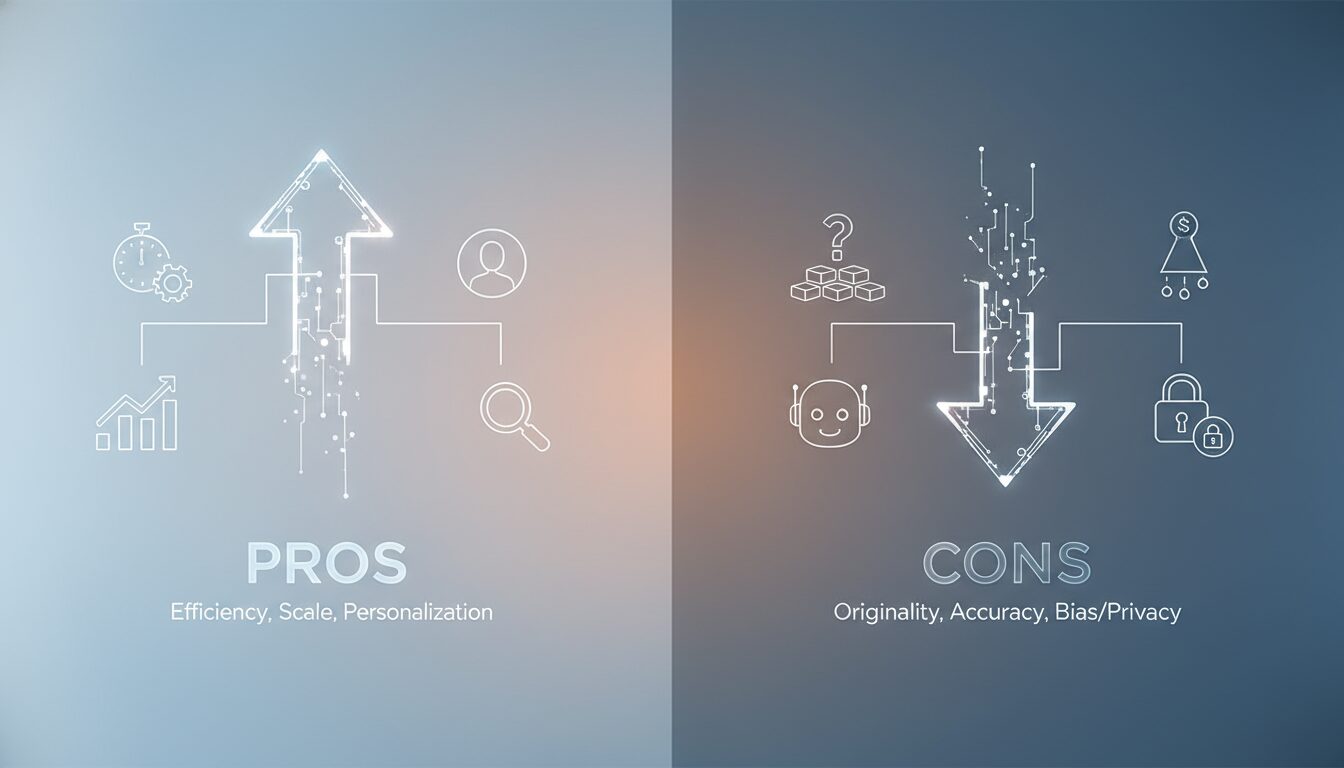
Like any significant shift in how you work, adopting AI for content comes with real advantages and genuine trade-offs worth understanding before you commit.
Pros
- Speed: Content that took days can be drafted in hours, freeing your team for higher-value strategy work.
- Consistency: AI tools trained on your brand guidelines produce on-voice content across every channel without drift.
- Scale: Small teams can publish across 8 or more channels simultaneously without adding headcount.
- Data integration: AI connects performance data directly to content decisions, reducing guesswork.
- Cost efficiency: Platforms like Blaze start at $79 per month, making enterprise-level content operations accessible to small businesses.
Cons
- Generic output risk: Without proper brand training, AI-generated content can sound flat and interchangeable.
- Human oversight required: AI still makes factual errors and requires editorial review before publishing.
- Adoption friction: Teams may resist AI tools due to fear of job displacement or unfamiliarity with new workflows.
- Bias exposure: AI models trained on broad datasets can produce messaging that inadvertently reflects cultural or demographic bias.
Common Use Cases Across Industries

From solo practitioners to multi-location service businesses, AI-powered content tools add value across a wide range of applications. These are the use cases where we see the strongest results.
Content Ideation and Research
AI tools scan competitor sites, social platforms, forums, and keyword databases to suggest topics that align with audience interests and search demand. Instead of brainstorming from scratch, content strategists receive a prioritized list of data-backed ideas, complete with estimated search volume, difficulty, and trending angles. According to SurveyMonkey, 45% of marketers use AI specifically for brainstorming content ideas.
AI-Assisted Writing and Creation
Generative AI writing assistants like Blaze and HubSpot’s AI tools can produce blog drafts, social media posts, email sequences, and video scripts. They maintain a consistent brand voice when properly trained on a company’s style guide. The key is human oversight: AI handles the heavy lifting, while editors layer in nuance, storytelling, and industry-specific expertise. For a dental front desk team or an HVAC dispatcher who wears multiple hats, this collaborative approach can boost output significantly without sacrificing quality.
SEO and Content Optimization
Advanced tools analyze search intent, readability, and content structure to ensure each piece ranks well and satisfies user queries. They can automatically generate meta tags, alt text, and internal linking suggestions. Tools like Surfer SEO and MarketMuse offer real-time optimization scores. The integration of AI with SEO has also made it possible to optimize content for AI answer engines, a practice now known as Generative Engine Optimization (GEO).
Multichannel Distribution and Scheduling
Once content is created, platforms like Blaze and Buffer can schedule and publish it across 8 or more channels, including Instagram, LinkedIn, Facebook, and Google My Business. Machine learning algorithms determine the optimal posting times and frequency for each channel based on historical engagement data. Some platforms also include automated reputation management, monitoring and responding to reviews across Google, Yelp, and industry-specific sites.
Regulated Industries: A Note on Compliance
For dental practices, MedSpas, law firms, and financial advisors, AI-generated content carries additional responsibility. Content in these industries must comply with HIPAA, FTC guidelines, state bar rules, or SEC regulations depending on the sector. As of 2026, several jurisdictions are also moving toward requiring disclosure when content is AI-generated. The practical answer is to build compliance review into your editorial workflow, not treat it as an afterthought. Your AI playbook should include a checklist specific to your industry’s regulatory requirements.
Overcoming the Real Challenges
The benefits are significant, but these tools also present challenges that teams must address directly.
Maintaining Brand Voice and Quality
One of the most common concerns is that AI-generated content sounds generic. Without proper training on a brand’s tone, terminology, and style preferences, the output may lack the human touch that builds trust. The solution is to create detailed AI prompts, upload thorough style guides, and always include a human review step. Many platforms, including contentmarketing.ai by Brafton, allow brands to define voice and persona guidelines that the AI follows across all content.
Algorithmic Bias and Ethics
AI models are trained on vast datasets that may contain biases related to gender, race, or culture. If not monitored, the output could inadvertently produce biased messaging or amplify stereotypes. Marketers must audit AI outputs regularly and ensure diverse training data. Transparency about AI usage is also becoming an ethical expectation and, in some jurisdictions, a legal requirement.
Integration and Team Adoption
Adopting these tools is not just a technology challenge. It is a change management initiative. Teams may resist AI due to fear of job displacement or lack of technical skills. Successful adoption requires training, clear documentation of AI-enhanced workflows, and a culture that views AI as a collaborator. According to IBM research, 77% of companies are exploring AI, but only 35% have implemented it, which means organizational readiness remains the biggest barrier, not the technology itself.
“The businesses that win with AI are not the ones that automate the most. They are the ones that automate the right things and keep humans in the loop where it matters.” – HubSpot State of Marketing Report, 2024
Building Your Strategy: 6 Steps That Work
Implementing AI content marketing successfully requires a structured approach. Follow these six steps to integrate AI into your content operations without disrupting what already works.
Step 1: Audit Your Current Content Processes and Pain Points
Map your entire content lifecycle from ideation to publishing and measurement, then identify the bottlenecks. Common pain points include time spent on research, inconsistency across channels, and slow approval cycles. Documenting these will clarify where AI can deliver the most immediate impact.
Step 2: Define Clear Goals and KPIs
Set specific, measurable objectives: increase content output by 50%, improve organic traffic by 30%, or reduce time-to-publish by 60%. Tie each goal to a KPI your tools can report on, such as monthly page views, engagement rate, or conversion rate. This ensures your AI investment connects to tangible business outcomes.
Step 3: Select the Right Tools for Your Stack
Based on your audit and goals, choose tools that fill the gaps. A content creation tool like Blaze or Jasper, a content operations platform like Airtable, and an SEO optimization suite like Surfer SEO might form a complete stack. Prioritize tools that integrate with your existing CMS and analytics.
Step 4: Develop and Document AI Usage Guidelines
Create an AI content playbook that outlines how your team will use these tools, including prompt templates, brand voice instructions, and review checklists. Include guidelines for fact-checking and bias detection. This is a crucial safeguard that most teams skip and later regret.
Step 5: Run a Pilot on One Channel for 30 to 60 Days
Instead of a full rollout, test on a single channel, such as social media or your blog, for 30 to 60 days. Measure performance against your baseline and gather team feedback. Use this pilot to refine workflows before scaling.
Step 6: Scale and Continuously Optimize
Once the pilot succeeds, expand to additional channels and content types. Use the analytics from your tools to double down on what is working and adjust underperforming areas. Regularly review your AI guidelines and retrain models as your brand evolves.
“Teams that document their AI workflows before scaling see significantly faster adoption and fewer quality control issues than those who figure it out as they go.” – Based on DigiMe client experience across dental, MedSpa, and HVAC accounts.
Top AI Content Marketing Tools in 2026: A Comparison
Choosing the right platform is critical. The table below compares five leading solutions based on features, pricing, and ideal use cases.
| Tool | Key Features | Pricing | Best For |
|---|---|---|---|
| Blaze | AI social media, blog, ads, reputation management, AI SDR; posts across 8 channels | From $79/mo (self-serve); managed from $899/mo | Small to mid-sized businesses wanting an all-in-one marketing platform |
| Airtable | AI content operations, customizable workflows, data integration, AI summarization via Claude | Free plan available; paid plans available | Teams needing a flexible content planning and asset management system |
| contentmarketing.ai (by Brafton) | Brand-aligned content creation, ideation, optimization, workflow automation | Custom quote (demo required) | Mid-market and enterprise companies seeking a strategic content marketing partner |
| Adobe Express (with AI) | Generative design tools, social media templates, AI image creation, content scheduling | Free tier; paid plans available | Creative teams that need visual content and design integrated with marketing |
| HubSpot AI Tools | AI blog writer, social caption generator, email AI, integrated CRM analytics | Free tools; contact for paid plans | Growing businesses that want AI-powered content tightly coupled with their CRM and sales data |
What the Next 3 to 5 Years Look Like
As AI technology matures, content marketing will become more automated, more personal, and more deeply integrated into business operations. Here is what to expect.
Predictive Content and Hyper-Personalization
Future AI systems will not only personalize content based on past behavior but predict what a user will need before they even search. By analyzing real-time signals including location, time of day, device, and interaction patterns, AI will generate unique content experiences for each individual. Static web pages and blanket email blasts will give way to entirely individualized campaigns.
Autonomous AI Agents
The next frontier is AI agents that manage entire content workflows. Picture a system that monitors industry news around the clock, drafts a response blog post, creates social clips, A/B tests headlines, and adjusts distribution timing with minimal human input. Platforms like Aprimo and Blaze are already introducing AI agents that act as planning librarians, compliance checkers, and production managers. This shift from assistive AI to agentic AI will redefine the marketer’s role from executor to strategist.
Multimodal Content Generation
Modern AI can generate text, images, voiceovers, and short videos from a single prompt. Tools like Adobe Express and RunwayML enable marketers to transform a blog post into a video summary, an audio snippet, and an infographic simultaneously. This multimodal capability will become standard, allowing brands to maintain a consistent presence across every format without multiplying creative resources.
The Enduring Role of Human Creativity
Despite these advances, the most effective strategies will always depend on human creativity, empathy, and strategic thinking. AI can produce content that is factually accurate and stylistically on-brand, but it cannot replicate genuine storytelling born from lived experience or build the deep emotional connections that drive brand loyalty. The future belongs to teams that master the human-AI partnership.
Making It Work for Your Business
AI content marketing is no longer a futuristic concept. It is a practical reality reshaping how brands create, optimize, and distribute content right now. By adopting the right tools, a structured strategy, and a collaborative mindset, marketing teams can dramatically increase output, improve personalization, and measure impact with precision. As generative AI continues to advance, the key to success will be balancing automation with authentic human touch, ensuring that every piece of content, no matter how efficiently produced, still resonates with the people it is meant to reach.
Ready to see what this looks like for your practice or service business? Book a free demo at digimeapp.com to see how AI can transform your content operations and start generating real results.
Frequently Asked Questions
What is AI content marketing?
AI content marketing is the use of artificial intelligence to automate and improve content creation, optimization, distribution, and performance analysis. It helps marketers scale output and personalize content while reducing manual effort across every channel.
How can AI improve content marketing ROI?
AI boosts ROI by accelerating content production, enabling real personalization at scale, and providing data-driven insights that guide strategy. Businesses using these tools typically see meaningful efficiency gains and stronger conversion performance compared to fully manual workflows.
Can AI replace human content marketers?
No. AI works best as a powerful assistant that handles repetitive tasks and data analysis, while humans provide creativity, strategic direction, and emotional nuance. The most successful teams combine AI efficiency with human expertise rather than treating them as substitutes.
What are the best free AI tools for content marketing?
Several platforms offer free tiers: Adobe Express includes AI design and scheduling, HubSpot AI provides blog and email tools, and Airtable offers a free plan for content operations. Blaze also offers a free trial so you can test the platform before committing.
How do I ensure AI-generated content is high quality and original?
Always review and edit AI outputs, train models on your brand’s style guide, and run plagiarism checks before publishing. Many platforms allow you to upload brand voice documents and personas, which makes the output more consistent and significantly reduces the editing burden.
What are the risks of using AI in content marketing?
Risks include producing generic or biased content, potential plagiarism, and over-reliance on automation that weakens brand authenticity. Mitigate these through strict human oversight, diverse training data, and clear internal policies on how and when AI tools are used.