B2B Content Marketing Strategy: Steps to Drive ROI in 2026
A b2b content marketing strategy is a documented plan for creating, distributing, and measuring content that attracts and converts business decision-makers. It aligns content with buyer journey stages to build trust, generate leads, and grow revenue.
Key Takeaways
- B2B content marketing is now a core growth lever: according to the Content Marketing Institute, 9 out of 10 B2B marketers actively use it.
- A documented marketing strategy separates top performers: 64% of the most successful teams have one, versus only 19% of the least successful.
- The goal is to educate, not pitch. Useful content builds trust and authority over time.
- High-ROI formats include case studies, white papers, webinars, and interactive tools like ROI calculators.
- Measurement goes beyond traffic: track leads, pipeline influence, and customer retention.
- In 2026, AI-driven personalization and intent data are reshaping how B2B teams plan and distribute content.
What Is a B2B Content Marketing Strategy?

A this type of strategy is a roadmap that outlines how a business will use content to achieve measurable marketing and sales goals. It defines the target audience, key messages, content types, distribution channels, and success metrics. Unlike ad hoc publishing, a strategic approach ensures every piece of content serves a clear purpose in moving buyers through the funnel.
The Difference Between Strategy and Tactics
A strategy is the overarching plan; tactics are the specific actions you take to execute it. For example, a strategy might aim to become the go-to resource for supply-chain optimization, while tactics include publishing a weekly blog, hosting quarterly webinars, and building an ROI calculator. Without a strategy, tactics become disconnected and fail to generate consistent results. According to the Content Marketing Institute, organizations with a documented this kind of marketing strategy are far more likely to report success than those without one.
Why Documentation Matters
A documented strategy acts as a single source of truth for your team. It aligns marketing, sales, and leadership on goals, audiences, and expectations. The Content Marketing Institute’s B2B Benchmarks research shows that 64% of top performers have a documented strategy, while only 19% of the least successful do. Documentation also simplifies onboarding and keeps messaging consistent when team members change.
Why a B2B Content Marketing Strategy Is Essential
Content marketing has moved from a nice-to-have to a core growth lever for B2B companies. Here’s why a focused strategy yields outsized returns.
It Builds Trust and Authority at Scale
Business buyers make decisions based on trust, and trust is earned through consistent, useful content. A well-executed content strategy positions your brand as an expert in solving industry-specific problems. Rather than promotional material, your content delivers actionable insights that buyers actually want. This trust translates into longer client relationships and higher lifetime value over time.
It Generates Demand Cost-Efficiently
Compared to paid advertising, content marketing offers a compelling long-term return. A blog post or white paper continues attracting leads months or even years after publication, unlike a paid ad that stops delivering the moment you pause the budget. This evergreen nature makes content a foundation of sustainable growth. Industry benchmarks suggest that well-executed content programs typically deliver 2 to 3 times the return of their initial investment over a 12-to-24-month window, according to analysis cited by Forbes.
It Supports the Entire Buyer Journey
B2B purchases are rarely impulse decisions. They involve multiple stakeholders, extended research periods, and formal approval processes. A strong b2b content marketing strategy covers every stage of the journey: from awareness (“What is this problem?”) to consideration (“What solutions exist?”) to decision (“Why choose you?”). Aligning content with the funnel reduces friction and accelerates pipeline velocity.
Core Components of a Winning B2B Content Marketing Strategy
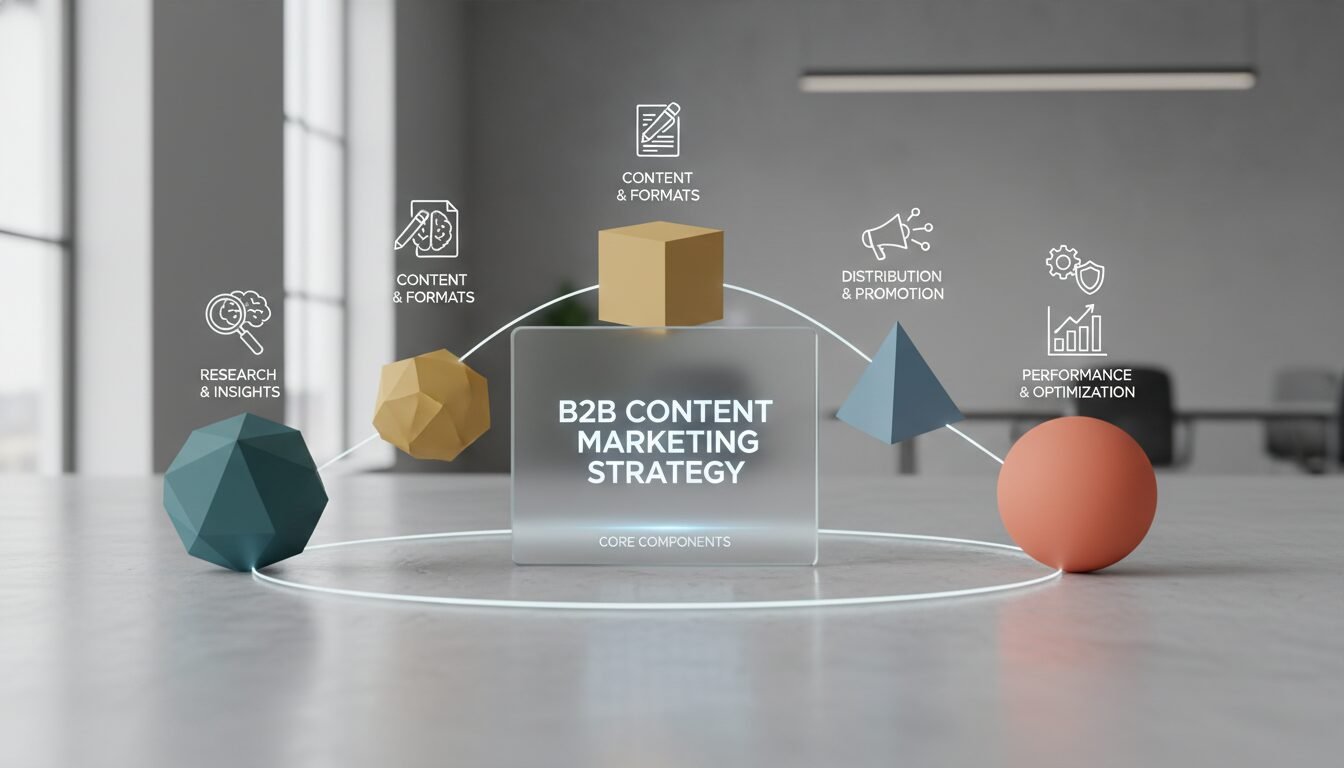
Whether you’re building from scratch or refining an existing plan, these six components are non-negotiable for any serious B2B content program.
1. Audience Research and Buyer Personas
Understanding your audience is the foundation of a strong b2b content marketing strategy. A buyer persona is a semi-fictional representation of your ideal customer, built on real data about demographics, goals, challenges, and buying behavior. In a B2B context, you often have multiple personas: end users, technical evaluators, and economic buyers. Dig deep into their pain points, preferred information sources, and decision criteria. The more precisely you define them, the more relevant every content asset becomes.
2. Competitive Analysis
Mapping your competitors’ content reveals gaps you can own. Analyze what topics they cover, which formats perform best, and where they fall short. Tools like SEMrush or Ahrefs help identify keyword opportunities and content gaps. A thorough competitive audit ensures your strategy isn’t a me-too effort but a differentiated approach that captures unique market space. Look for topics where competitors rank but produce thin, outdated content: those are your fastest wins.
3. Clear Objectives and KPIs
Set SMART goals: Specific, Measurable, Achievable, Relevant, and Time-bound. Common B2B objectives include increasing organic traffic by 30% in six months, generating 50 qualified leads per month from content, or raising brand awareness in a new vertical. Align content KPIs such as page views, time on page, form fills, and opportunity influence with broader revenue goals. A documented b2b content marketing strategy always ties content performance to business outcomes, not just vanity metrics.
4. Content Mix and Formats
Successful strategies mix short-form and long-form content to address different buyer needs. The table below shows popular B2B content types and their primary role in the buyer journey:
| Content Type | Best Use Case | Funnel Stage |
|---|---|---|
| Blog Posts | SEO, educating on industry topics | Awareness |
| White Papers / eBooks | In-depth problem analysis | Consideration |
| Case Studies | Proving real-world value | Decision |
| Webinars / Virtual Events | Demonstrating expertise, live Q&A | Consideration |
| Infographics | Simplifying complex data | Awareness |
| ROI Calculators / Assessments | Showing direct business impact | Decision |
5. Distribution and Promotion Plan
Great content still needs a push. Outline how you’ll distribute across owned channels (website, email newsletter), earned channels (PR, guest posts), and paid channels (social ads, promoted posts). For B2B, LinkedIn is typically the primary social platform. Share blog snippets, infographics, and event invitations there regularly. Employee advocacy programs can amplify organic reach by 5x or more, according to LinkedIn’s own platform data. A b2b content marketing strategy that treats distribution as an afterthought will consistently underperform.
6. Measurement and Iteration
Build a dashboard that tracks both leading indicators (traffic, social shares, time on page) and lagging indicators (leads, pipeline generated, revenue influenced). Review performance monthly or quarterly and use those insights to refine your approach. A/B test headlines, CTAs, and content formats to lift engagement over time. Continuous improvement is what separates a good strategy from a great one.
Pros and Cons of B2B Content Marketing

Pros
- Long-term ROI: Content assets compound over time, generating leads months or years after publication with no additional spend.
- Trust and authority: Consistent, educational content positions your brand as the expert buyers turn to first.
- Cost efficiency: Compared to paid advertising, content marketing typically costs less per qualified lead over a 12-month horizon.
- Sales enablement: A strong content library gives sales reps the right asset for every stage of a deal, shortening cycles.
- SEO compounding: Well-optimized content builds domain authority, improving rankings across your entire site over time.
Cons
- Slow to start: Content marketing typically takes 6 to 12 months before you see meaningful organic traffic or lead volume.
- Resource intensive: Producing high-quality content consistently requires skilled writers, designers, and strategists.
- Attribution is complex: Multi-touch B2B sales cycles make it hard to directly credit revenue to a single content piece.
- Requires ongoing maintenance: Outdated content can hurt rankings and credibility, so regular audits and updates are necessary.
Step-by-Step: How to Build a B2B Content Marketing Strategy from Scratch
Follow this seven-step process to build a plan that drives real business results.
Step 1: Define Your Audience and ICP
Start by identifying your ideal customer profile (ICP): the firmographic and behavioral attributes of your best customers. Then create 2 to 4 detailed buyer personas, including job titles, responsibilities, media consumption habits, and top challenges. Use interviews with existing customers, input from your sales team, and analytics data to inform these profiles. A precise audience definition ensures every content asset hits the right person at the right moment.
Step 2: Audit Existing Content and Assets
Catalog what you already have before creating anything new. Score each asset on relevance, performance, and how well it maps to buyer stages. Identify content that can be updated, repurposed, or retired. Repurposing top-performing blog posts into slide decks, short videos, or email sequences is one of the most efficient ways to extend the life of your best work without starting from zero.
Step 3: Set Measurable Goals
Choose 3 to 5 primary goals that align with company objectives. Examples: increase organic blog traffic by 50% in 12 months, grow email subscribers by 20% in 6 months, or generate 100 Marketing Qualified Leads (MQLs) per quarter from gated content. Attach specific numbers and deadlines to each goal. Clearly defined targets keep the team focused and make it straightforward to prove ROI to leadership.
Step 4: Map Content to the Buyer Journey
Create a content matrix that assigns formats and topics to each stage. Awareness content might include “10 Industry Trends in 2026.” Consideration content could be “Choosing the Right ERP: A Comparison Guide.” Decision content might be a case study showing how a client reduced processing time by 40%. This matrix ensures no gaps exist in your funnel and gives prospects a logical path from first touch to closed deal.
Step 5: Develop an Editorial Calendar
Plan topics, formats, authors, and deadlines for at least the next quarter. Use keyword research tools like SEMrush, Ahrefs, or Google Search Console to find high-intent queries your audience is actively searching. Aim for a mix of evergreen pillar content and timely pieces tied to industry news. Include distribution tasks such as social posts and email sends directly on the calendar so nothing falls through the cracks.
Step 6: Create and Optimize Content
Produce high-quality, original content that demonstrates real expertise. Follow on-page SEO best practices: use target keywords naturally, include internal links, and write compelling meta descriptions. For B2B, depth beats breadth. A 2,000-word guide backed by original research or client data often outperforms six shorter posts on the same topic. Always include a clear call-to-action that advances the reader to the next stage of the journey.
Step 7: Distribute, Measure, and Refine
Launch content through your planned channels and monitor performance against your KPIs. Use UTM parameters to track traffic sources precisely. Platforms like Google Analytics, HubSpot, and Salesforce can attribute leads and pipeline to specific content pieces. Every quarter, review what’s working and adjust your b2b content marketing strategy accordingly. Data-driven iteration is what separates teams that plateau from those that keep growing.
B2B Content Types and Tactics That Deliver Results
Not all content performs equally in B2B. The most effective pieces solve a specific business problem or answer a pressing question. Here are the formats that consistently move the needle.
Long-Form Educational Content
Comprehensive guides, white papers, and industry reports consistently generate the most leads in B2B. A white paper titled “The State of Cloud Security in 2026” can attract IT decision-makers and position your brand as an authority. Gated behind a form, it becomes a lead generation engine. Pair it with a promotional webinar to maximize reach and engagement from a single content investment.
Case Studies and Social Proof
There’s no better sales tool than a well-told success story. Detail the client’s challenge, the solution you provided, and measurable results: for example, “reduced processing time by 40%” or “cut onboarding costs by $30,000 in the first year.” Use real client quotes and, where possible, data visualizations. Distribute case studies across email campaigns, sales decks, and your website’s resources section for maximum coverage.
Interactive and Visual Content
ROI calculators, assessments, quizzes, and infographics engage buyers more deeply than static text. A custom ROI calculator lets a prospect input their own numbers and see projected savings in real time: a powerful bottom-of-funnel tool. According to research by FT Longitude, the most successful B2B marketers already spend 40% or more of their content budget on high-engagement formats like these, and that share is growing year over year.
LinkedIn-Specific Content Tactics
LinkedIn is the dominant B2B distribution channel, and it rewards content that feels native to the platform. Short-form text posts with a clear point of view consistently outperform link-heavy updates in organic reach. LinkedIn newsletters have become a powerful tool for building a direct subscriber base outside of email. Document posts, carousels, and short video clips perform well for thought leadership. For paid amplification, LinkedIn’s account-based targeting lets you serve content to specific job titles, company sizes, and industries: a precision that generic social ads can’t match. Budget at least 20 to 30 percent of your LinkedIn content effort toward employee advocacy, where team members share and comment on company posts to extend reach organically.
B2B vs. B2C Content Marketing: Key Differences
Understanding the distinction helps you allocate budget and choose the right formats from the start.
| Dimension | B2B Content Marketing | B2C Content Marketing |
|---|---|---|
| Primary audience | Business decision-makers, buying committees | Individual consumers |
| Sales cycle | Weeks to months, multiple touchpoints | Hours to days, often single touchpoint |
| Content tone | Educational, data-driven, logic-focused | Emotional, entertaining, aspirational |
| Top formats | White papers, case studies, webinars, ROI tools | Social posts, short videos, influencer content |
| Primary channels | LinkedIn, email, SEO, industry events | Instagram, TikTok, YouTube, paid social |
| Success metrics | MQLs, pipeline influenced, revenue attributed | Reach, engagement, direct conversions |
Budget Allocation for B2B Content Marketing
Knowing where to put your dollars is as important as having a plan. Industry benchmarks offer a useful starting point for teams at any stage.
According to the Content Marketing Institute’s B2B research, the most successful B2B marketers allocate 40 percent or more of their total marketing budget to content. For teams just getting started, a more practical split is to dedicate roughly 25 to 35 percent of the marketing budget to content creation and distribution, then scale as you prove ROI. Within that content budget, a reasonable breakdown looks like this:
- Content creation (writing, design, video): 40 to 50 percent of the content budget
- Distribution and promotion (paid amplification, email tools): 25 to 35 percent
- Technology (CMS, analytics, marketing automation like HubSpot or Marketo): 15 to 20 percent
- Strategy and measurement (agency, consultant, or internal analyst time): 10 to 15 percent
Small teams with limited budgets should prioritize creation and distribution first. Technology investments pay off only once you have a consistent content engine running. Tools like HubSpot, Pipedrive, and Salesforce become genuinely valuable when you have enough content touchpoints to track and attribute properly.
Measuring the Success of Your B2B Content Marketing Strategy
Without measurement, you’re operating on instinct rather than evidence. Here’s how to track what actually matters.
Leading vs. Lagging Indicators
Leading indicators such as page views, social shares, and email open rates tell you whether content is resonating in the short term. Lagging indicators such as Marketing Qualified Leads, pipeline generated, and revenue influenced show whether content drives business results. Both matter, but every metric should ultimately connect back to revenue. A strong b2b content marketing strategy makes that connection explicit, not assumed.
Attribution Models for B2B Content
Because B2B sales cycles are long and involve multiple touchpoints, single-touch attribution models miss most of the story. Multi-touch attribution or a weighted model gives a more accurate picture. First-touch attribution credits the first piece a lead engaged with; last-touch credits the conversion driver; linear distributes credit evenly across all touches. The right model depends on your funnel complexity. Ensure your CRM, whether Salesforce, HubSpot, or Pipedrive, is configured to capture content interactions at every stage.
Content Scoring and Pipeline Influence
Advanced teams assign a “content score” to assets based on how often they appear in winning deals. High-scoring content gets more investment. Review closed-won deals and identify which content pieces were consumed along the way. This feedback loop helps you double down on what actually moves buyers forward, and it gives you a defensible story when leadership asks why you’re investing in a particular format or topic.
Overcoming Common B2B Content Marketing Challenges
Even experienced marketers hit roadblocks. Here’s how to address the three most common ones.
Challenge 1: Lack of Internal Resources
Creating consistent, high-quality content is resource-intensive. If you have a small team, focus on one or two core formats you can execute well rather than spreading thin across six. Consider outsourcing article writing, design, or video production to freelancers or specialist agencies. Repurpose top-performing blog posts into slide decks or short videos to get more mileage from every asset you produce.
Challenge 2: Aligning Sales and Marketing
Misalignment between sales and marketing can quietly undermine an otherwise solid b2b content marketing strategy. Bridge the gap by holding monthly syncs to review content performance and gather feedback on what’s resonating in actual sales conversations. Build a shared content library tagged by buyer persona and deal stage, so reps can quickly find the right asset to send at the right moment.
Challenge 3: Proving ROI
Executives want to see bottom-line impact, not engagement metrics. Move beyond likes and shares to track leads sourced and revenue influenced. A simple dashboard showing how many opportunities were created by content, and at what cost per opportunity, often convinces skeptical stakeholders. When you can show that a single white paper generated 15 qualified opportunities worth $500K in pipeline, budget conversations get much easier.
“The brands that win in B2B content are the ones that treat every piece of content as a business asset, not a marketing expense. If you can’t connect it to pipeline, rethink why you’re creating it.” – Content Marketing Institute, B2B Benchmarks Research
Future Trends: AI and Personalization in B2B Content Marketing
The way business buyers consume content is shifting fast. As of 2026, these trends are already reshaping how the best teams operate.
AI-Powered Content Creation and Curation
AI tools like ChatGPT, Jasper, and HubSpot’s AI writing assistant are helping marketers draft outlines, generate ideas, and personalize content at scale. In 2026, expect AI to handle more of the repetitive work: automating first drafts, suggesting content topics based on real-time buyer intent signals, and personalizing email sequences dynamically. Human oversight remains essential to maintain quality, accuracy, and brand voice. AI is a production accelerator, not a replacement for strategic thinking.
Intent Data and Hyper-Personalization
Intent data reveals which companies are actively researching topics you cover, even before they fill out a form. Platforms like 6sense and Demandbase surface these signals so you can serve the right content to the right account at the right time. Incorporating intent data into your b2b content marketing strategy enables truly personalized web experiences, targeted email cadences, and better-timed sales outreach. Teams using intent data typically see shorter sales cycles and higher conversion rates from content-sourced leads.
Voice and Visual Search Optimization
With the rise of AI-powered search tools like Google’s Search Generative Experience and ChatGPT, optimizing for conversational queries and structured data is becoming essential. Use FAQ-style content, schema markup, and concise direct-answer paragraphs to appear in featured snippets and AI-generated responses. This evolution means your b2b content marketing strategy must include technical SEO components more deliberately than ever before.
“Intent data is the single biggest unlock in B2B content right now. When you know a target account is actively researching your category, you can serve them the exact content they need, days before your competitor even knows they’re in market.” – Demandbase, State of B2B Advertising Report
Frequently Asked Questions
What is a b2b content marketing strategy?
A b2b content marketing strategy is a documented plan that outlines how a business will use content to attract, engage, and convert decision-makers at other companies. It defines target audiences, key messages, content types, distribution channels, and measurement methods to achieve marketing and sales objectives.
How do I measure the ROI of B2B content marketing?
Calculate content ROI by dividing the revenue influenced by content by the total content production and distribution costs. Track leads generated, pipeline created, and deals closed with content touches using CRM attribution in tools like Salesforce or HubSpot. Leading indicators like traffic and engagement provide early signals, but revenue impact is the ultimate metric.
Which content formats work best for B2B lead generation?
White papers, case studies, webinars, and interactive tools like ROI calculators are highly effective for B2B lead generation. Gated content performs well when it offers substantial value in exchange for contact information. Blog posts and infographics are better suited for top-of-funnel attraction and SEO.
How often should I publish content for B2B?
Consistency matters more than volume. Aim for one high-quality blog post per week and one in-depth resource such as a white paper or case study per month. Supplement with regular LinkedIn posts and a monthly email newsletter. Quality and strategic alignment with buyer needs matter far more than raw publishing frequency.
What’s the difference between B2B and B2C content marketing?
B2B content marketing targets business decision-makers, involves longer sales cycles, and focuses on logic-driven value propositions like ROI and operational efficiency. B2C content targets individual consumers, often appeals to emotions, and supports shorter purchase paths. B2B demands more in-depth, educational content; B2C often relies on entertainment and brand storytelling.
What are the latest trends in B2B content marketing for 2026?
Key trends include AI-powered content creation and personalization, the use of intent data platforms like 6sense and Demandbase for hyper-targeted campaigns, optimization for AI-driven search, and a shift toward interactive formats like calculators and assessments. Video and podcasts are also growing as B2B buyers increasingly prefer on-the-go content consumption.