Key Takeaways
- Marketing is a broad strategic process for identifying, predicting, and meeting customer needs, while advertising is a paid subset focused on promoting products or services.
- Integrating marketing and advertising creates a unified customer journey, leading to higher brand loyalty and conversion rates.
- Careers in marketing and advertising span roles like brand manager, digital strategist, and media buyer, with sales managers earning a median of $121,000 annually.
- Modern tools such as AI and data analytics are reshaping how businesses plan and execute both marketing and advertising campaigns.
Marketing and advertising are two distinct but interconnected business functions that work together to drive growth and customer acquisition for companies of all sizes.
What Are Marketing and Advertising?
Defining Marketing
Marketing is the business practice of identifying, predicting, and meeting customer needs through strategic planning and execution. It includes a wide range of activities, from market research and brand positioning to pricing strategy and distribution. The American Marketing Association emphasizes that effective marketing blends orientation, mix, environment, and target market analysis to build long‑term customer relationships. In both B2C and B2B contexts, marketing drives growth by creating value and fostering loyalty.
Defining Advertising
Advertising is the act of paying for visibility to promote a company, product, or service through various channels. As a component of marketing, advertising focuses on crafting compelling messages to influence consumer behavior and generate immediate action. It spans traditional media like TV and print, digital platforms such as social media and search engines, and native ads that blend with editorial content. The primary goal is to capture attention and drive sales within a defined campaign period.
Core Distinctions Between the Two Disciplines
Scope and Focus
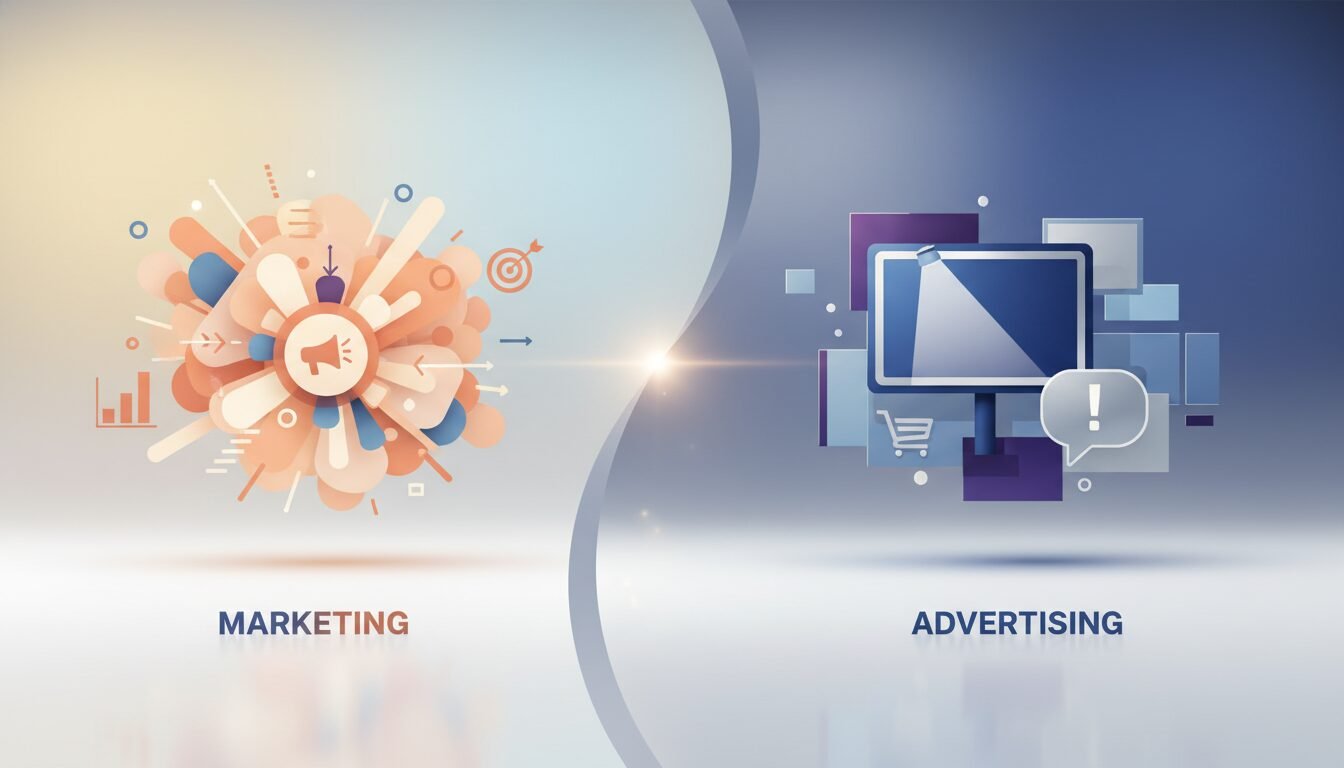
Where marketing embraces the full customer lifecycle, from research to post‑purchase engagement, advertising zooms in on a specific stage: promotion. Marketing asks, “Who is the customer and what do they need?”; advertising asks, “How do we place our message in front of them most persuasively?” This difference explains why marketing strategies can take months to develop, while ad campaigns often launch in weeks.
Goals and Metrics
Marketing success is measured by brand equity, customer lifetime value, and market share. Advertising performance, on the other hand, is tracked through impressions, click‑through rates, conversion rates, and return on ad spend. For example, a marketing team might aim to increase net promoter score (NPS) by 10 points over a year, while an advertising team targets a 3% click‑through rate on a new display campaign.
Time Horizon
Marketing strategies operate on a continuum, building awareness, nurturing leads, and sustaining loyalty over years. Advertising typically works in short bursts: a four‑week product launch, a seasonal promotion, or a retargeting sequence lasting days. Because of their different timelines, companies must balance the long‑term vision of marketing with the quick wins of advertising to achieve sustainable growth.
| Aspect | Marketing | Advertising |
|---|---|---|
| Definition | Strategic process of identifying and satisfying customer needs | Paid placement of promotional messages |
| Scope | Entire customer journey, from research to retention | One component of the promotional mix |
| Goal | Build brand equity, loyalty, and long‑term revenue | Drive immediate awareness, leads, or sales |
| Key Metrics | NPS, customer lifetime value, market share | Impressions, CTR, conversion rate, ROAS |
| Budget Approach | Allocated across product development, branding, and communications | Focused on media buying and creative production |
| Example Activities | Consumer research, pricing strategy, content creation | TV commercials, Google Ads, billboard placements |
The Strategic Role of Marketing

Market Research and Consumer Insights
Before any campaign launches, marketing digs into who the customer is. Tools like surveys, focus groups, and web analytics reveal demographic, behavioral, and psychographic patterns. For instance, a SaaS company might analyze user behavior to identify the exact features that drive subscription upgrades, intel that shapes both product development and later advertising messages.
“Effective marketing strategies evaluate orientation, mix, environment, and market to align with customer needs.” , American Marketing Association
Brand Building and Positioning
A strong brand sets a company apart in a crowded marketplace. Marketing defines the brand’s personality, voice, and value proposition. Through consistent storytelling across owned media like websites, blogs, and email newsletters, marketing builds trust and emotional connection. The four Ps, product, price, place, and promotion, still serve as the classic framework, but many modern teams now apply the four Cs: client/customer, cost, convenience, and communication.
The Marketing Mix and Decision‑Making
The marketing mix guides day‑to‑day decisions. Whether a business opts for a product‑oriented approach or a customer‑centric one, every element must work in harmony. Salesforce notes that marketing efforts fall into three buckets: paid (ads and sponsorships), owned (your website and social channels), and earned (media mentions and reviews). Balancing these three ensures a brand remains visible without overspending on any single channel.
How Advertising Drives Visibility and Sales

Traditional Advertising Channels
For decades, television, radio, print, and outdoor billboards dominated. These mass‑market channels still deliver broad reach, particularly for consumer goods. A 30‑second Super Bowl spot, for example, can introduce a brand to over 100 million viewers in one evening. However, traditional advertising requires substantial budgets and often offers limited targeting compared to its digital counterpart.
Digital and Native Advertising
The internet transformed advertising into a precision tool. Platforms like Google Ads and Meta allow advertisers to target users by location, interests, and even past behavior. Programmatic advertising automates bidding in real‑time, ensuring ads reach the right person at the right moment. Native ads, such as sponsored articles or promoted social posts, blend into the platform’s existing content, reducing banner blindness and often achieving higher engagement rates.
Measuring Advertising ROI
Because advertising is paid, tracking return is critical. Key performance indicators include cost per click (CPC), click‑through rate (CTR), and return on ad spend (ROAS). A campaign with a ROAS of 4:1 means every dollar spent generated four dollars in revenue, a benchmark many direct‑response advertisers aim for. Advanced attribution models now connect ad exposure to offline purchases, giving a more complete picture of effectiveness.
Integrating Marketing and Advertising for Business Success
Creating a Unified Customer Journey
When and advertising work in silos, the customer experience fragments. A potential buyer might see a compelling Instagram ad but land on a homepage that feels unrelated. Integration ensures messaging, visuals, and value propositions remain consistent from first touch to final sale. Mapping the customer journey, awareness, consideration, decision, and advocacy, helps both teams align their efforts and resources.
Aligning Messaging Across Channels
A brand guideline document serves as the single source of truth. It outlines tone, color palette, and key phrases that every ad, email, and blog post must follow. For example, a luxury hotel chain might mandate that all these advertising materials emphasize “exclusive experiences” and use a warm, inviting vernacular. Regular cross‑team meetings keep everyone on the same page, avoiding contradictory messages that confuse consumers.
Case Study: Omnichannel Campaigns
Consider a product launch that begins with influencer partnerships (earned), followed by targeted Facebook ads (paid), and supported by a blog series on the company’s site (owned). This orchestrated approach amplifies reach while nurturing leads at every stage. Industry data shows that omnichannel campaigns retain significantly more customers compared to single‑channel efforts, underscoring the power of integrated such advertising strategies.
Pros and Cons
Pros
- Integrated approach creates consistent customer experiences across all touchpoints
- Combined strategies maximize reach while optimizing budget allocation
- Data sharing between teams improves targeting and personalization
- Long‑term brand building supports short‑term advertising effectiveness
Cons
- Coordination between teams requires additional time and resources
- Conflicting priorities can arise between brand building and immediate sales goals
- Measuring attribution across multiple channels remains complex
- Budget allocation decisions become more challenging with overlapping functions
Modern Trends Reshaping the Industry
Artificial Intelligence and Automation
AI now powers predictive analytics, programmatic buying, and even content generation. Marketers use machine learning to score leads and personalize email sequences, while advertisers rely on AI to optimize bid strategies and creative variations. Chatbots handle customer service queries, freeing human teams for higher‑level strategy. According to Salesforce research, organizations that adopt AI in their marketing and see improved efficiency, translating to more campaigns run with the same budget.
Data Privacy and Ethical Practices
With regulations like GDPR and CCPA, businesses must handle consumer data carefully. Transparent data practices are no longer optional; they are a competitive differentiator. Ethical and advertising now means obtaining explicit consent, respecting opt‑outs, and never using data in ways that erode trust. Brands that prioritize privacy often enjoy stronger customer loyalty and avoid costly fines.
Sustainability and Purpose‑Driven Campaigns
Consumers increasingly expect brands to take a stand on social and environmental issues. these advertising campaigns that highlight sustainable sourcing, carbon‑neutral operations, or community support resonate with values‑driven buyers. For example, a clothing retailer might promote a “buy one, plant one” initiative, combining paid ads with organic social content to amplify its purpose. Purpose‑led approaches not only attract customers but also improve employee morale and investor relations.
Careers and Education in Marketing and Advertising
Job Roles and Responsibilities
The field offers a spectrum of careers, from creative roles like copywriter and art director to analytical roles such as media planner and SEO specialist. such advertising agencies employ account managers who liaise with clients, while in‑house teams might need brand managers to oversee product launches. Common job titles include digital marketer, social media manager, market research analyst, and media buyer.
Educational Pathways and Certifications
A bachelor’s degree in marketing, business, or communications remains the most common entry point. Many universities now offer specialized majors in marketing and that blend strategy, creativity, and data analysis. Professional certifications, like Google’s Digital Marketing & E‑commerce certificate or the AMA’s Professional Certified Marketer, provide hands‑on skills and can be completed online in under six months. GCU’s Colangelo College of Business, for instance, offers degrees that prepare students for both corporate and agency roles.
“As reported by Coursera’s analysis of industry data, sales managers in the field earn a median salary of $121,000 per year.”
Salary Expectations and Industry Growth
Salaries vary by role and geography. Entry‑level digital coordinators might start at $45,000, while senior advertising directors can exceed $150,000. The Bureau of Labor Statistics projects steady growth for and advertising specialists through 2030, driven by the constant need for companies to reach customers in an ever‑evolving media landscape. Specialized skills in SEO, data analytics, and AI command premium pay.
Future Outlook: The Next Era of Marketing
The Rise of Voice Search and AI Answer Engines
As smart speakers and voice assistants become ubiquitous, marketing and advertising strategies must adapt to conversational queries. SEO now covers “how‑to” voice searches, and advertisers are experimenting with audio ads on platforms like Pandora and Spotify. AI answer engines, which generate direct responses instead of blue links, demand that content be structured with clear definitions and concise answers, making traditional long‑form content less effective if not optimized.
Personalization at Scale
Advances in data processing allow real‑time personalization across millions of users. Netflix’s recommendation engine is a prime example of personalization in practice, while dynamic creative optimization (DCO) in advertising serves different banners to different audiences based on browsing history. Consumers now expect experiences tailored to their preferences, and companies that deliver see higher engagement and conversion.
The Blurring Lines Between Marketing and Advertising
Technology is eroding the old boundaries. Influencer partnerships sit at the intersection of earned and paid media; shoppable posts turn social content into direct sales channels. As marketing and advertising continue to converge, professionals must be adept at both strategic planning and creative execution. Agility, continuous learning, and a data‑driven mindset will be the hallmarks of future leaders in the field.
Making Marketing and Advertising Work Together
Treating marketing and advertising as separate silos limits growth. A unified approach, where marketing defines the long‑term brand strategy and advertising amplifies it through targeted paid placements, creates a self‑reinforcing cycle. By aligning goals, sharing data, and maintaining consistent messaging, businesses can turn first‑time buyers into lifelong advocates. Start with a solid foundation, layer on sharp advertising tactics, and constantly measure what works. The most successful brands are those that master the art of blending marketing and advertising into a single, customer‑obsessed operation.
Book a free demo at digimeapp.com to see how AI can transform your practice.
Frequently Asked Questions
What is the meaning of marketing and advertising?
Marketing is the comprehensive process of understanding customer needs and delivering value through product, price, place, and promotion. Advertising is a specific paid activity within marketing that promotes products or services to drive sales.
What are the key differences between marketing and advertising?
Marketing covers the entire customer lifecycle and builds long‑term brand equity; advertising is a short‑term, paid tactic focused on immediate results. Marketing is strategic, advertising is tactical. Marketing uses multiple channels (owned, earned, paid), while advertising is exclusively paid.
What jobs can you get with a marketing and advertising degree?
Graduates can pursue roles such as brand manager, digital specialist, media planner, copywriter, SEO analyst, or account executive. Both corporations and agencies hire talent with a mix of creative and analytical skills.
How do marketing and advertising work together?
Marketing sets the overall strategy and brand message; advertising executes that message through paid placements to a targeted audience. They align through shared goals, consistent creative, and integrated performance tracking to create smooth customer experiences.
Can you succeed with only advertising and no marketing?
Short‑term results are possible, but without marketing to understand the audience and define the brand, advertising may lack direction and waste budget. Sustainable growth requires the research and relationship‑building that only marketing provides.
What is a typical marketing and advertising course like?
A course usually covers consumer behavior, market research, brand management, digital strategies, and advertising principles. Programs often include practical projects where students create real campaign plans or analyze case studies from companies like Coca‑Cola or Nike.