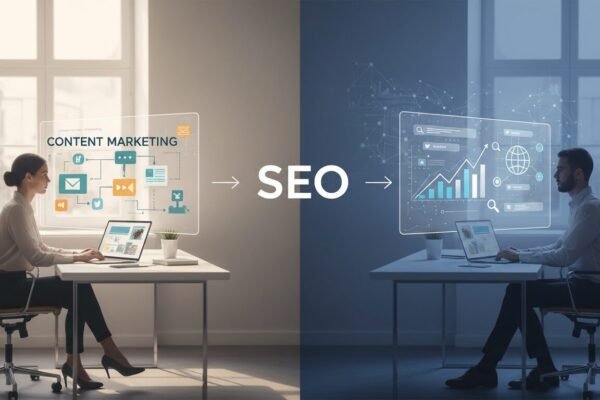
Content marketing for small businesses is the practice of creating and sharing valuable content, like blog posts, videos, and social media updates, to attract customers and build lasting trust. It costs far less than traditional advertising and works around the clock to generate leads.
Key Takeaways
- small businesses is one of the most cost-effective ways to build brand awareness and earn customer loyalty.
- A strong strategy starts with knowing exactly who your audience is and what problems they need solved.
- Educational content, authentic storytelling, and user-generated content consistently outperform generic promotional messaging.
- Distributing content across social media, email, and audio channels multiplies your reach without multiplying your budget.
- Tracking performance with free tools like Google Analytics ensures every piece of content earns its place in your strategy.
- Results typically build over 6 to 12 months, so consistency matters more than any single piece of content.
What Is Content Marketing for Small Businesses?
 Marketing for Small Businesses? – content marketing for small businesses | DigiMe” class=”wp-image-1230″ loading=”lazy” width=”1792″ height=”1024″ />
Defining Content Marketing
Content marketing for small businesses is a strategic approach to creating and distributing material that educates or entertains your audience rather than pitching them directly. According to the Content Marketing Institute, it is “a strategic marketing approach focused on creating and distributing valuable, relevant, and consistent content to attract and retain a clearly defined audience, and, ultimately, to drive profitable customer action.” The U.S. Chamber of Commerce describes a content strategy as your plan for how your business distributes information to its audience, moving you away from random acts of marketing toward a repeatable, measurable system.
How Content Marketing Differs from Traditional Advertising
Traditional advertising interrupts. Content marketing attracts. Where a radio spot or print ad demands attention for 30 seconds, a well-written blog post earns it for 5 minutes, and keeps earning it every time someone searches for that topic. For a small business, that difference is significant. A landscaping company that publishes short lawn care tutorials is delivering real value before asking for a single dollar. That goodwill compounds over time, converting curious readers into paying clients.
The Rising Relevance in 2026
As of 2026, the digital noise problem is only getting louder. According to Salesforce research, 53% of small and medium business leaders feel they are at a competitive disadvantage compared to larger enterprises when it comes to meeting customer expectations. Content marketing for small businesses directly addresses that gap. It lets you showcase expertise and personality that no big-box competitor can replicate. With AI-assisted writing and editing tools now accessible to teams of one, producing professional-grade content no longer requires a full marketing department.
Pros and Cons of Content Marketing for Small Businesses

Pros
- Cost-effective long-term asset: A single evergreen blog post can drive organic traffic for years, delivering returns that paid ads cannot match once the budget runs out.
- Builds genuine trust: Consistently helpful content positions your business as a credible authority, which shortens the sales cycle for new customers.
- Levels the playing field: A well-written article or a compelling short video can outrank a national brand in local search results.
- Compounds over time: Each new piece of content adds to your library, increasing your chances of being found across multiple search queries.
- Supports every stage of the buyer journey: From awareness to decision, content can guide a prospect without requiring any direct sales effort.
Cons
- Slow to show results: Significant organic traffic and lead generation typically take 6 to 12 months of consistent effort to materialize.
- Requires ongoing commitment: A content strategy that goes quiet for 2 to 3 months loses momentum and search ranking ground quickly.
- Quality matters enormously: Thin or generic content can actually hurt your SEO standing, so cutting corners rarely pays off.
- Measurement can be tricky: Attributing a sale directly to a blog post read 4 months ago requires proper analytics setup that many small businesses skip.
Why Content Marketing Matters for Small Businesses in 2026

Building Trust and Authority with Your Audience
Trust is the currency of modern business, and content is how you earn it. When you consistently publish accurate, helpful material, your audience stops seeing you as a vendor and starts seeing you as a resource. Forbes New York Business Council member Sergio Mannino found that sharing his interior design expertise through writing actually brought him more clients, not fewer, because it positioned him as the obvious expert in the room. The same principle applies to a financial advisor who demystifies tax planning on a blog, or a dental practice that explains what to expect during a root canal. Transparency builds confidence, and confidence drives appointments.
Standing Out in a Crowded Marketplace
Consumers have more choices than ever, which means differentiation is everything. Content gives you the platform to tell your story, highlight your values, and connect on a human level. As New York-based dentist Edward Alvarez pointed out in Forbes, using stock photos or outsourced generic content signals that a business does not take pride in what it actually does. Original content that reflects your real team, real work, and real voice resonates in a way that polished but hollow marketing never will. For local businesses especially, that authenticity is a genuine competitive advantage.
Cost-Effective Growth for Limited Budgets
Most small businesses cannot outspend their competitors. They can, however, out-teach them. A blog post costs a fraction of a print ad and keeps working long after it is published. Podcasting, as Francesco Baschieri of Voxnest noted in Forbes, requires almost no upfront investment: production and distribution needs are handled right from a smartphone, making it far less costly than video. Evergreen content, meaning material that stays relevant for years, is particularly valuable because it generates leads without requiring ongoing spend. That is the core financial case for content marketing for small businesses: you build assets, not just campaigns.
How to Build a Content Marketing Strategy: 5 Steps
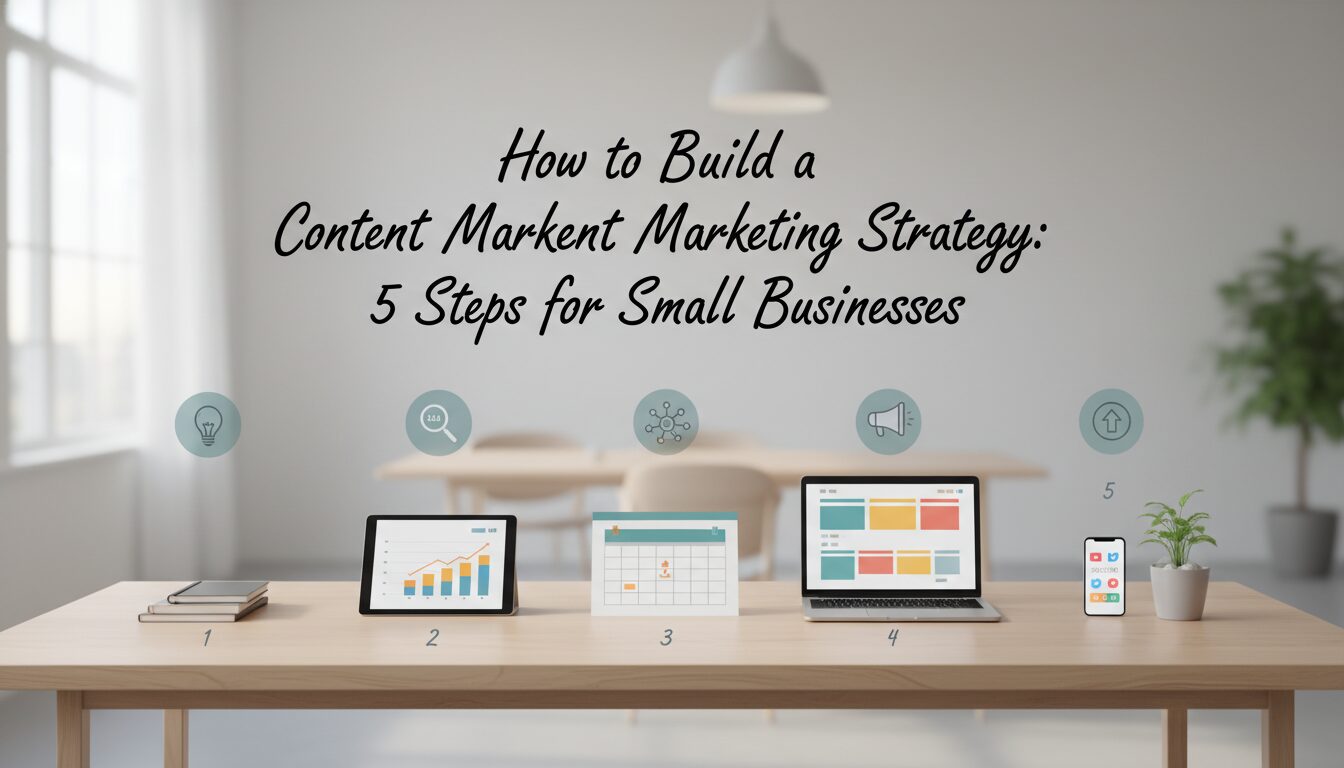 Content Marketing Strategy: 5 Steps – content marketing for small businesses | DigiMe” class=”wp-image-1233″ loading=”lazy” width=”1792″ height=”1024″ />
The following five-step process will help even complete beginners build a solid content marketing plan for their small business.
Step 1: Define Your Goals and Objectives
Start by deciding what success looks like before you write a single word. Are you trying to increase website traffic, generate consultation requests, boost brand awareness, or retain existing customers? Each goal shapes your content topics, formats, and distribution channels differently. The U.S. Chamber of Commerce makes the point well: when businesses get clearer about who they are for, and who they are not for, their content improves almost immediately. Write down your primary goal and one or two secondary goals. Everything you create should connect back to at least one of them.
Step 2: Identify Your Target Audience and Their Pain Points
Effective content marketing for small businesses depends entirely on knowing who you are talking to. Dig into your existing customer base, run short surveys, and build simple buyer personas. As Tom Conlon of North Street advises, identify exactly who you are speaking to and what keeps them up at night. Then map the questions those people ask at each stage of the buying process. A pet supply store targeting first-time dog owners, for example, should be answering questions like “how do I choose the right dog food” long before those owners ever visit the store. Relevance is what separates content that converts from content that gets ignored.
Executing Your Content Marketing Plan
Step 3: Select Content Types and Distribution Channels
Choose formats that match how your audience actually consumes information. Blog posts, short-form video, email newsletters, podcasts, and social media updates each serve different purposes and reach different segments. The Forbes New York Business Council panel stressed the importance of creating meaningful, entertaining content and sharing knowledge as freely as possible. Diversify your mix to appeal to different habits, but do not spread yourself so thin that quality suffers. The table below compares the most practical content types for small businesses.
| Content Type | Primary Goal | Small Business Example | Difficulty Level |
|---|---|---|---|
| Educational/How-To | Build authority, answer questions | Landscaping company “Lawn Care 101” video series | Medium |
| Storytelling/Brand Stories | Create emotional connection | Restaurant sharing family recipes and origins | Medium |
| Interactive (Quizzes, Polls) | Engage and gather data | Clothing store “style quiz” with personalized recommendations | High |
| User-Generated Content | Build community and trust | Photo contest with branded hashtag | Low |
| Video/Short-Form Video | Demonstrate products, show personality | Fitness studio behind-the-scenes workout clips | Medium |
Step 4: Build a Content Calendar and Creation Process
Consistency separates businesses that see results from those that give up after 60 days. A content calendar helps you plan topics, assign responsibilities, and schedule publication so nothing falls through the cracks. Andy Seibert of Imprint puts it plainly: create content focused on your audience, not yourself. Provide a clear “what’s in it for me” and your content will perform. Decide on a realistic publishing cadence, whether that is one blog post per week or two social posts per day, and protect that schedule. Free tools like Google Calendar, Trello, or Asana work well even for solo operators.
Step 5: Measure and Optimize Your Results
Tracking performance is the step most small businesses skip, and it is the one that makes everything else more effective. Use Google Analytics to monitor website traffic, Google Search Console to track keyword rankings, and your social platform insights to measure engagement. According to Salesforce, whose research surveyed nearly 5,000 marketers worldwide, data-driven decision-making is a consistent trait among top-performing content teams. Look at which topics drive the most traffic, which formats generate the most leads, and which calls-to-action convert best. Then do more of what works and less of what does not.
Types of Content That Drive Results for Small Businesses
Educational and How-To Guides
Educational content is the foundation of content marketing for small businesses. It answers real questions, ranks in search engines, and positions you as the go-to expert in your category. A hardware store publishing a series of home repair tutorials targets local DIY enthusiasts who are already searching for exactly that help. Rob Taormina of the Forbes New York Business Council emphasizes that every piece of content should clearly communicate what, why, and how. If it solves a specific problem in plain language, it will earn both traffic and trust over time.
Authentic Storytelling and Brand Narratives
Stories stick in ways that product descriptions never do. A family-owned Italian restaurant sharing the history behind its recipes creates a connection that no paid ad can manufacture. A coffee shop explaining the sourcing story of its single-origin Ethiopian beans gives customers a reason to feel good about their purchase. As Jill Strickman noted in Forbes, content allows potential clients to get to know you as a person and understand your company’s values. In a market saturated with mass-produced messaging, that human element is a real differentiator.
User-Generated and Interactive Content
Your best content creators are often your existing customers. Encourage them to share photos, leave reviews, or participate in a branded hashtag campaign. A boutique clothing store running a seasonal style contest can generate dozens of authentic posts at near-zero cost. Interactive formats like quizzes and polls add another layer: a “what’s your skin type” quiz on a MedSpa’s website, for example, captures lead information while delivering personalized value. When woven into your broader strategy, user-generated content amplifies your reach in ways that paid promotion simply cannot replicate.
Content Distribution Channels for Maximum Reach
Social Media and Short-Form Video
Platforms like Instagram, TikTok, and Facebook are where your audience already spends time, which makes them essential distribution channels. Short-form video has grown dramatically in importance over the past 3 to 4 years. Bite-sized tutorials, behind-the-scenes clips, and customer testimonials filmed on a smartphone can drive significant visibility without a production budget. The key is tailoring your content to each platform’s format while keeping your brand voice consistent. As the Forbes panel stressed, originality matters: avoid stock imagery and canned messaging. Real content from real businesses connects.
Email Marketing and Newsletters
Email remains one of the highest-ROI channels available to small businesses, and it costs almost nothing to maintain. A regular newsletter sharing blog highlights, seasonal tips, or exclusive offers keeps your audience engaged between purchases. Set up an automated welcome sequence for new subscribers so every new contact gets a strong first impression. Segment your list by customer interest or purchase history for better personalization. According to industry benchmarks from HubSpot’s State of Marketing research, email consistently ranks among the top 3 channels for lead nurturing across small business categories.
Podcasts and Audio Content
Podcasting remains one of the most underused channels for small businesses, which is exactly why it represents an opportunity. With a smartphone and a free hosting platform, you can publish episodes that explore topics relevant to your industry and audience. Warren H. Cohn of HeraldPR described launching a podcast called “The Brick Wall” that grew directly from a team phrase, building company culture while delivering genuine value to listeners. Audio fits naturally into busy schedules, reaching audiences during commutes, workouts, and errands. A consistent podcast builds a loyal audience that is hard to reach through any other format.
“Create content that is focused on them, not you. Create solutions for them, provide a ‘what’s in it for me,’ and your content marketing will soar.” – Andy Seibert, Imprint, via Forbes New York Business Council
Measuring Content Marketing Success for Small Businesses
Key Metrics to Track
Measuring impact is essential to justify the time and money you invest in content marketing for small businesses. The metrics that matter most are website traffic (unique visitors and page views), engagement (average time on page, bounce rate, social shares), lead generation (form fills, downloads, consultation requests), and sales directly attributed to content. Use UTM parameters in your links to track exactly which piece of content drove a specific action. If a how-to blog post leads a reader to book a consultation, that is a measurable, attributable win worth replicating.
Free and Affordable Analytics Tools
You do not need expensive software to get meaningful data. Google Analytics provides comprehensive website tracking at no cost. Google Search Console shows which keywords bring organic traffic and which pages rank where. Social platforms offer built-in insights for post performance. Email tools like Mailchimp include open rates and click-through data on free plans. For competitive research, tools like Semrush offer entry-level plans starting around $120 per month. The goal is not to track everything but to track the 3 to 5 metrics that connect directly to your stated business goals.
Using Data to Refine Your Content Strategy
Data-driven refinement is what separates a strategy that improves over time from one that plateaus. If a particular topic or format consistently outperforms, produce more of it. If something consistently underperforms after 3 to 6 months, retire it or reformat it. A/B test headlines, calls-to-action, and content lengths to gather real-world insights. What works for a dental practice in one market may not work for an HVAC company in another. Let your own analytics lead the way rather than copying what competitors appear to be doing.
“Identify exactly who you’re speaking to and what keeps them up at night. That clarity is what makes content actually convert.” – Tom Conlon, North Street, via Forbes New York Business Council
Common Content Marketing Mistakes Small Businesses Should Avoid
Inconsistent Posting and Lack of Planning
Erratic publishing is the fastest way to undermine an otherwise solid strategy. Search engines reward consistency, and so do audiences. Develop a content calendar and protect it, even if your publishing frequency is modest. One high-quality post per week beats five rushed posts followed by six weeks of silence. The U.S. Chamber of Commerce specifically warns against random acts of marketing: without a plan, your efforts lack direction and fail to build the momentum that compounds into real results.
Focusing on Sales Instead of Value
Hard-sell messaging in every piece of content pushes audiences away rather than drawing them in. Hoda Mahmoodzadegan of Molly’s Milk Truck put it well in Forbes: give them what they want, because it is not about you, it is about what customers need. A practical guideline is the 80/20 rule: roughly 80% of your content should be genuinely useful and non-promotional, with about 20% focused on your products or services. That balance builds relationships without feeling transactional.
Ignoring SEO and Distribution
Great content that nobody finds is just a well-kept secret. Optimize every piece for search by including relevant keywords naturally, writing descriptive meta tags, and earning quality backlinks from local directories, industry publications, and partner websites. Then distribute actively through email, social media, and community partnerships. Ignoring SEO limits your organic reach permanently, while skipping distribution means even your existing audience may never see what you publish. Both sides of the equation matter equally.
Making Content Marketing for Small Businesses Work for You
Content marketing for small businesses is not a passing trend. It is a fundamental shift in how brands earn customer attention and loyalty. By creating and sharing genuinely useful content, even the smallest company can build authority, deepen relationships, and drive sustainable growth. The Salesforce research is clear: 53% of SMB leaders already recognize the urgent need to improve how they connect with customers through content. Start with a clear strategy, stay consistent, and always put your audience’s needs first. The return, measured in trust, leads, and revenue, will follow.
Ready to see how AI-powered content tools can accelerate your results? Book a free demo at digimeapp.com to see how AI can transform your practice.
Frequently Asked Questions
What is content marketing for small businesses?
Content marketing for small businesses is a strategy that involves creating and sharing online content, such as blogs, videos, and social media posts, to attract and engage a specific audience. The goal is to provide genuine value, build trust, and drive profitable customer action without relying on direct sales pitches.
How much does content marketing cost for a small business?
Costs can range from near-zero when you create content yourself using free tools, to a few hundred dollars per month for software subscriptions and occasional freelance help. Many small businesses start by investing time rather than money, using a smartphone for video and free platforms for blogging and email.
What type of content works best for local small businesses?
Local small businesses typically see strong results from content that highlights community involvement, such as local event coverage, customer spotlights, and area-specific guides. Blog posts optimized for location-based searches, Google Business Profile updates, and visually authentic social media content also help attract nearby customers effectively.
How long does it take to see results from content marketing?
Content marketing is a long-term strategy. While individual social media posts may generate immediate engagement, meaningful results like consistent organic search traffic and steady lead generation typically require 6 to 12 months of sustained, consistent effort. Patience and a reliable publishing schedule are the two most important factors.
Do I need a blog for my small business content marketing?
A blog is one of the most versatile and durable tools available for content marketing. It serves as a central hub for educational content that drives organic search traffic over time. If your audience strongly prefers video or audio, you can lead with those formats, but a blog helps anchor your overall content ecosystem and supports SEO in ways other formats cannot.
Can I do content marketing myself, or should I hire a professional?
Most small business owners start by handling content creation themselves, particularly with today’s accessible tools. As your business scales, bringing in a freelancer or a specialized agency can help maintain quality and free up your time for operations. Whoever creates the content must understand your brand voice and audience deeply, whether that is you or someone you hire.