Financing new HVAC is using loans, credit lines, or dealer payment plans to spread the cost of a heating and cooling system over manageable monthly payments. Most homeowners choose this path because HVAC replacements cost $7,500-$12,000 upfront.
Key Takeaways
- Financing new HVAC spreads the high upfront cost of a replacement or installation into manageable monthly payments through loans, credit lines, or dealer plans.
- Personal loans offer fast funding (often within 24 hours) and are unsecured, with APRs ranging from 5.99% to 35.99% depending on creditworthiness.
- Manufacturer-backed deals like Carrier’s 0% APR for 60 months or Trane instant rebates up to $900 can dramatically cut costs when combined with qualifying purchases.
- Home equity products (HELOCs or loans) typically provide the lowest interest rates but require sufficient equity and a longer approval process.
- Beware of deferred-interest promotions: if the balance isn’t paid in full by the end of the term, you could owe all interest retroactively from the purchase date.
- Stacking financing with utility incentives, manufacturer rebates, and tax credits can reduce the net cost of a new system by 15–25% or more.
What Is Financing New HVAC?

Financing new HVAC allows homeowners to replace or install heating and cooling systems without paying the full cost upfront. This alternative to cash payments makes home comfort upgrades accessible even when savings are limited. With average system replacements costing several thousand dollars, many homeowners turn to financing new HVAC options to avoid draining emergency funds.
Why Homeowners Seek Financing
HVAC systems rarely fail at a convenient time. The strain of extreme weather can push an aging unit over the edge, forcing a quick replacement decision. According to industry surveys, fewer than 40% of U.S. households could cover a $5,000 emergency expense from savings, making financing new HVAC a practical necessity rather than a luxury. Dealer financing programs with 0% APR for 60 months have become especially popular for those who qualify, offering a true zero-cost borrowing option when paid off within the promotional window.
The Real Cost of New HVAC Systems
While a simple repair may cost a few hundred dollars, a full system replacement, including the furnace, air conditioner, and installation, can run anywhere from $7,500 to $12,000 depending on size, efficiency, and brand. These figures explain why financing new HVAC is often the only path forward for homeowners needing immediate comfort. By spreading the cost over 60 months or longer, monthly payments can drop to a manageable level (often $150–$250 per month) that fits most budgets.
“A personal loan can be a fast way to finance a new or replacement HVAC system. Many lenders can fund a loan by the next day after approval.”
, NerdWallet
Types of Financing New HVAC
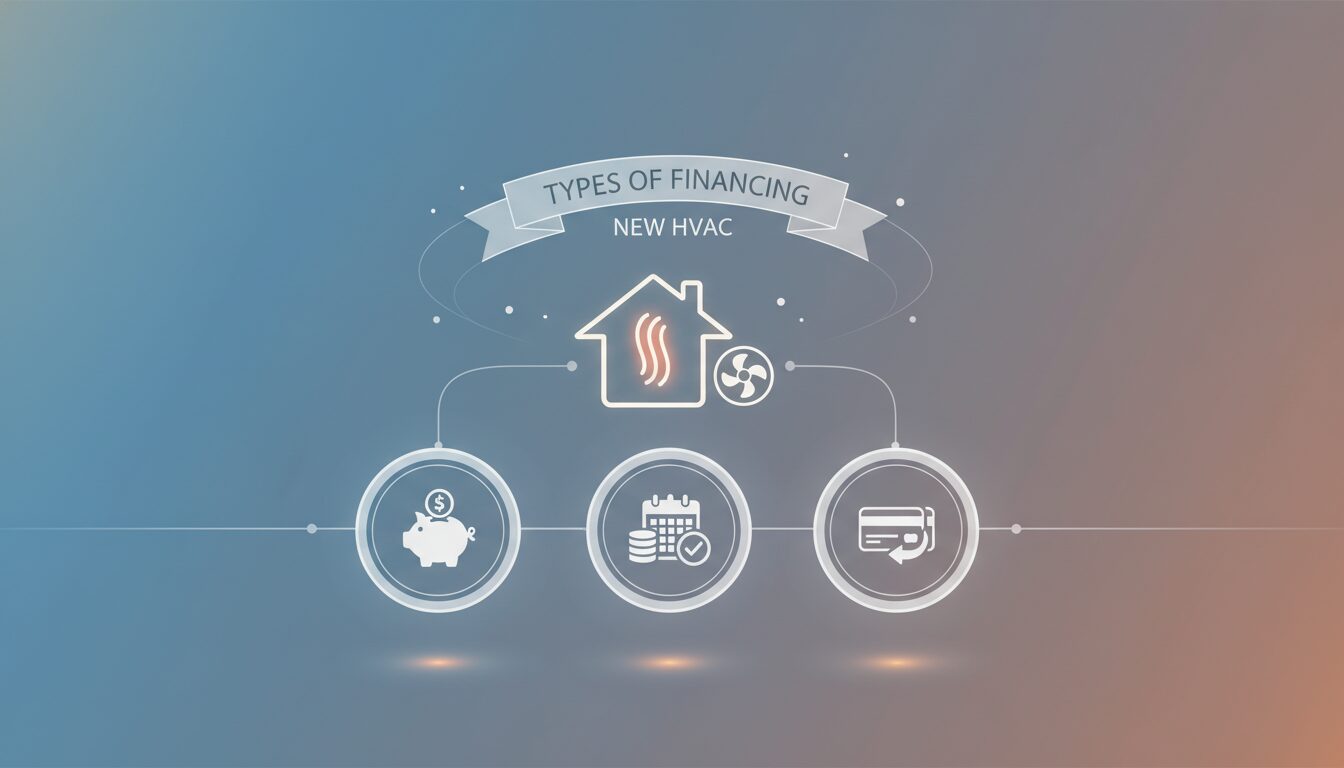
There are four primary paths for financing new HVAC systems: personal loans, home equity borrowing, manufacturer/dealer promotional plans, and government-backed PACE programs. Each carries distinct qualification requirements, interest rates, and repayment terms. The right choice depends on your credit score, home equity, and how quickly you need the funds.
Personal Loans
Unsecured personal loans from online lenders, banks, and credit unions are a popular choice because they don’t require home equity. Approval and funding can happen in as little as 24 hours. Loan amounts range from $1,000 to $75,000 with terms typically between two and seven years. Annual percentage rates start around 5.99% for well-qualified borrowers and can go as high as 35.99% for those with lower credit scores. For example, a $10,000 loan at 7% APR over 60 months results in a monthly payment of about $198.
Home Equity Financing (HELOC and Home Equity Loans)
Borrowing against your home’s equity typically offers the lowest interest rates, often 2–4% lower than unsecured personal loans. A home equity line of credit (HELOC) works like a credit card with a draw period, while a fixed-rate home equity loan provides a lump sum. Both require appraisals and can take 3–6 weeks to close, so they aren’t ideal for emergencies. However, the interest may be tax-deductible if the funds are used for substantial home improvements, adding a long-term financial benefit.
| Financing Option | Typical APR Range | Loan Term | Best For | Key Advantage |
|---|---|---|---|---|
| Personal Loan | 5.99%–35.99% | 2–7 years | Fast funding, no equity needed | Speed and flexibility |
| Home Equity Loan/HELOC | 3.25%–8.50% | 5–30 years | Large projects, lower rates | Lowest borrowing cost |
| Manufacturer/Dealer Financing | 0 percent–29.99 percent | 6–60 months | Promotional offers, quick setup | Possible 0 percent interest |
| PACE Program | 6 percent–8 percent | 5–20 years | Energy-efficient upgrades, bad credit | No credit score minimum |
Manufacturer and Dealer Promotional Financing
Major brands like Carrier and Trane offer subsidized financing through partners like Wells Fargo and Synchrony. A standout example is Carrier’s 0 percent APR for 60 months on qualifying system purchases, available with approved credit. Dealers may also bundle instant rebates: Carolina Comfort Air, for instance, advertises up to $900 in instant rebates on Trane systems and $500 off for members. These promotional periods make dealer financing a first-choice option for buyers with good credit scores, often 650 or above.
Top Lenders for HVAC Loans in 2026
While dealer financing dominates the market, many homeowners find better terms through direct lenders when financing new HVAC systems. The table below highlights products that scored well in NerdWallet’s latest comparison of HVAC-specific loans, considering APR, credit requirements, and funding speed.
Best for Good Credit: LightStream and Upgrade
LightStream (a division of Truist) offers unsecured loans up to $100,000 with APRs starting at 6.99 percent and no fees. Its “Rate Beat” program promises a 0.10 percent rate reduction over any competitor’s approved offer. Upgrade, with a minimum credit score of 600, provides amounts from $1,000–$50,000 and rates from 7.74 percent. Both can fund within one business day and carry fixed rates, making budgeting straightforward.
Best for Bad Credit: Upstart and LendingPoint
Borrowers with FICO scores below 640 still have options for financing new HVAC installations. Upstart uses AI to assess non-traditional data, employment, education, and may approve applicants with no credit score at all. Its APRs range from 6.70 percent–35.99 percent, with loans up to $75,000. LendingPoint requires a score of at least 640 but offers terms up to six years and funding in one day. These lenders fill a critical gap for the roughly 30 percent of American adults with subprime credit.
“According to industry data, homeowners who combine manufacturer rebates with 0% promotional financing can reduce their net system cost by 20-30% compared to cash purchases.”
How to Apply for Financing New HVAC
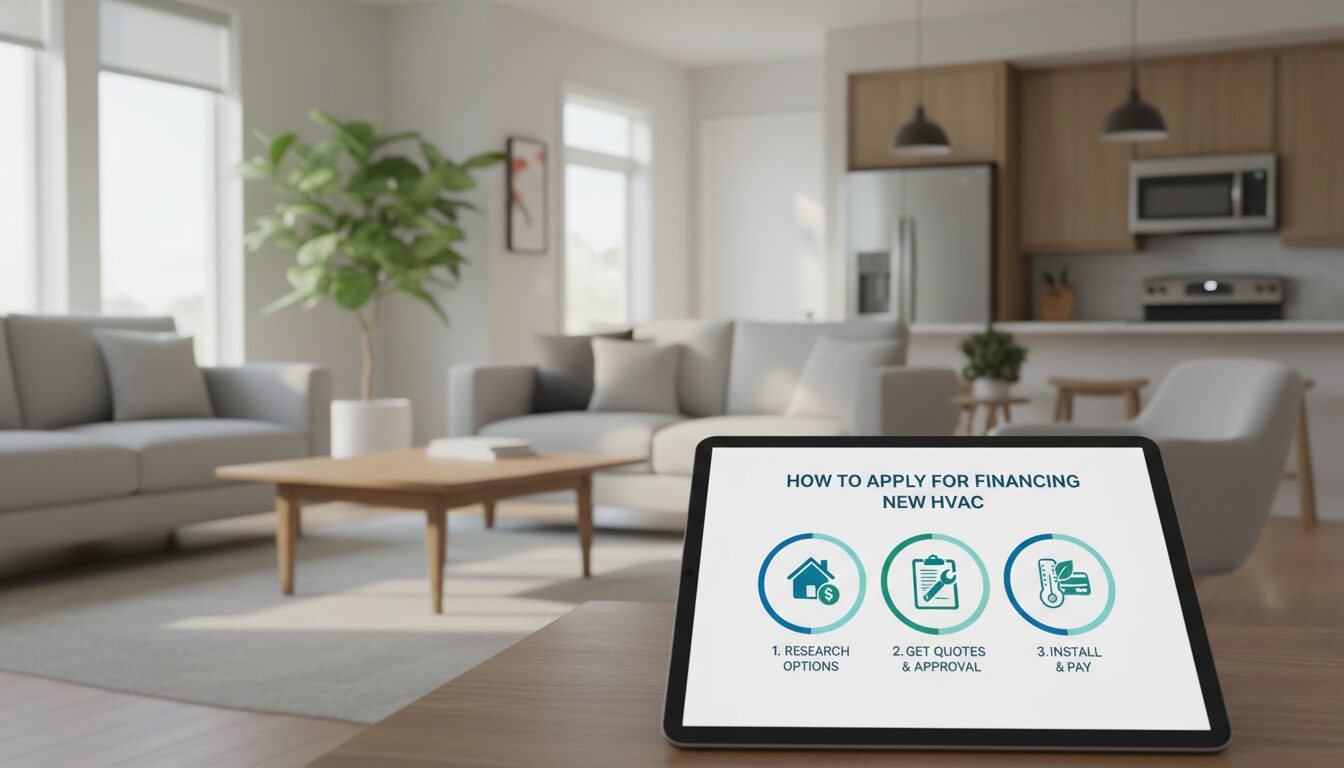
The application process for financing new HVAC varies by lender, but the core steps remain similar whether you choose a personal loan, dealer financing, or a HELOC.
Step-by-Step Application Process
- Check your credit score. Know where you stand before applying. Services like Credit Karma provide free scores. Minimum requirements range from 600 (Upgrade) to no minimum (Upstart).
- Get a system estimate. A certified HVAC technician will assess your home, recommend equipment, and provide a total installed cost, typically $7,500–$12,000.
- Compare financing pre-qualifications. Use online tools (NerdWallet, LendingTree) to see estimated rates without a hard credit pull. This step takes 2–3 minutes.
- Choose your loan type and term. Decide between a personal loan, HELOC, or the dealer’s in-house plan. Balance monthly payment comfort against total interest paid.
- Submit a formal application. Provide proof of income, identification, and, for home equity products, recent mortgage statements. Most online lenders respond within 24 hours.
- Sign and schedule installation. Once approved, funds are disbursed directly to your bank account or to the HVAC contractor. Many dealers will schedule installation as soon as the next business day.
Documents You’ll Need
Typical requirements include a government-issued ID, two most recent pay stubs or tax returns, W-2s or 1099s, and three months of bank statements. For home equity financing, lenders will also require a current mortgage statement and often order an appraisal, which can add 7–10 days to the timeline.
Pros and Cons
Pros
- Immediate comfort without depleting savings
- Fixed monthly payments for easy budgeting
- Access to high-efficiency systems that qualify for rebates
- Quick approvals and funding (as fast as 24 hours)
- Potential to improve home value and energy efficiency
Cons
- Total cost increases due to interest (except 0 percent deals)
- May tempt homeowners to overspend on more expensive equipment
- Deferred-interest plans can trigger retroactive charges if not paid in full
- Some lenders charge origination fees up to 8 percent
- Secured loans (HELOC) put your home at risk if you default
Hidden Costs and Pitfalls of “No Interest” Deals
Many HVAC contractors advertise 0 percent financing for 12, 18, or 60 months, but the catch is often buried in the fine print when financing new HVAC systems. These offers typically use deferred interest, meaning interest accrues from day one at a high rate (often 25–29.99 percent APR) and is added to your balance if the entire purchase price isn’t paid off by the end of the promotional term.
How Deferred Interest Works
Imagine you finance a $10,000 system with a 0 percent for 18 months deferred-interest plan. If you pay $556 per month, you’ll clear the balance in time and pay zero interest. But if you still owe even $1 after month 18, the lender can charge you all the interest that would have accrued at the standard rate, potentially $2,500 or more, retroactively from the purchase date. This trap has caught many homeowners off guard, turning a “free” loan into one of the most expensive ways to finance a new system.
How to Avoid Paying Retroactive Interest
To protect yourself, always read the financing agreement carefully. Look for the phrase “deferred interest” rather than “0 percent APR.” Set up automatic payments that ensure you pay off the balance at least one month before the promotional deadline. Alternatively, use a personal loan with a low, fixed rate if you’re not certain you can meet the deadline, the certainty often outweighs the cost.
“Enjoy the flexibility of special financing, plus upfront savings with Cool Cash rebates.”
, Carrier Residential
Stacking Rebates and Incentives with Financing
Savvy homeowners rarely pay full price when financing new HVAC systems. By combining financing with available rebates and tax incentives, you can reduce the effective cost of a new HVAC system by 15–25 percent or more. This approach requires a bit of research but can yield significant savings.
Manufacturer Rebates Like Carrier Cool Cash
Carrier’s Cool Cash program, for example, offers rebates up to $2,100 on qualifying systems when purchased before a seasonal cutoff (typically May 31). Trane dealers may provide instant rebates up to $900. These are often stackable with financing promotions, meaning you can combine a 0 percent APR offer with a $900 check at closing, effectively lowering the amount financed. Always ask your contractor about current promotions; many are time-sensitive and tied to specific efficiency ratings.
Utility and Government Incentives
Beyond manufacturer offers, local utility companies frequently provide cash rebates for ENERGY STAR® certified systems. A typical utility program in the Midwest might offer $200–$500 for a high-efficiency air conditioner or heat pump. At the federal level, the Energy Efficient Home Improvement Credit (25C) allows a tax credit of 30 percent of the cost up to $600 for qualifying air conditioners and heat pumps. By layering these incentives with smart financing, the net out-of-pocket cost can drop dramatically, making a premium system as affordable as a base model.
Frequently Asked Questions
What credit score do I need to finance a new HVAC system?
Minimum credit scores vary by lender and program. For personal loans, a score of 600 often qualifies you with lenders like Upgrade, while others like Upstart have no minimum score. Dealer financing through Wells Fargo or Synchrony typically requires 650 or higher for the best promotional rates. If your score is below 580, you may still qualify for PACE financing, which evaluates home equity rather than personal credit.
Is it better to finance through the HVAC company or my own bank?
It depends on the promotion. Dealer financing can be superior when it offers 0 percent APR for extended terms, but always check for deferred-interest clauses. Banks and credit unions often provide lower fixed rates than the standard dealer APR, and a home equity loan from your own bank may have the lowest rate of all. Compare the total cost over the loan term, not just the monthly payment, to make the best choice.
Can I finance a new HVAC system with bad credit?
Yes. Subprime lenders like Upstart and LendingPoint offer HVAC loans even with scores as low as 560. Expect APRs in the 20–36 percent range, which means a $10,000 loan could cost over $300 per month. PACE programs are another option: they require no minimum credit score and base eligibility on home equity and the ability to repay, with fixed rates around 6–8 percent.
What is the catch with 0% HVAC financing?
The catch is usually deferred interest. If you don’t pay off the entire balance within the promotional period, say, 18 months, you’ll be charged all the interest that accrued from the purchase date at a high standard rate. To avoid this, set up a payment plan that clears the balance at least one month early, or consider a fixed-rate personal loan if you need more time.
How long can you finance a new HVAC system?
Terms range from 6 months (for some deferred-interest plans) to 20 years (for PACE programs). Personal loans typically max out at 7 years, while home equity loans can extend to 30 years. Longer terms lower the monthly payment but increase total interest paid. For example, a $10,000 loan at 8 percent APR costs $1,472 in total interest over 5 years versus $2,427 over 7 years.
Are there any government programs to help pay for a new HVAC?
Yes. The PACE (Property Assessed Clean Energy) program is available in many states and allows homeowners to finance energy-efficient upgrades through an assessment on their property tax bill. Federally, the 25C tax credit offers up to $600 for qualifying HVAC equipment. Some states also have low-income weatherization assistance that covers a portion of replacement costs. Check the DSIRE database for programs in your area.
Book a free demo at digimeapp.com to see how AI can transform your practice.