Marketing consulting services are specialized advisory engagements that help businesses design, execute, and optimize marketing strategies to drive growth and improve customer acquisition efficiency. If you’ve ever felt like your marketing budget disappears without a clear return, you’re not alone — and that’s exactly the problem these services exist to solve.
Key Takeaways
- Marketing consulting services combine strategic advisory, data analytics, and execution support to increase customer acquisition and retention.
- Leading engagements reduce customer acquisition costs by 15–25% and boost conversion rates through evidence-based experimentation.
- Engagement models range from short-term project work ($10K–$50K) to fractional retainer partnerships ($5K–$25K/month).
- Email marketing ROI benchmarks at $36 for every $1 spent, according to Litmus research.
- Personalization leaders achieve roughly 40% more revenue than peers, per McKinsey data.
- The right consultant compresses an 18-month internal learning curve into a 90-day impact window.
What Marketing Consulting Services Include
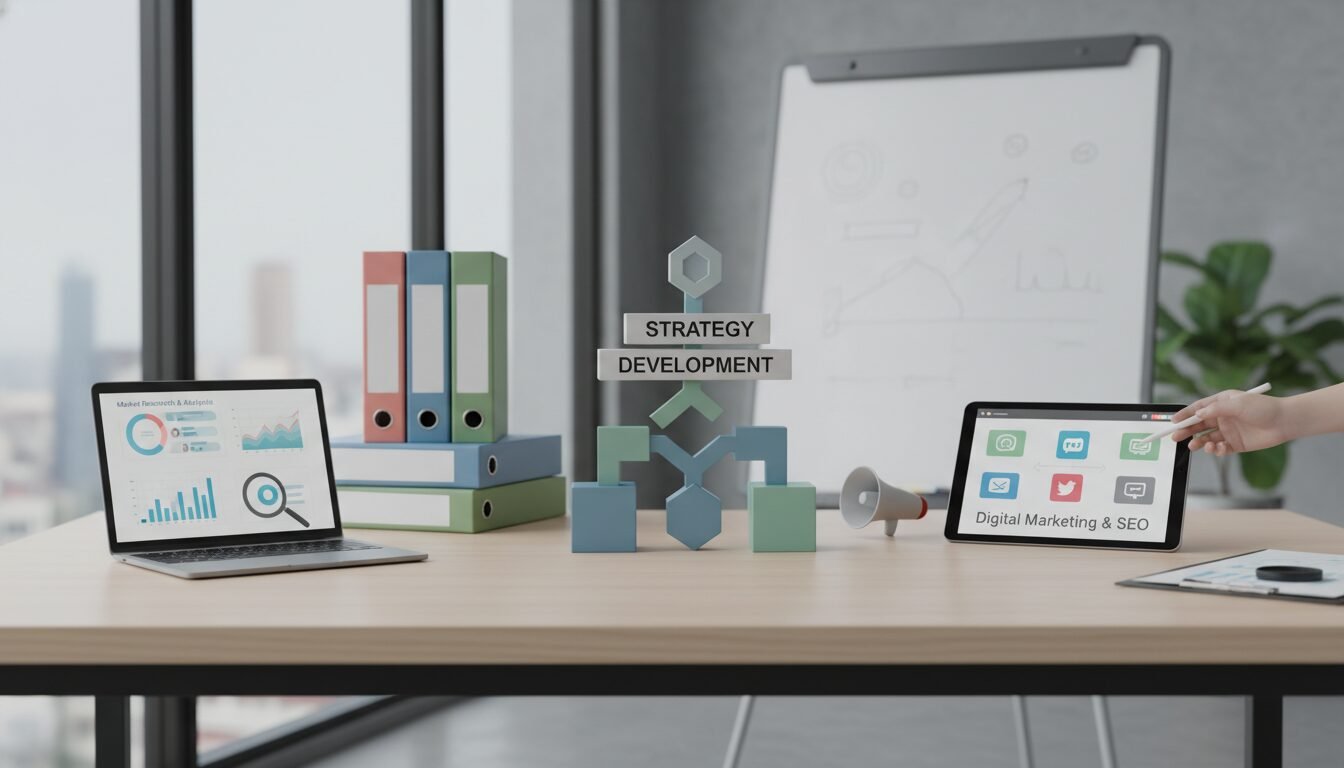
Marketing consulting services cover a wide range of disciplines, from strategy formulation to hands-on implementation. The exact scope depends on your business‘s maturity and goals, but most engagements cluster around three core pillars.
Strategic Planning and Research
Consultants analyze market trends, competitor positioning, and customer insights to define target segments, value propositions, and growth pathways. According to McKinsey, personalization leaders achieve roughly 40% more revenue than their peers. This phase typically includes SWOT analysis, total addressable market sizing, and persona development — ensuring every tactic ties back to a verified market opportunity rather than a gut feeling.
Brand and Positioning
Brand work clarifies why a company exists beyond its product features. Messaging frameworks, design systems, and proof points are built to hold across digital, sales, and product experiences. A clear brand reduces friction throughout the buyer journey. According to Gartner, buyers are 57–70% through their research before they ever contact sales, which means your brand does most of the selling before a human gets involved.
Digital and Performance Marketing
Paid media, SEO, email, and content marketing are continuously optimized inside a well-run engagement. Consultants design incrementality tests, set customer acquisition cost (CAC) guardrails, and build attribution models that actually reflect reality. The payoff is real: the Litmus email ROI benchmark of $36 per $1 spent shows why disciplined performance marketing remains one of the highest-return activities a business can invest in.
Why Businesses Invest in Marketing Consulting Services
Internal teams often operate with blind spots, bandwidth constraints, or playbooks that were written three years ago. External consultants inject fresh perspective and specialized skills that accelerate growth without the overhead of a permanent hire.
De-risking Growth
A marketing consultant validates before scaling. Instead of pouring budget into untested channels, they run structured experiments that protect your bottom line. According to Demand Metric, content marketing generates roughly 3x the leads of outbound at about 62% lower cost. These data-backed guardrails prevent the kind of wasted spend that kills small business marketing budgets.
Accessing Specialized Expertise
Few in-house teams possess deep pricing science, lifecycle design, or product-led growth playbooks. Consulting Success research confirms that marketing remains the biggest challenge for consultants themselves — which underscores just how much value dedicated expertise delivers. Whether you bring in a fractional CMO or a growth strategist, you’re paying for precision, not trial and error.
Faster Time-to-Impact
Seasoned consultants compress months of learning into weeks. With pre-built frameworks and tested playbooks, they often deliver a 90-day turnaround from diagnosis to measurable lift. That’s a significant advantage over the typical 18-month internal ramp for complex strategic shifts.
How Marketing Consulting Services Drive Measurable Results

Strong marketing consulting services link every tactic to revenue, margin, and customer lifetime value (CLV). Vague activity reports are a red flag. Real engagements produce scorecards.
Metrics That Matter
Consultants track both leading and lagging indicators: CAC by channel, payback period, conversion rates by funnel stage, and net revenue retention. According to Bain & Company, aligning marketing KPIs to financial outcomes lifts return on investment by 2–3x. A clear scorecard prevents the all-too-common situation where a team is busy but the business isn’t growing.
CAC and CLV: The Compounding Effect
Lowering CAC while lifting CLV creates a compounding effect that builds over time. Strategies like lifecycle email nurturing, win-back campaigns, and tiered pricing can improve CLV by 30% or more. As McKinsey notes, a 1% price improvement can raise operating profits by 11%, making pricing one of the most direct growth levers marketing consultants address.
Incrementality and ROI
Modern media measurement goes beyond last-click attribution. Incrementality testing reveals what truly drives marginal sales. Consultants design holdout groups and lift studies that can turn a modest 1.5x return into 3x or more by reallocating budget to validated channels. That’s not theory — it’s the result of disciplined measurement applied consistently.
“A 1% improvement in price can lift operating profits by 11% — making pricing strategy one of the highest-ROI levers marketing consultants address.” — McKinsey & Company
Types of Marketing Consulting Engagement Models

Marketing consulting services come in several structures, each suited to different goals and budgets. Not every business needs a permanent hire or a six-figure retainer.
| Engagement Model | Typical Investment | Best For | Key Benefit |
|---|---|---|---|
| Project-Based | $10,000–$50,000 | Defined scope: rebrand, go-to-market plan, analytics audit | Fixed cost, clear deliverables |
| Fractional/Retainer | $5,000–$25,000/month | Ongoing strategic leadership; scaling a marketing function | Embedded expertise without full-time CMO cost |
| Advisory/Coaching | $300–$500/hour | Executive coaching, board-level advisory, startup mentorship | Flexibility, high-level guidance |
Project-Based Engagements
Best for single initiatives like a rebrand or a market entry strategy. The deliverable — a roadmap, a new positioning, a tech stack audit — is handed off upon completion. Typical timelines run 6–16 weeks, which makes this model predictable for budget planning.
Fractional or Retainer Partnerships
This model suits companies that need ongoing marketing leadership without a full-time executive salary. Fractional CMOs, a model popularized by firms like Chief Outsiders, work 1–3 days per week and embed directly in leadership teams. You get decades of experience at a fraction of the cost of a full-time hire.
Advisory and Coaching
Light-touch engagements for leaders who need a sounding board. Hourly or monthly advisory sessions help refine strategies, review plans, and work through high-stakes decisions. These are especially popular with founders who already have a capable team but want experienced outside perspective.
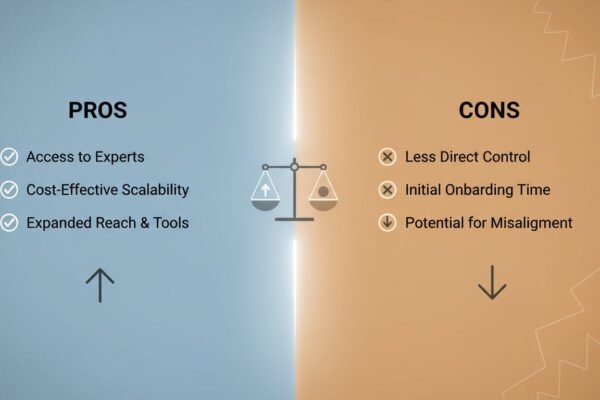
Pros and Cons of Marketing Consulting Services
Marketing consulting services offer real advantages, but they’re not the right fit for every situation. Here’s an honest look at both sides.
Pros
- Faster results: Pre-built frameworks and tested playbooks compress the learning curve from months to weeks.
- Specialized expertise on demand: Access pricing science, lifecycle strategy, or PLG playbooks without hiring a full-time specialist.
- Objective perspective: External consultants see blind spots that internal teams miss because they’re too close to the work.
- Flexible cost structure: Pay for what you need — project, retainer, or hourly — without long-term employment commitments.
- Measurable ROI: Good consultants set KPIs upfront and tie their work directly to revenue and CAC outcomes.
Cons
- Knowledge transfer risk: When the engagement ends, institutional knowledge can walk out the door if playbooks aren’t documented properly.
- Onboarding time: Even experienced consultants need 2–4 weeks to understand your business, customers, and competitive context.
- Cost at scale: Retainer fees of $5K–$25K/month can strain budgets for very early-stage businesses.
- Misaligned incentives: Hourly billing without deliverable definitions can extend timelines without producing results.
Industries That Use Marketing Consulting Services
Marketing consulting services apply across sectors, but some verticals see particularly strong demand and measurable returns.
Technology and SaaS
With complex products and long sales cycles, SaaS firms rely on consultants for product-led growth (PLG) strategy, pricing experimentation, and customer onboarding optimization. Dedicated go-to-market consultants help these companies reduce time-to-breakeven by compressing the trial-to-paid conversion window.
Local Service Businesses: Dental, MedSpa, and HVAC
Local service businesses are among the fastest-growing users of marketing consulting. A dental practice, for example, might work with a consultant to build a patient reactivation email sequence, optimize Google Business Profile, and set up a review generation system — all tied to measurable new appointment bookings. MedSpa owners use consulting to build seasonal promotion calendars and referral programs. HVAC companies benefit from demand forecasting and local SEO strategies that fill the schedule during shoulder seasons. If you want to see how this works in practice, our dental marketing platform and MedSpa growth tools are built around exactly these consulting principles.
Healthcare and Life Sciences
Strict regulations make marketing uniquely challenging in this space. Consultants design compliant lead generation, physician engagement programs, and patient journey mapping. According to Consulting.us, over 500 firms compete in the US marketing consulting space alone, with specialized life science practices at firms like ZS Associates leading the category.
Consumer Products and Retail
Consumer brands lean on consultants for brand repositioning, omnichannel strategy, and direct-to-consumer transitions. Personalization is the main battleground here: the roughly 40% revenue lift from tailored experiences is especially acute in e-commerce, where the difference between a generic and a personalized experience can determine whether a customer converts or bounces.
How to Choose Marketing Consulting Services
With over 764,000 marketing consulting providers listed on LinkedIn, narrowing your options requires a structured approach. Volume is not the problem. Finding the right fit is.
Evaluating Expertise and Track Record
Look for case studies that match your industry and challenge. Ask for quantified results, not just a list of activities. A strong consultant can show past improvements in CAC, conversion rate, or revenue growth — ideally with real dashboard screenshots, not just slide decks.
Cultural Fit and Communication
Consultants become temporary extensions of your team. Their working style, responsiveness, and transparency matter as much as their credentials. Schedule a working session before signing anything to gauge alignment. If they can’t explain their approach clearly in that session, they won’t explain it clearly when things get complicated.
Pricing and Contract Structure
Align incentives from the start. Project fees tied to milestones, retainers with clear scope definitions, or performance bonuses for hitting KPIs all work better than open-ended hourly billing. A solid engagement letter spells out objectives, success metrics, and exit clauses. If a consultant resists putting success metrics in writing, that’s a signal worth heeding.
Implementing Marketing Consulting Services: A Step-by-Step Process
A well-run engagement can achieve measurable impact within 12 weeks. These five steps create predictable outcomes regardless of industry or business size.
- Diagnose. Audit current channels, funnel metrics, and team capabilities. Identify gaps in data, processes, and skill sets before writing a single strategy document.
- Design. Co-create a strategy with clear hypotheses, target segments, and a 12-month roadmap. Set a measurement plan with leading indicators so you know early whether the strategy is working.
- Launch. Execute campaigns in 14-day agile sprints with regular check-in cadences. Use a test-and-learn approach to validate assumptions before scaling spend.
- Optimize. Analyze performance weekly, refine creative and targeting, and double down on what works. Retire underperforming tactics quickly rather than letting them drain budget.
- Scale. Document playbooks, hire and train internal team members, and transition ownership so gains are sustained after the engagement ends.
“Email marketing still drives an average ROI of $36 for every $1 spent, making it a foundation of customer retention and activation programs.” — Litmus
The Future of Marketing Consulting Services
As AI, privacy regulations, and changing buyer behaviors reshape how businesses grow, marketing consulting services are evolving to match. The consultants who thrive will be the ones who combine algorithmic efficiency with human judgment.
AI and Automation
Generative AI tools now produce ad copy, images, and even strategic recommendations at scale. Consultants increasingly act as translators between AI outputs and real business context. The firms that blend speed-to-output with strategic oversight will define the next decade of growth consulting. At DigiMe, we’ve built AI-powered tools specifically for local service businesses — not as a replacement for strategy, but as a way to execute it faster and more consistently.
Data Privacy and Ethics
With third-party cookies fading and regulations tightening globally, consultants help clients build first-party data strategies, consent management systems, and ethical personalization frameworks. Governance standards like ISO 27701 are becoming baseline recommendations in any serious engagement, not optional add-ons.
Integrated Revenue Operations
The old divide between marketing and sales is dissolving. Marketing consulting services now routinely include sales alignment, shared pipeline management, and unified tech stacks for centralized performance tracking. According to industry benchmarks, this convergence improves lead-to-revenue conversion by 25% or more — a meaningful gain for any business trying to grow without simply spending more on ads.
Frequently Asked Questions
What exactly do marketing consulting services cover?
Marketing consulting services cover strategy, branding, demand generation, analytics, pricing, and sales alignment. The scope is tailored to the client’s growth stage and specific objectives, ranging from a single project like a rebrand to ongoing fractional leadership.
How much do marketing consulting services cost?
Project fees typically range from $10,000 to over $100,000 depending on complexity. Retainer engagements run $5,000–$25,000 per month, while hourly advisory rates generally fall between $300 and $500 per hour. Local service businesses often find project-based or fractional models the most cost-effective starting point.
What is the difference between a marketing consultant and a marketing agency?
A consultant focuses on strategy, diagnosis, and roadmap development, while an agency executes the tactical work. Many consultants also implement, which blurs the line — but the key distinction is the emphasis on advisory thinking and capability-building rather than production volume.
How long does a typical marketing consulting engagement last?
Project-based work often lasts 2–4 months. Retainer relationships average 12–18 months, while advisory arrangements may be ongoing with no fixed end date. The right duration depends on the complexity of your goals and how much internal capacity you have to absorb and execute recommendations.
Can marketing consulting services help my small business?
Yes, and small businesses often gain the most from these engagements. A consultant can define a clear marketing path without the cost of a full-time executive. Look for consultants who specialize in early-stage or local business growth, and ask specifically how they’ve helped businesses at your revenue stage.
How do I measure the success of a marketing consulting engagement?
Set mutual KPIs upfront: lower CAC, higher conversion rate, improved ROI, or faster time-to-market. Progress is tracked through scorecards and regular business reviews. If a consultant won’t agree to measurable success criteria before the engagement starts, that’s a reason to keep looking.