A digital marketing audit is a structured, objective review of every online marketing channel, strategy, and asset your business runs. It shows you what’s working, what’s wasting budget, and where your next growth opportunity is hiding.
Key Takeaways
- A marketing audit covers seven core areas: website, SEO, content, social media, paid ads, email, and governance.
- Run a full audit at least once a year, with lighter quarterly check-ins tied to your planning cycles.
- The RACE framework (Plan, Reach, Act, Convert, Engage) gives you a repeatable structure so nothing gets missed.
- Benchmarking against 3–5 competitors is non-negotiable. Without external context, you can’t tell if your numbers are actually good.
- AI-powered audit tools can cut manual data work significantly, surfacing patterns that spreadsheets routinely miss.
- According to industry data, roughly 63% of businesses have increased their digital marketing budgets in recent years, making competitive auditing more urgent than ever.
What Is a Digital Marketing Audit?

A this type of audit is a data-driven examination of all your digital marketing efforts, from your website and SEO to social media, content, and paid advertising. The goal is simple: find out whether your current strategy is actually moving you toward your business objectives, or just burning budget. Unlike a one-time campaign review, a full audit gives you a complete picture of your digital health and competitive position.
“At the simplest level, you need to measure what you set out to achieve with your marketing objectives.”
– Sunil Gupta, Harvard Business School Professor, Digital Marketing Strategy course
Core Components of an Audit
Every this kind of audit must examine seven core areas to be genuinely useful:
- Website and UX: design, navigation, load speed, mobile responsiveness.
- Search Engine Optimization (SEO): keyword rankings, backlink profile, on-page factors.
- Content Marketing: blog posts, lead magnets, video, and their engagement metrics.
- Social Media: brand presence, follower growth, engagement rates.
- Paid Advertising: ad spend efficiency, ROAS, targeting accuracy.
- Email Marketing: list health, automation workflows, open and click rates.
- Governance and Accessibility: compliance with standards like WCAG 2.1, proper channel management.
Why Audits Matter More in 2026
With global digital advertising spend projected to surpass $600 billion in 2026, channels are more crowded and acquisition costs are climbing. According to Harvard Business School Online, roughly 63% of businesses have increased their digital marketing budgets in recent years. That means more competition for the same eyeballs. A digital marketing is how you stop guessing and start allocating resources where they actually produce returns.
Pros and Cons
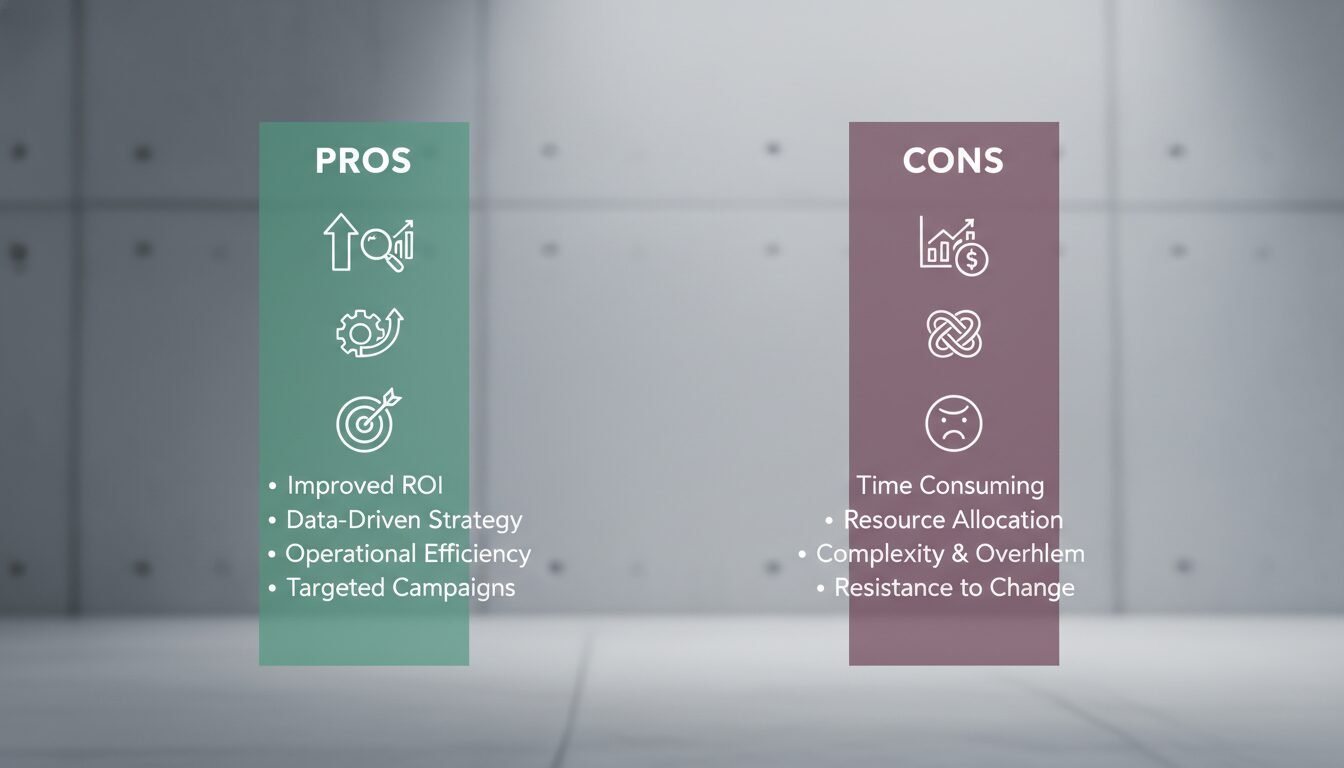
Pros
- Reveals hidden waste: Most businesses discover at least one channel eating budget with little to show for it.
- Aligns team and strategy: A structured audit forces everyone to agree on what success looks like before debating tactics.
- Improves ROI: Redirecting spend from underperformers to high-converting channels typically produces meaningful efficiency gains within one to two quarters.
- Creates a competitive baseline: Benchmarking against 3–5 competitors shows you exactly where you’re losing ground and where you have an edge.
- Supports compliance: Auditing governance and accessibility keeps you on the right side of GDPR, CAN-SPAM, and WCAG 2.1 requirements.
Cons
- Time-intensive: A thorough audit takes 2–4 weeks for most organizations, which can strain small teams.
- Data access challenges: Fragmented tools and siloed platforms make it hard to get a clean, unified data picture.
- Risk of analysis paralysis: Without clear prioritization, a long list of findings can stall action rather than drive it.
- Cost of external expertise: Agency-led audits range from $5,000 to $50,000 depending on scope, which puts comprehensive reviews out of reach for some small businesses.
Step-by-Step Process to Conduct a Digital Marketing Audit
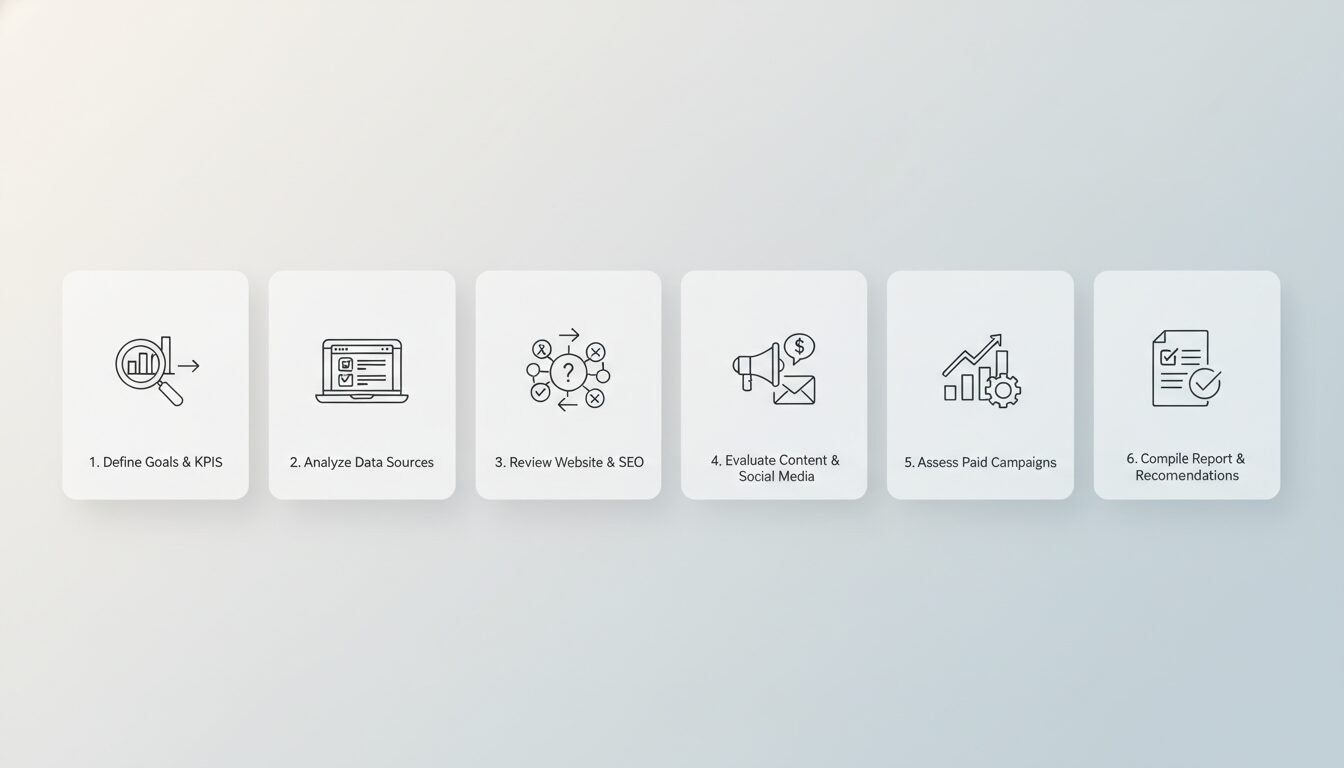
Conducting a marketing audit becomes manageable when you break it into four clear steps. Follow this sequence and you’ll turn raw data into a strategic roadmap, not just another report that sits in a shared drive.
Step 1: Define Clear Objectives and KPIs
Start by establishing what success looks like before you touch a single dashboard. Align your audit goals with overall business objectives, whether that’s increasing revenue, improving lead quality, or reducing cost per acquisition. The HBS this type of audit framework makes this point clearly: measurable objectives are the foundation of any useful audit. Athletic footwear brand OOFOS, for example, set one primary objective (increase revenue) and two supporting goals (build brand awareness and boost sales performance) before pulling any data. Define your KPIs upfront: conversion rate, cost per acquisition, and customer lifetime value are good starting points.
Step 2: Evaluate Current Performance Across Channels
Next, collect and analyze data from every active digital channel. Break performance down by funnel stage: awareness, consideration, and conversion. For awareness, measure organic traffic and unaided brand recall. For consideration, look at time on site and content engagement. For conversion, track lead submissions and closed sales. Tools like Google Analytics 4 (GA4), HubSpot, and Semrush can automate much of the data collection. The key is to quantify volume, quality, value, and cost for each channel so you can clearly see which ones are pulling their weight.
Step 3: Benchmark Against Competitors
A this kind of audit without a competitive review is just an internal report. Use tools like Semrush or Ahrefs to compare your domain authority, keyword rankings, and social engagement against 3–5 key competitors. The Smart Insights RACE model specifically emphasizes benchmarking visits and conversions against industry peers to spot gaps. You might find that a competitor is outranking you on 20+ high-intent keywords simply because they publish more consistently. That’s an actionable finding.
Step 4: Identify Gaps and Prioritize Optimization
The final step is turning your findings into a prioritized action plan. Separate quick wins (fixing broken links, updating underperforming meta tags) from longer-term strategic shifts (reallocating budget from low-converting paid search to high-performing organic content). The Digital Marketing Institute recommends sorting recommendations into immediate, short-term, and long-term buckets. This prevents the common trap of trying to fix everything at once and actually fixing nothing.
Key Areas of a Digital Marketing Audit

A thorough digital marketing drills into each functional area with specific questions and metrics. Here’s what to scrutinize in each one.
Website and SEO Performance
Your website is the foundation of your digital presence. An audit examines technical SEO factors like site speed, crawlability, and mobile optimization, alongside on-page elements like title tags, header structure, and internal linking. Analyze organic traffic trends, keyword rankings, and backlink quality. A healthy domain authority and minimal technical errors correlate strongly with higher search visibility. Use Google Search Console to surface crawl errors and page experience issues, and Semrush to benchmark keyword positions against competitors. Even small fixes, like compressing images to hit Google’s Core Web Vitals thresholds, can produce measurable ranking improvements within 4–8 weeks.
Content Marketing and Engagement
Content drives both SEO and social performance, so it deserves its own audit lane. Assess which pieces generate traffic, produce leads, and earn shares. Prune outdated or thin content, and refresh high-potential evergreen articles with updated data and keywords. The StartupGrind guide points out that a content audit also means checking for broken links and updating CTAs to keep conversion flow intact. A simple content inventory spreadsheet, scoring each asset by traffic, leads, and recency, is often the fastest way to prioritize what to fix first.
Don’t overlook video. As of 2026, video content consistently outperforms static formats on most social platforms in terms of reach and engagement. If your audit finds a library of unoptimized video assets, that’s a quick-win opportunity worth flagging.
Social Media and Paid Media Channels
Social media audits go beyond follower counts. Look at posting frequency, content format performance, hashtag reach, and audience demographics for each platform. For paid media, calculate return on advertising spend (ROAS) and cost per acquisition (CPA) for every active campaign. Are certain ad sets burning through budget with a CPA that’s 3–4x your target? A marketing audit surfaces those inefficiencies so you can reallocate before the next billing cycle. Also review whether your creative formats match platform best practices: vertical video for Instagram Reels, thought-leadership posts for LinkedIn, and so on.
Email Marketing and Automation
Email remains one of the highest-ROI channels in digital marketing, but a neglected list erodes deliverability fast. Audit open rates, click-through rates, list segmentation, and automation workflow performance. Flag inactive subscribers for a re-engagement sequence or removal. Critically, verify compliance with GDPR and CAN-SPAM: confirm you have proper consent records, functioning unsubscribe links, and accurate sender identification in every campaign. Non-compliance carries real financial penalties, not just reputational risk. Tools like DigiMe can consolidate email KPIs into a single dashboard, making this part of the audit significantly faster.
The RACE Framework: A Structured Approach to Digital Audits
The RACE framework, first developed by Dr. Dave Chaffey and Smart Insights, breaks digital marketing into five sequential stages: Plan, Reach, Act, Convert, and Engage. It’s one of the most practical structures available for a digital marketing audit because it maps directly to the customer journey and forces you to evaluate every stage, not just the ones you’re comfortable with.
Plan: Strategy and Resource Audit
Start by evaluating your overall strategy and resources. This means reviewing target personas, SMART objectives, team capabilities, and your marketing technology stack. Many businesses skip this stage entirely, which is exactly where misalignment between goals and execution begins. Ask whether you have a documented strategy, how resources are allocated across channels, and whether there are skill gaps that need training or outside help.
Reach: Media and Traffic Acquisition
Examine how you attract visitors through owned, earned, and paid media. Analyze organic search, paid search, social media, display advertising, and email campaigns using volume, quality, value, and cost metrics. The audit should reveal which channels deliver the highest-quality traffic at the lowest cost. You might find that organic search drives the most conversions but has plateaued, while paid social drives volume at a CPA that’s no longer sustainable. Quantifying these trade-offs is the whole point.
Act and Convert: Lead Nurturing and Sales Funnel
These two stages focus on turning visitors into leads and leads into customers. Audit your landing pages, forms, CTAs, and automation sequences. Benchmark conversion rates and identify where users drop off. Simple fixes, like shortening a form from 8 fields to 4, or clarifying a value proposition above the fold, can produce meaningful conversion lifts without any additional ad spend. Heatmap tools like Hotjar show exactly where users hesitate or abandon pages, giving you specific targets rather than guesses.
Engage: Customer Retention and Advocacy
Post-purchase engagement is where lifetime value is built or lost. Audit your email nurturing sequences, loyalty programs, and social community management. Measure repeat purchase rate and Net Promoter Score (NPS). Businesses that close the feedback loop with customers consistently see lower acquisition costs over time because referrals and repeat business offset paid channel spend. Check whether you have automated post-purchase follow-ups in place and whether customer feedback is actually informing product or service decisions.
Comparison: Digital Audit Components and Key Metrics
The table below summarizes the major components of a digital marketing audit, what to evaluate, key metrics, and tools commonly used. Use it to prioritize efforts and allocate resources where they’ll have the most impact.
| Audit Component | What to Evaluate | Key Metrics | Tools / Platforms |
|---|---|---|---|
| Website and UX | Navigation, design, mobile-friendliness, page speed | Bounce rate, session duration, pages per session, conversion rate | Google Analytics 4, Hotjar, Google PageSpeed Insights |
| SEO | Keyword rankings, backlink profile, on-page optimization, technical health | Organic traffic, domain authority, keyword positions, CTR from SERP | Semrush, Ahrefs, Google Search Console |
| Content Marketing | Blog quality, video engagement, lead magnet performance, content freshness | Page views, average time on page, social shares, leads generated | Google Analytics, BuzzSumo, HubSpot |
| Social Media | Follower growth, engagement, audience demographics, posting consistency | Reach, impressions, engagement rate, click-through rate | Sprout Social, Hootsuite, native platform analytics |
| Paid Advertising | Ad spend allocation, targeting accuracy, creative performance | ROAS, CPA, CTR, conversion rate | Google Ads, Meta Ads Manager, LinkedIn Campaign Manager |
| Email Marketing | List health, segmentation, automation workflows, design | Open rate, click-through rate, unsubscribe rate, conversion rate | Mailchimp, Klaviyo, ActiveCampaign |
Common Pitfalls in Digital Marketing Audits
Even experienced marketers fall into traps that undermine the value of an audit. Recognizing these pitfalls before you start ensures your audit produces real change, not just a polished report.
Focusing Only on Vanity Metrics
Page views and follower counts feel good but rarely correlate with revenue. A digital marketing audit must prioritize metrics tied to business outcomes: conversion rates, cost per lead, and customer lifetime value. According to Smart Insights, assessing volume, quality, value, and cost together prevents over-indexing on numbers that look impressive in a slide deck but don’t move the business forward.
Ignoring Competitor Context
Without external benchmarks, you can’t tell whether your performance is genuinely strong or just mediocre in a weak market. Many companies discover that their organic traffic, while growing month over month, still lags behind competitors who have invested more consistently in content. A competitive review isn’t optional. It’s what separates an internal performance review from an actual audit.
Neglecting Governance and Accessibility
Governance ensures you have the right people, processes, and access controls to sustain digital efforts long-term. Accessibility compliance, specifically WCAG 2.1 standards, is no longer just a best practice. It carries legal weight in many jurisdictions. An audit that skips these areas leaves your organization exposed to compliance risk and operational fragility when key team members leave or platforms change.
Overlooking Data Integration
Most businesses run separate tools for different channels, which creates fragmented views and missed cross-channel insights. A digital marketing audit should assess how well data flows between your CRM, analytics platform, and marketing automation tools. Siloed data leads to inefficient spending and decisions made on incomplete information. A centralized reporting platform like DigiMe can unify audit data and make future analyses significantly faster.
How Often Should You Conduct a Digital Marketing Audit?
Audit frequency should align with your business dynamics and planning cycles, not an arbitrary calendar. Most practitioners find that a comprehensive audit once a year, paired with lighter quarterly check-ins, strikes the right balance between thoroughness and operational reality.
Audit Frequency by Business Size and Industry
Small businesses with stable offerings may need a full digital marketing audit only once a year. E-commerce companies in fast-moving categories should audit at least twice a year. B2B SaaS companies often audit quarterly to keep pace with product launches and shifting buyer behavior. The Digital Marketing Institute advises auditing before each major campaign planning cycle so past learnings directly inform future strategy, rather than being rediscovered six months later.
Triggers for an Urgent Audit
Some events demand an immediate audit regardless of schedule. A sudden drop in organic traffic, a major Google Core Update, a merger or acquisition, or a new competitor entering your market can all erode your digital position quickly. Waiting for the next scheduled review in these situations is a costly mistake. Treat these triggers as a signal to run a focused, channel-specific audit within two to three weeks of the event.
Integrating Audits into Agile Marketing Sprints
As of 2026, agile marketing methodologies are standard practice at most growth-focused organizations. Incorporating a focused micro-audit of one channel per sprint, perhaps email one month and paid search the next, keeps your digital presence continuously optimized without overwhelming your team. This iterative approach also makes the annual comprehensive audit faster, since most channels have already been reviewed in the preceding months.
AI-Powered Digital Marketing Audits in 2026
Artificial intelligence has changed how audits get done. Modern AI tools can ingest data from dozens of sources, identify anomalies, and generate preliminary reports in hours rather than weeks. The manual effort required for a traditional audit drops significantly, freeing your team to focus on interpretation and strategy rather than data wrangling.
“The businesses seeing the strongest ROI from AI in marketing aren’t using it to replace human judgment. They’re using it to process more data faster so human judgment can be applied to better questions.”
– HubSpot State of Marketing Report, 2025
Automating Data Aggregation with AI
Modern audit tools with AI capabilities automatically pull data from Google Analytics, advertising platforms, and social media APIs. They normalize metrics across sources and present unified dashboards that would take a human analyst days to build manually. This eliminates transcription errors and ensures all data points reflect the same time period. Platforms like DigiMe use machine learning to flag underperforming campaigns and surface budget reallocation recommendations without requiring a data science background to interpret them.
Predictive Insights for Smarter Recommendations
Beyond describing what happened, AI can forecast what’s likely to happen next. A digital marketing audit enhanced with predictive analytics might show that a modest increase in SEO investment could yield a meaningful uplift in organic leads within two quarters, based on historical trend data. These forward-looking insights help you prioritize actions by expected return, not just by what feels urgent. That’s a fundamentally different, and more valuable, kind of audit output.
If you want to see how AI-powered auditing works in practice for a dental practice, MedSpa, or HVAC business, our dental marketing page and MedSpa marketing page walk through real-world applications. You can also explore our broader thinking on local business digital marketing in the DigiMe blog.
Ready to stop guessing and start optimizing? Book a free demo at digimeapp.com to see how AI can transform your practice’s marketing performance.
Frequently Asked Questions
What is a digital marketing audit?
A digital marketing audit is a structured, data-driven evaluation of all your digital marketing channels, strategies, and assets. It identifies what’s working, what’s wasting budget, and where your biggest growth opportunities are hiding.
How long does a digital marketing audit take?
A full audit typically takes 2–4 weeks depending on the organization’s size and how accessible the data is. Focused single-channel audits can be completed in a few days, which is why many teams run micro-audits monthly and save the comprehensive review for annual planning cycles.
What tools are best for a digital marketing audit?
Core tools include Google Analytics 4 for web traffic analysis, Semrush or Ahrefs for SEO, Hotjar for UX behavior, and native analytics for social platforms. A centralized dashboard like DigiMe can consolidate data across channels, which significantly reduces the time spent pulling and reconciling reports.
Can I do a digital marketing audit myself?
Yes. Small businesses can run a solid basic audit using free tools and publicly available templates. That said, an external reviewer brings objectivity and pattern recognition from seeing dozens of audits, which often surfaces issues that internal teams are too close to notice.
What is the difference between a digital audit and a digital marketing audit?
A digital audit can cover all digital assets broadly, including IT infrastructure, cybersecurity, and internal systems. A digital marketing audit focuses specifically on marketing-related activities: advertising, content, social media, email, SEO, and the customer acquisition funnel.
How much does a digital marketing audit cost?
Costs vary widely based on scope. A basic audit using free tools can be done in-house at no direct cost beyond staff time. Comprehensive agency-led audits typically range from $5,000 to $50,000 depending on the number of channels, data complexity, and deliverable depth.