Key Takeaways
- Web marketing uses internet channels like search, social, and email to promote a business, attract visitors, and boost sales.
- It includes search engine optimization (SEO), pay-per-click (PPC) ads, content creation, and more, each serving a distinct role in the customer journey.
- A data-driven web marketing strategy reduces waste, targets the right audience, and can lower customer acquisition costs compared to traditional advertising.
- Businesses that adopt a balanced mix of organic and paid tactics see stronger long-term growth, with search engines being a primary discovery channel for new brands.
- The 70-20-10 rule helps allocate resources wisely: 70% on proven tactics, 20% on promising new channels, and 10% on experimental ideas.
What Is Web Marketing?

Web marketing is the promotion of products, services, or brands using internet-based channels to attract and convert online customers.
At its core, marketing is about meeting your audience where they already spend time, online. Whether someone is searching Google for a solution, scrolling through Instagram, or checking their inbox, your brand can show up with a relevant message. This form of marketing has evolved rapidly, and today it encompasses everything from influencer partnerships to programmatic ad buying. The goal remains consistent: drive meaningful actions, from a website click to a completed purchase.
“these marketing is the process of marketing your business online, and it’s a cost-effective way to reach people who are most interested in your business.”
, WebFX
The Evolution of Web Marketing
such marketing began in the 1990s with simple banner ads and email blasts. As internet access expanded, so did the tools, from search engine ads to sophisticated retargeting based on user behavior. By 2026, artificial intelligence and machine learning have made personalization scalable, allowing even small businesses to deliver one-to-one messaging. Yet the fundamental principles of knowing your audience and crafting compelling offers remain unchanged.
Why Choose Web Marketing Over Traditional Methods?
Traditional advertising, TV, radio, print, reaches a broad audience but lacks precise targeting. web, by contrast, enables granular targeting by demographics, interests, and online behavior. It also offers real-time analytics so you can measure exactly what’s working and adjust on the fly. For most businesses, this leads to a higher return on ad spend (ROAS) and the ability to scale campaigns quickly without huge upfront costs.
The Importance of Web Marketing for Modern Businesses

With over 5.4 billion people using the internet globally, ignoring marketing means forfeiting access to the world’s largest marketplace. But beyond sheer reach, these marketing levels the playing field: a well-optimized website can compete with industry giants for the same search rankings. It also supports the modern buyer’s journey, most consumers research online before making a purchase, often across multiple devices and platforms.
Cost Efficiency and Measurable ROI
One of the strongest arguments for such marketing is its cost efficiency. While traditional media buys often require large minimum spends, digital channels let you start with as little as $5 a day and scale based on performance. Tools like Google Analytics and CRM integrations allow you to track customer acquisition cost (CAC) and lifetime value (LTV) with precision, making every dollar accountable.
“Search engines are a primary way consumers discover new brands, making your website presence critical for growth.”
, Based on industry research from leading marketing platforms
Building Brand Authority and Trust
Consumers trust brands that appear at the top of search results, produce helpful content, and maintain an active social presence. web allows you to demonstrate expertise through educational blog posts, case studies, and video tutorials. Over time, this builds authority that translates into higher conversion rates and customer loyalty.
Core Components and Types of Web Marketing
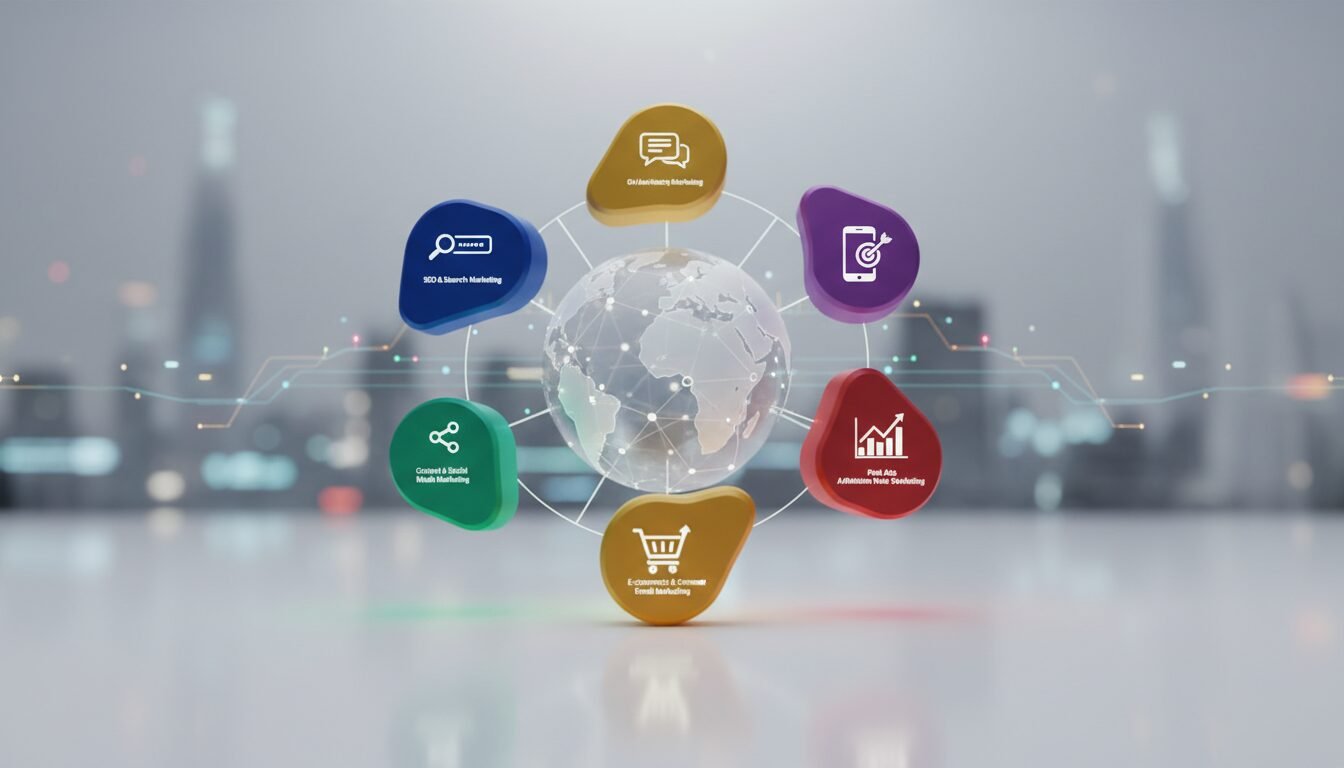
marketing is not a single tactic but a collection of interconnected disciplines. Understanding the main categories helps you allocate resources where they’ll have the most impact.
Search Engine Optimization (SEO)
SEO is the practice of optimizing a website to rank higher in organic search results. Given that Google processes billions of searches each day, appearing on page one for relevant queries is critical. This involves on-page factors like keyword optimization and technical aspects like site speed, as well as off-page signals such as backlinks. Effective SEO delivers long-term, sustainable traffic.
Pay-Per-Click (PPC) Advertising
PPC allows businesses to bid on keywords and display ads at the top of search results or on other websites. You pay only when someone clicks. Platforms like Google Ads and Microsoft Advertising offer robust targeting options, from location to device to time of day. PPC is particularly useful for driving immediate traffic, testing new markets, and promoting time-sensitive offers.
Content Marketing
Content marketing focuses on creating and distributing valuable, relevant content to attract a clearly defined audience. Blog posts, ebooks, videos, and infographics all fall under this umbrella. The key is to provide genuine value rather than a sales pitch. When done right, content marketing fuels SEO, social media, and email campaigns while positioning your brand as a helpful resource.
Email Marketing
Email remains one of the highest-converting these marketing channels, with a measurable ROI that consistently outperforms many other tactics. Automated sequences welcome new subscribers, nurture leads, and re-engage past customers. Personalization, such as sending product recommendations based on past purchases, significantly boosts open and click-through rates.
Social Media Marketing
Platforms like Facebook, Instagram, LinkedIn, and TikTok allow you to build communities, share content, and run highly targeted ad campaigns. Social media marketing merges brand awareness with direct response; for example, shoppable posts let users buy without ever leaving the app. Success here hinges on consistency, authentic engagement, and understanding each platform’s unique audience.
How to Build a Winning Web Marketing Strategy

Random acts of marketing rarely deliver results. Follow a structured framework to move from scattered efforts to a unified plan that grows your business.
Step 1: Define Clear Objectives and KPIs
Start by identifying what you want to achieve, more website traffic, higher sales, greater brand awareness, and choose key performance indicators (KPIs) that align with those goals. Examples include organic sessions, conversion rate, cost per lead, and customer lifetime value. Specific, measurable objectives make it easier to track progress and justify budget.
Step 2: Research Your Target Audience
Develop detailed buyer personas based on demographics, online behavior, and pain points. Use tools like Google Analytics, social media insights, and customer surveys to understand what triggers a purchase. The better you know your audience, the more precisely you can tailor such marketing messages and channel selection.
Step 3: Choose the Right Mix of Channels
No single channel works for every business. An e‑commerce store might prioritize SEO, PPC, and Instagram ads; a B2B software company could lean on LinkedIn, webinar content, and email nurturing. Apply the 70-20-10 rule: allocate 70% of your budget to proven channels, 20% to promising newer channels, and 10% for experimentation. This balances stability with growth.
Step 4: Create Valuable, Optimized Content
Content is the engine that powers modern web. Develop assets that address each stage of the buyer’s journey: awareness (blog posts, infographics), consideration (comparison guides, webinars), and decision (case studies, free trials). Ensure every piece is optimized for search by including relevant keywords, internal links, and compelling calls to action.
Step 5: Launch, Measure, and Iterate
Deploy your campaigns with proper tracking in place. Monitor KPIs weekly, and run A/B tests on headlines, ad creatives, and landing pages. marketing thrives on continuous improvement, small tweaks, like adjusting a button color or email subject line, can improve conversions over time.
Comparing Web Marketing Channels: A Quick Reference
| Channel | Description | Best For | Typical Cost/Time to Results |
|---|---|---|---|
| SEO | Improving organic search rankings through on‑page, off‑page, and technical optimizations | Long‑term traffic growth, building authority | Low–medium investment; 3–6 months to see traction |
| PPC | Paid ads on search engines and partner sites, charged per click | Immediate traffic, product launches, competitive niches | Variable (CPC); results in days |
| Content Marketing | Creating blogs, videos, guides to attract and educate audiences | Brand building, lead nurturing, SEO support | Time‑intensive; consistent effort needed for 6+ months |
| Email Marketing | Targeted campaigns to subscribers and past customers | Retention, promotions, personalized offers | Low cost; can generate quick returns if list exists |
| Social Media | Organic posting and paid ads on platforms like Instagram, LinkedIn, TikTok | Community engagement, visual storytelling, brand awareness | Low to high; organic growth takes months, ads scale quickly |
Key Performance Indicators for Web Marketing Success
Measuring what matters separates guesswork from strategy. Focus on a blend of leading and lagging indicators to gauge both immediate efforts and long‑term outcomes.
Traffic Metrics
Monitor total sessions, unique visitors, and traffic sources (organic, paid, social, direct). A healthy these marketing mix usually shows a diverse traffic profile, reducing dependency on any single channel. Look for trends over time rather than daily fluctuations.
Engagement and Conversion Metrics
Bounce rate, average session duration, and pages per visit signal whether visitors find your content useful. Conversion rate, whether it’s a form fill, download, or purchase, directly ties marketing to revenue. Tools like Google Analytics 4 and CRM dashboards make these metrics accessible even for solo marketers.
Return on Investment (ROI)
Calculate ROI by comparing the cost of your such marketing campaigns to the revenue they generate. For e‑commerce, this is straightforward with sales data; for lead‑based businesses, you’ll need to track lead‑to‑customer conversion rates and average deal size. A positive ROI justifies scaling; a negative one signals the need for optimization.
Pros and Cons
Pros
- Precise targeting based on demographics, interests, and behavior
- Real-time performance tracking and optimization capabilities
- Lower barrier to entry compared to traditional advertising
- Scalable campaigns that can grow with your business
- Global reach with 24/7 availability
Cons
- Requires ongoing time investment and skill development
- Algorithm changes can impact campaign performance
- High competition in popular niches drives up costs
- Results can take months to materialize for organic strategies
- Privacy regulations increasingly limit targeting options
Web Marketing vs. Digital Marketing: What’s the Difference?
Many people use these terms interchangeably, but there are subtle distinctions. web specifically refers to promotion conducted through a website or via browser‑based activities. Digital marketing is broader, it includes web marketing plus channels like mobile apps, SMS, digital billboards, and even in‑game advertising. In practice, the lines are blurring, and most strategies combine both.
When the Distinction Matters
If your primary goal is to drive traffic to a website or optimize on‑site conversions, focusing on web marketing is sufficient. But if you’re running a multi‑channel campaign that also includes app‑based promotions, SMS alerts, or digital TV, a digital marketing umbrella strategy ensures consistency.
Common Web Marketing Mistakes to Avoid
Even experienced marketers can fall into traps. Being aware of the most frequent missteps can save time and budget.
Ignoring Mobile Optimization
With mobile devices accounting for over half of global web traffic, a site that isn’t mobile‑friendly will frustrate visitors and suffer in search rankings. Google’s mobile‑first indexing means your mobile experience directly impacts SEO. Test your site on various devices and simplify navigation, reduce pop‑ups, and ensure fast loading speeds.
Neglecting Data Analysis
Web marketing offers a wealth of data, but many businesses fail to look beyond vanity metrics like “likes.” Regularly review conversion paths, attribution models, and customer lifetime value. Data‑free decisions lead to wasted ad spend and missed opportunities.
Using a “Set It and Forget It” Approach
Algorithms change, consumer behaviors shift, and competitors adapt. A campaign that worked six months ago may be stale today. Schedule monthly audits of your web marketing performance, update outdated content, and test new ad formats to stay ahead.
Ready to transform your marketing results? Book a free demo at digimeapp.com to see how AI can streamline your web marketing efforts and drive measurable growth for your business.
Frequently Asked Questions
What is web marketing in simple words?
Web marketing is promoting your business using online tools like websites, search engines, social media, and email. It helps you reach customers who are already looking for what you offer.
How is web marketing different from traditional marketing?
Traditional marketing uses offline channels (TV, radio, print) and often targets a broad audience. Web marketing reaches specific audiences online, offers real-time performance data, and is typically more cost-efficient.
What are the most effective web marketing strategies?
The most effective strategies combine SEO for long-term traffic, PPC for quick wins, content marketing to build authority, email for nurturing leads, and social media for engagement. The right mix depends on your audience and goals.
How much does web marketing cost?
Costs vary widely, from free organic efforts like SEO to paid ads starting at a few dollars a day. A small business might spend $500–$5,000 per month on web marketing, while larger companies invest tens of thousands. ROI should always guide spending.
Can I do web marketing without a website?
Technically yes, you can use social media profiles, email campaigns, or third-party platforms like Amazon or Etsy. However, owning a website gives you control over your brand, customer data, and conversion optimization, making it highly recommended.
Do I need to hire a web marketing agency?
It depends on your resources and expertise. Many small businesses start with DIY tools, but an experienced agency or consultant can accelerate results, avoid costly mistakes, and free up your time for other business priorities.