Positions in digital marketing are specialized job roles within the online marketing field, spanning from entry-level coordinators to executive leadership positions. We’ve analyzed thousands of current job listings to show you what’s really available, what companies pay, and how to build a career that survives industry changes.
Key Takeaways
- Digital marketing roles span creative, technical, and strategic functions, choose from SEO, social media, content marketing, PPC, and more.
- The global digital marketing market is projected to reach $1.1 trillion by 2032, fueling demand for specialized talent (Digital Marketing Institute).
- In New York alone, over 11,000 digital marketing jobs are currently listed on platforms like LinkedIn.
- Entry-level specialists can earn $48,000–$60,000, while senior managers command $116,000–$135,000 or more, based on recent DigitalMarketingJobs.com listings.
- AI and automation are creating brand-new roles, AI marketing specialist and prompt engineer are among the fastest-growing titles.
What Are the Different Types of Digital Marketing Positions?

Digital marketing breaks down into distinct specializations, each demanding a unique blend of creative, analytical, and technical skills. Understanding these categories helps you choose the right career trajectory for your interests and strengths.
Marketing Specializations
These roles form the backbone of any digital team, responsible for executing specific channels or content types. A social media manager crafts platform-specific content and grows community engagement. An SEO specialist optimizes websites to rank higher in search engines and drives organic traffic. A PPC (pay-per-click) specialist manages paid advertising campaigns on Google Ads and social media platforms. A content marketing manager plans and creates blogs, ebooks, and videos that attract and convert audiences. An email marketing specialist designs automated email campaigns to nurture leads through the sales funnel.
Management and Leadership Roles
Above the specialists, these roles evolve into supervisory and strategic responsibilities. A digital marketing manager oversees all online channels, sets KPIs, and manages a team of specialists. A director of digital marketing defines the overall digital vision and aligns marketing goals with business objectives. At the executive level, a VP of digital marketing or chief marketing officer (CMO) leads company-wide marketing transformation. These roles blend deep industry knowledge with people management and budgeting skills.
Emerging and Hybrid Roles
The industry is rapidly shifting, giving rise to roles that didn’t exist five years ago. An AI marketing specialist uses machine learning tools to personalize customer experiences at scale. A marketing technologist bridges the gap between marketing and IT, managing the ever-growing stack of martech tools. A growth product marketing lead combines product management with growth hacking to accelerate user acquisition, a role increasingly common at tech companies like Tinder and Google. These hybrid roles command top salaries and are reshaping team structures.
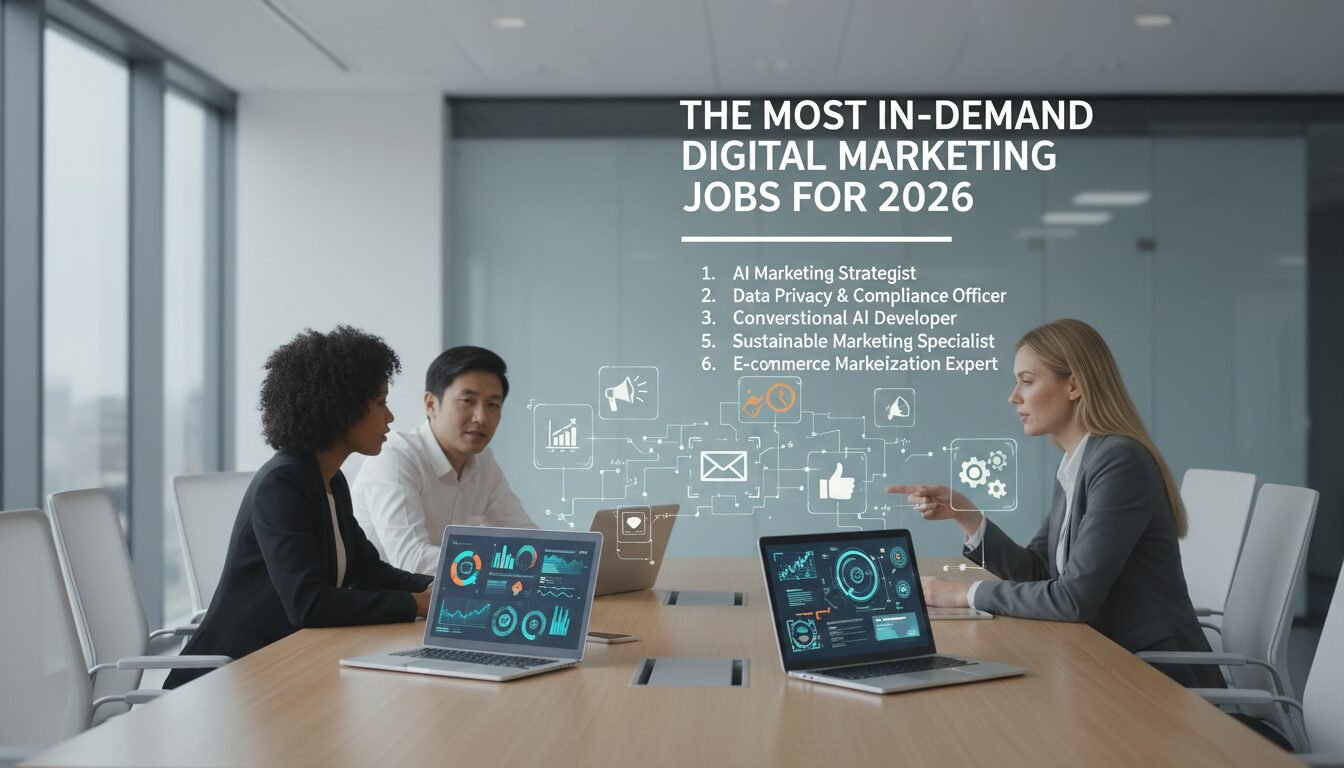
The Most In-Demand Digital Marketing Jobs for 2026
Current Market Data
“Over 11,000 digital marketing jobs are currently listed in New York alone, signaling immense demand across all verticals.”
Analysis of current job boards shows that social media managers, SEO specialists, and digital marketing managers consistently top the charts. Companies like Netflix, Google, and Cartier frequently advertise openings for these profiles. Remote and hybrid options have expanded the talent pool, making geographic location less of a barrier than it was three years ago.
Growth Areas: AI, Automation, and Analytics
The fastest-growing segment is AI-related roles. An AI content strategist not only generates copy but also trains AI models on brand voice. A marketing data analyst translates campaign performance into actionable insights. With the global digital marketing market expected to hit $1.1 trillion by 2032 (Digital Marketing Institute), professionals who can use AI to optimize spend and personalize messaging will be indispensable.
The Rise of the T-Shaped Marketer
Employers increasingly value a “T-shaped” skill profile, broad knowledge across digital marketing domains combined with deep expertise in one or two areas. For example, a content marketer who also understands basic SEO and data analytics is far more effective than a pure writer. This convergence of skills makes candidates more versatile and is a key differentiator in competitive job markets like New York City.
Skills That Make Candidates Stand Out

Technical Skills: SEO, Analytics, CRM
Nearly every role now requires at least a foundational understanding of search engine optimization (SEO), Google Analytics 4, and customer relationship management (CRM) platforms like Salesforce or HubSpot. For paid media roles, proficiency in Google Ads and Meta Ads Manager is mandatory. Email marketing specialists need hands-on experience with platforms like Mailchimp or Klaviyo. As marketing technology stacks grow, the ability to quickly learn new tools becomes a career advantage.
Soft Skills: Creativity, Communication, Adaptability
Technical know-how alone isn’t enough. Creativity is essential for developing compelling campaigns, while strong communication skills ensure alignment with cross-functional teams. Adaptability has become critical as algorithms change overnight and new platforms emerge. Employers often cite a candidate’s ability to tell a data-driven story as a deciding factor during interviews.
Certifications and Continuous Learning
Certifications carry significant weight in hiring decisions. The Google Analytics Individual Qualification, Meta Certified Digital Marketing Associate, and HubSpot Content Marketing Certification are among the most recognized. Platforms like Digital Marketing Institute and Coursera offer specialized programs that align with industry needs. A commitment to continuous learning is expected, as the half-life of digital marketing skills is shrinking due to rapid technological change.
Salary Ranges and Career Growth Prospects

Entry-Level Jobs and Expected Pay
For newcomers, roles typically start with titles like digital marketing coordinator or social media assistant. According to recent job postings on DigitalMarketingJobs.com, these roles offer between $48,000 and $60,000 per year in the New York area. Internships, often titled digital marketing intern, provide a foot in the door and can lead to full-time offers within 6-12 months.
Mid-Level and Senior Role Compensation
With 3–5 years of experience, professionals can step into manager-level roles. A digital marketing manager in New York commands a salary range of $116,000 to $135,000, while a social media manager can earn $75,000 to $85,000. At the senior end, a VP of social media strategy or a director of product marketing can exceed $200,000, especially at tech giants like Netflix and Google.
Comparison of Popular Digital Marketing Jobs and Salaries
| Position | Salary Range (USD, NYC) | Experience Level | Key Skill |
|---|---|---|---|
| Digital Marketing Specialist | $48,000 – $60,000 | Entry-Level | Multi-channel execution |
| Social Media Manager | $75,000 – $85,000 | Mid-Level | Content strategy & community |
| SEO Specialist | $65,000 – $90,000 | Mid-Level | On-page & off-page optimization |
| Digital Marketing Manager | $116,000 – $135,000 | Senior | Team leadership & analytics |
| VP, Social Media Strategy | $150,000 – $160,000+ | Executive | Brand vision & crisis mgmt |
Data sourced from recent New York listings on DigitalMarketingJobs.com and similar platforms.
How AI Is Redefining Digital Marketing Careers
Automation of Routine Tasks
AI-powered tools now handle many repetitive marketing tasks, automating email flows, generating ad copy variants, and even scheduling social media posts. This shift frees up human talent for higher-order strategic work. According to Digital Marketing Institute, companies that use generative AI report significant improvement in campaign efficiency, allowing teams to reallocate hours to creativity and testing.
New Job Titles: AI Content Strategist, Prompt Engineer
As AI matures, entirely new roles are emerging. An AI content strategist oversees AI-generated material, ensuring brand consistency and factual accuracy. A prompt engineer designs the queries that produce high-quality AI outputs, a skill quickly becoming a standalone career. Even traditional roles are being augmented, SEO specialists now use AI for topic clustering and content gap analysis.
The Need for Human Oversight and Strategy
“AI won’t replace digital marketers; it will replace marketers who don’t know how to use AI.”
The human element, understanding cultural nuances, ethical boundaries, and emotional storytelling, remains irreplaceable. Companies actively seek professionals who can interpret AI-generated data and apply it to high-stakes strategic decisions. The future belongs to hybrid marketers who pair domain expertise with AI fluency.
Pros and Cons of Digital Marketing Careers
Pros
- High demand and job security , Digital marketing roles are growing faster than traditional marketing positions
- Remote work flexibility , Many roles offer hybrid or fully remote arrangements
- Competitive salaries , Entry-level roles start around $48K, with senior positions exceeding $200K
- Diverse career paths , Multiple specializations allow you to find your niche
- Continuous learning opportunities , The field evolves rapidly, keeping work interesting
Cons
- Constant change and pressure to upskill , Algorithms and platforms change frequently
- High-stress environment , Campaign performance directly impacts revenue, creating pressure
- Oversaturated entry-level market , Competition for junior roles can be intense
- Work-life balance challenges , Social media and campaigns don’t follow 9-to-5 schedules
Freelance, Remote, and In-House: Choosing Your Work Environment
The Growth of Remote and Hybrid Options
The pandemic permanently altered work models. Today, many roles offer remote or hybrid arrangements. Listings for social media content creator (hybrid from NY) and digital marketing manager (remote) are routine. This flexibility has expanded the talent market, allowing professionals to work for top-tier brands without relocating. Platforms like Built In NYC and DigitalMarketingJobs.com prominently highlight remote-friendly options.
Freelancing vs. Full-Time Employment
Freelancing is a legitimate career path. Independent consultants often specialize in high-demand niches like paid media strategy or conversion rate optimization. While freelancing offers schedule autonomy and unlimited earning potential, it also demands entrepreneurial skills like client acquisition and financial management. Conversely, in-house roles provide stability, benefits, and deeper involvement in a brand’s long-term vision.
Geographic Hotspots and Remote Flexibility
Though New York, San Francisco, and London remain hubs, remote work has leveled the playing field. A social media manager in Iowa can now manage campaigns for a brand headquartered in Manhattan. However, some executive and networking-intensive roles still favor urban centers. The key is to align your preferred lifestyle with the expectations of the specific role you target.
Building a Resilient Career in Digital Marketing
Networking and Personal Branding
Your online presence is your résumé. Maintaining an updated LinkedIn profile, sharing thought-leadership content, and engaging with industry communities (like Digital Marketing Institute‘s network or local American Marketing Association chapters) can open doors. Many hiring managers actively search for passive candidates who demonstrate expertise through personal projects or a strong portfolio.
Staying Current with Industry Trends
The only constant in digital marketing is change. Subscribe to trusted resources, blogs from Moz for SEO, Social Media Examiner for social media, and Marketing Brew for daily news. Attend webinars and virtual conferences like INBOUND or Content Marketing World. Continuous education protects your career from obsolescence and prepares you for the next wave of opportunities.
Transitioning to Leadership Roles
Moving from specialist to head of department requires more than just tenure. It demands a shift in mindset: from executing tasks to building systems, mentoring teams, and speaking the language of revenue. Formal training, such as the Digital Management and Leadership track from Digital Marketing Institute, can accelerate this transition. Start by volunteering to lead cross-functional projects, and prove you can drive results beyond your own channel.
As the digital economy expands, the variety and complexity of these roles will only grow. Whether you’re launching your career as a content creator or steering global strategy as a CMO, continuous growth and adaptability will define your success. The roles are abundant, the salaries are competitive, and the opportunity is genuinely global, now is the time to step confidently into this dynamic field.
Book a free demo at digimeapp.com to see how AI can transform your practice.
Frequently Asked Questions
What are the highest paying positions in digital marketing?
Senior management roles like VP of Digital Marketing, Director of Growth, and Chief Marketing Officer top the salary charts, often exceeding $200,000 per year. Highly specialized roles, such as AI Marketing Specialist or Product Marketing Manager at large tech firms, also command premium compensation due to their niche expertise and direct impact on revenue.
Do I need a degree for a digital marketing position?
While a marketing or communications degree is helpful, many employers now prioritize practical skills and certifications. A strong portfolio with demonstrable results, combined with Google or Meta certifications, can effectively substitute for a formal degree in most entry- and mid-level roles.
What is the difference between a digital marketing specialist and a manager?
A specialist focuses on executing tasks within a specific channel (e.g., SEO, paid ads), while a manager oversees strategy, coordinates across channels, and leads a team. Managers typically have broader business acumen and are accountable for KPIs and budget.
How can AI skills help in a digital marketing career?
AI proficiency allows marketers to automate routine tasks, personalize customer journeys at scale, and extract deeper insights from data. It’s increasingly a baseline expectation; job descriptions now commonly list “experience with AI tools” as a requirement.
Are remote digital marketing jobs here to stay?
Yes. The widespread adoption of collaboration tools and cloud-based marketing software has made remote work feasible and productive. While some companies have returned to office, remote and hybrid arrangements remain prevalent, especially for individual contributor roles.
What is the typical career progression in digital marketing?
Career paths often start with an internship or coordinator role, progress to specialist, then manager, followed by director or head of department. Some professionals branch into consulting or start their own agencies after gaining deep expertise.