Digital marketing packages are bundled service plans combining SEO, PPC, social media, content, and email into one coordinated strategy. Prices range from $1,000 to over $50,000 per month based on scope and agency expertise.
Key Takeaways
- marketing packages combine SEO, PPC, social, content, and email into one integrated plan for cohesive online growth.
- Pricing varies widely: from $1,000/month for basic services to over $50,000/month for enterprise solutions, with options in between.
- Bundled packages often include a discount compared to purchasing services individually, saving businesses 5% to 15% on average.
- AI-powered tools are increasingly standard in modern packages, with the market projected to surpass $107 billion by 2028.
- The right package depends on your business stage, budget, and growth goals, not just the price tag.
What Are Digital Marketing Packages?

A digital marketing package is a bundled set of professional marketing services designed to help businesses increase their online presence, attract leads, and drive sales. Instead of hiring separate specialists for search engine optimization, paid ads, social media, content creation, and email automation, companies purchase one coordinated solution. These packages are also called marketing bundles or all-in-one marketing plans.
According to Clutch data from digital marketing firms, monthly retainers for such services span from $5,000 to $50,000, though smaller entry-level plans start around $1,000. The exact scope depends on the number of channels managed, the depth of strategy, and the agency’s expertise.
Why Businesses Prefer Service Bundles
Bundled this type of packages offer cost savings of 5–15% compared to purchasing each service individually. They also provide time efficiency, as a dedicated team manages all aspects, freeing business owners to focus on operations. Consistency across channels is another hallmark: one strategy guides SEO, social, and paid ads so the brand voice stays uniform. Packages are also scalable, letting a company start with a basic plan and upgrade as it grows.
Common Misconceptions About These Packages
Many business owners assume a single “standard” package works for everyone, but no one-size-fits-all solution exists. Another misconception is that all packages produce overnight results. In reality, SEO efforts typically require 3–6 months to show significant organic traffic gains, while paid campaigns can generate leads within days. Some also believe low-cost DIY tools deliver the same outcome, yet they lack the strategic oversight and customization that agencies provide.
Why Businesses Choose Bundled Marketing Plans

Integrated this kind of packages solve a critical pain point: fragmented marketing. When different vendors handle SEO, social, and ads in isolation, strategies often conflict, wasting budget and diluting impact. A unified package ensures all channels work toward the same key performance indicators (KPIs).
From a financial perspective, assembling an in-house team to replicate a full-service package is expensive. Building out a complete internal marketing department, including strategists, copywriters, paid media specialists, and analysts, can run well over $500,000 annually in salaries and benefits alone. Outsourcing to an agency converts that fixed overhead into a predictable, lower monthly expense.
“The businesses that grow fastest aren’t the ones spending the most on marketing. They’re the ones with the most coordinated strategy. A single integrated package beats five disconnected vendors every time.” – DigiMe Advisory Team
The Efficiency of a Single Point of Contact
A dedicated account manager serves as the single point of contact, streamlining communication. Rather than chasing multiple freelancers, businesses receive consolidated monthly performance reports covering all channels. This saves time and provides a complete view of marketing ROI.
How Packages Align with Business Growth Stages
Startups may begin with a budget-friendly plan focused on local SEO and social media, while scaling companies often need advanced conversion rate optimization (CRO) and paid advertising. Enterprise packages add features like dedicated account-based marketing (ABM) and AI-driven analytics. This tiered approach lets businesses evolve their marketing without switching providers.
Pros and Cons of Digital Marketing Packages
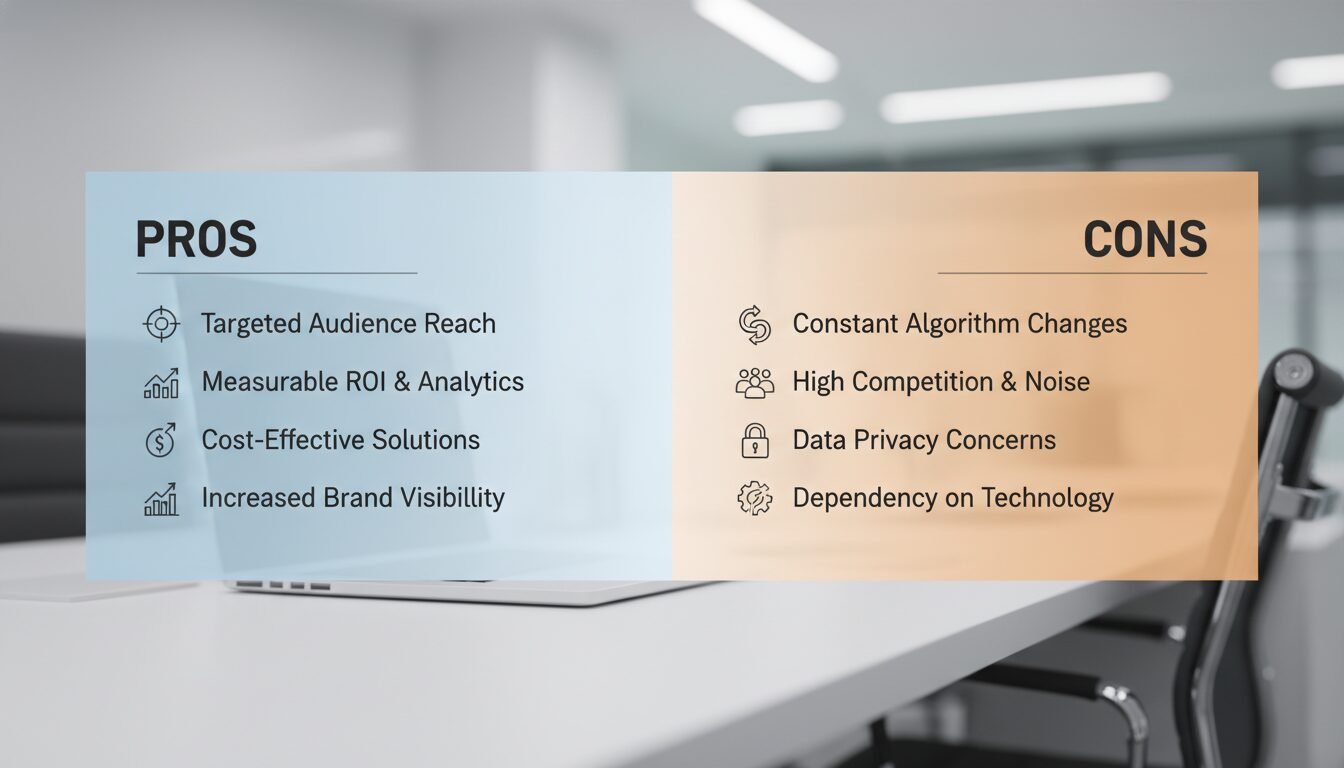
Digital marketing packages offer real advantages for most local service businesses, but they’re not the right fit for every situation. Here’s an honest look at both sides.
Pros
- Cost efficiency: Bundled pricing typically saves 5–15% versus buying services separately, and eliminates the overhead of building an in-house team.
- Coordinated strategy: One team manages SEO, paid ads, social, and email together, so every channel reinforces the others instead of pulling in different directions.
- Scalability: Most agencies offer tiered plans, so you can start small and add services as your revenue grows, without switching providers.
- Access to specialized tools: Agencies bring platforms like SEMrush, HubSpot, and Google Analytics 4 to the table, tools that would cost thousands per month to license independently.
- Faster results from PPC: Paid advertising components can generate qualified leads within days, giving you quick wins while SEO builds long-term momentum.
Cons
- Upfront cost: Quality digital marketing packages start around $2,000–$5,000/month, which can feel steep for early-stage businesses with tight cash flow.
- Results take time: SEO components typically require 3–6 months before delivering measurable organic traffic gains. Patience is required.
- Variable quality: Not all agencies deliver equal value at the same price point. Vetting providers thoroughly is essential before signing any agreement.
- Potential for lock-in: Some agencies require 6–12 month contracts. If the relationship isn’t working, exiting early can be costly.
SEO Services Inside Digital Marketing Packages

SEO is the foundation of most digital marketing packages. It covers strategies to improve a website’s visibility in organic search results on engines like Google and Bing. Without SEO, even a well-designed site stays invisible to potential customers.
A typical SEO component includes keyword research and strategy, on-page optimization (title tags, meta descriptions, content optimization, image alt texts), technical SEO (site speed, mobile responsiveness, structured data), and off-page efforts like link building and local citations. For brick-and-mortar businesses, local SEO, including optimizing Google Business Profile and managing directory listings, is especially critical.
On-Page and Technical SEO Breakdown
On-page SEO ensures each piece of content is fine-tuned for target keywords. Technical SEO goes deeper, fixing crawl errors, improving Core Web Vitals, and implementing schema markup so search engines better understand the site. Many packages now include GEO (Generative Engine Optimization) to optimize for AI-driven search results, a practice that a growing majority of businesses are actively planning to adopt, according to industry forecasts.
Measuring SEO Success
Key metrics in monthly reports include organic traffic growth, keyword ranking improvements, and domain authority (DA). Reliable agencies also track conversion rates from organic visits, proving that SEO contributes directly to revenue, not just visibility.
Paid Advertising and Social Media in Packages
While SEO builds long-term momentum, pay-per-click (PPC) advertising delivers immediate traffic. PPC models like Google Ads charge only when users click, making them cost-effective for testing campaigns quickly. Social media marketing combines organic community building with paid ad strategies across platforms like Facebook, Instagram, LinkedIn, and TikTok.
PPC services within a package typically include account setup and campaign structure, keyword bidding and management, landing page optimization, and retargeting campaigns to recapture visitors who didn’t convert. Mid-range digital marketing packages generally allocate a dedicated budget for PPC alongside organic social media management.
Integrating Organic and Paid Social Media
Organic social posting builds brand trust and engagement, while paid social ads amplify reach to targeted demographics. A complete package handles content creation (images, videos, copy), community management (responding to comments and messages), and influencer outreach where relevant. A/B testing of ad creatives is standard practice to improve click-through and conversion rates.
Tracking ROI Across Channels
Advanced data tracking uses UTM parameters and pixel installations to attribute sales to specific campaigns. Monthly reports break down cost-per-click (CPC), return on ad spend (ROAS), and conversion path analysis. This transparency ensures businesses know exactly which channels drive the most value.
Content Marketing, Email, and Conversion Optimization
Content marketing powers both SEO and social media by providing valuable, educational material that attracts and nurtures prospects. Email marketing retains existing customers through segmented, automated sequences. Conversion rate optimization (CRO) ties everything together by ensuring website visitors take desired actions, whether filling a form, making a purchase, or booking a consultation.
Common content services include blog writing optimized for target keywords, video production for YouTube and social, case studies and white papers, and infographics. Content is planned in an editorial calendar that aligns with product launches and seasonal trends.
Email Automation That Drives Revenue
Email marketing remains one of the highest-ROI channels available to local service businesses. Packages often set up drip campaigns for new subscribers, abandoned cart sequences for e-commerce, and re-engagement series for inactive users. Segmentation by purchase history or behavior increases relevance, and A/B testing of subject lines and CTA buttons refines performance over time.
Conversion Rate Optimization: The Revenue Accelerator
CRO audits the entire user journey, from landing page design to checkout flow. Techniques include heatmap analysis to see where users click, A/B testing of page elements, and form length optimization. Even a modest improvement in conversion rate can significantly boost revenue without increasing ad spend.
Industry-Specific Digital Marketing Packages
The best digital marketing packages aren’t generic. They’re built around the specific customer journey, compliance requirements, and competitive dynamics of your industry. A dental practice has very different needs than an e-commerce retailer or a personal injury law firm.
Healthcare and Dental Practices
For dental and medical practices, digital marketing packages typically prioritize local SEO, Google Business Profile management, and reputation management. Patient reviews on Google and Healthgrades directly influence appointment volume. Packages for healthcare providers must also account for HIPAA-compliant email marketing and landing page design. At DigiMe, we’ve seen dental practices add 20–40 new patient inquiries per month by combining local SEO with automated review request campaigns. You can explore our dental marketing solutions to see what a purpose-built package looks like for practices.
MedSpa and Aesthetic Clinics
MedSpa businesses compete heavily on visual content and social proof. Effective digital marketing packages for this segment lean on Instagram and TikTok content creation, before-and-after photo campaigns, and paid social ads targeting local demographics. Email automation for appointment reminders and seasonal promotions also drives strong repeat bookings. Our MedSpa marketing platform is built specifically for this workflow.
HVAC, Legal, and Other Local Services
HVAC companies benefit most from Google Local Services Ads combined with seasonal SEO content, targeting searches like “AC repair near me” during summer peaks. Law firms, operating in one of the highest cost-per-click categories on Google Ads, need packages that balance paid search with strong organic content to control acquisition costs. E-commerce businesses require a different mix entirely: product feed optimization, Google Shopping campaigns, and abandoned cart email sequences take priority over local SEO.
“Industry-specific packages outperform generic ones because the keyword strategy, ad targeting, and content topics are all calibrated to how real buyers in that industry actually search and decide.” – DigiMe Advisory Team
Digital Marketing Package Pricing: A Detailed Breakdown
Understanding the cost of digital marketing packages requires examining not just the sticker price but what’s included at each tier. The table below compares real-world offerings from four distinct providers, illustrating the range from DIY tools to premium agency solutions.
| Provider | Package Name | Price/Month | Key Services | Notable Features |
|---|---|---|---|---|
| Citypeak Marketing | BASE | $2,350 | SEO – Bronze, Social – Bronze, PPC – Bronze, Data Reports | 5% bundle discount, 24/7 client support |
| Citypeak Marketing | ALPINE | $4,295 | SEO – Silver, Social – Silver, PPC – Silver, Email Marketing, Advanced Data Reports | 10% bundle discount, monthly meetings |
| Citypeak Marketing | PEAK | $6,495 | SEO – Gold, Social – Gold, Email Marketing, Website Development, Expert Data Reports | 15% bundle discount, bi-weekly meetings |
| TechArk | Silver SEO | starting at $1,000 | Local SEO, Google My Business Optimization, Social Bookmarkings | No long-term contracts, dedicated account manager |
| Chatter Buzz | Basic | $5,000 | Consulting & strategy planning, 1–2 services from full stack menu | 35 campaign points, fractional CMO access |
| Chatter Buzz | Growth | $20,000 | Up to 6 services, integrated 360-degree strategy | 140 campaign points, most popular |
| GoDaddy | Visibility | $21.99 | SEO health checks, AI visibility measurement, reputation management | DIY platform, AI content generator |
Pricing data sourced from agency websites and Clutch.
What Influences Package Costs
Five primary factors affect pricing: 1) Service depth, such as a basic SEO audit versus comprehensive content creation; 2) Ad spend management, since some packages include ad spend while others bill it separately; 3) Industry competition, as high-CPC sectors like law or insurance cost more to compete in; 4) Geographic targeting, since national campaigns cost more than local ones; 5) Reporting frequency and depth, where custom dashboards and real-time analytics add cost.
Hidden Fees to Watch For
Transparent agencies clearly state what’s covered. Watch for additional charges for content creation beyond a monthly limit, rush fees, technical changes outside the package scope, or ad spend management fees on top of the base retainer. Request a detailed service-level agreement (SLA) before signing anything.
How to Choose the Right Digital Marketing Package
Selecting the right digital marketing packages for your business requires a structured evaluation. Follow this step-by-step process to match a package with your objectives and budget.
Step 1: Define Clear, Measurable Goals. Are you aiming to increase online sales by a specific target over six months, generate a set number of qualified leads per week, or boost brand awareness in a new region? Quantifiable targets guide which services you actually need.
Step 2: Audit Your Current Digital Presence. Review existing website analytics, SEO rankings, social media engagement, and email performance. Identify gaps. Strong organic traffic but poor conversion rates signals a need for CRO services, not more SEO spend.
Step 3: Set a Realistic Budget. Based on industry benchmarks, allocate between $1,000 and $50,000 monthly depending on scope. A mid-market business should expect to invest $2,350–$6,495 for a balanced package, per Citypeak’s published pricing.
Step 4: Evaluate Agency Proposals. Compare at least three agencies. Look at their case studies, client testimonials, and the specific deliverables listed. Ask how they measure success and what reporting cadence they provide.
Step 5: Request a Trial or Pilot Project. Some agencies offer a limited-scope engagement to demonstrate their approach. This reduces risk before committing to a longer contract.
Step 6: Negotiate Customization and Scalability. Ensure the package can add services, like TikTok ads or AI analytics, as your business grows. Confirm there’s no long-term lock-in unless it offers significant savings.
Red Flags When Evaluating Packages
Be cautious of guaranteed #1 rankings. No ethical agency can promise this due to algorithm volatility. Overly cheap packages under $500/month often rely on automated, low-quality tactics that can harm your site. Lack of clear reporting or a dedicated point of contact signals poor service. Avoid agencies that insist on an annual contract with no exit clause.
Questions to Ask Potential Providers
- Which specific tools and platforms do you use for SEO, PPC, and reporting?
- Can you share an example of a business similar to mine that you’ve helped?
- How do you handle ad spend: is it included, or managed through our accounts?
- What happens if results don’t meet agreed-upon KPIs?
DIY vs. Managed Digital Marketing Packages
Not all marketing bundles are created equal. A clear divide exists between DIY software suites (offered by platforms like GoDaddy or HubSpot) and fully managed agency services. Understanding the differences prevents mismatched expectations.
DIY tools, such as GoDaddy’s Visibility plan at $21.99/month, provide access to SEO scanners, AI content generators, and email marketing systems. The business owner must execute the work. These suit very small operations or solopreneurs with the time to learn marketing basics. They lack strategic oversight, custom creative, and dedicated optimization. Managed digital marketing packages, in contrast, assign a team of specialists to research, execute, and refine campaigns. TechArk’s packages, for example, include a dedicated account manager and transparent monthly reporting even at the $1,000 starting tier.
The Hybrid Model: Agency-Supported DIY
Some agencies now offer a middle ground. You use a dashboard to view real-time data and create content using AI, but an assigned marketer provides monthly strategy calls and performance reviews. This hybrid model reduces costs while maintaining human strategy oversight.
When to Upgrade from DIY to a Full-Service Package
If your business generates more than $100,000 in annual revenue or you’re in a competitive market, DIY typically underdelivers. The time required to master SEO, ads, and social media could be better spent closing sales. A full-service package often pays for itself within months through increased lead volume and conversion rates.
The Role of AI in Modern Marketing Packages
AI has moved from novelty to practical necessity in digital marketing packages. Forward-thinking agencies now embed AI across services: predictive analytics for ad bidding, natural language generation for content drafts, and machine learning for email personalization. According to Statista market research, AI in marketing is projected to contribute over $107 billion by 2028, reflecting how central these tools have become to agency workflows.
AI-powered packages can optimize campaigns in real time, automatically reallocating budget toward high-performing keywords or audiences. They also enable hyper-personalization, tailoring website content, email offers, and ad creatives to individual user behavior at a scale no human team could match manually.
AI for Smarter Reporting and Insights
Instead of static monthly PDFs, agencies now offer live dashboards with AI-driven anomaly detection and forecasting. This allows proactive adjustments rather than reactive reviews. If organic traffic dips unusually, the AI alerts the team to investigate a possible algorithm update before the client even notices.
Limitations and the Human Element
AI excels at data processing and pattern recognition but lacks emotional intelligence and genuine creative thought. The most effective digital marketing packages combine AI efficiency with human strategists who interpret data, craft brand stories, and make judgment calls. Always ask how an agency balances automation with human oversight before signing.
If you want to see how AI-powered marketing works in practice for local service businesses, book a free demo at digimeapp.com to see how it can transform your practice’s lead flow.
Frequently Asked Questions
What is typically included in a digital marketing package?
Most digital marketing packages include SEO, paid advertising (PPC), social media management, content creation, email marketing, and analytics reporting. Premium plans add conversion rate optimization, video production, and AI-powered tools for campaign optimization.
How much do digital marketing packages cost?
Prices range from $1,000/month for basic local SEO to over $50,000/month for enterprise-level plans. Mid-market packages for small businesses average between $2,350 and $6,495/month, as reflected in Citypeak Marketing’s published tiers. DIY platforms like GoDaddy start as low as $21.99/month but require the business owner to execute all work.
How do I choose the right digital marketing package for my business?
Start by defining your goals and setting a realistic budget. Audit your current digital presence to identify gaps, then compare at least three agency proposals. Request past performance data and confirm the package can scale with your growth before signing.
Can I customize a digital marketing package?
Yes, most agencies allow customization. You can typically add or remove services like SEO, social media, or email marketing to align with your specific needs. Some agencies also offer fully bespoke digital marketing packages built around your industry and growth stage.
Are low-cost DIY marketing platforms as effective as agency packages?
DIY platforms like GoDaddy’s digital marketing plans starting at $21.99/month work well for beginners with limited budgets, but they lack personalized strategy and ongoing optimization. Agencies provide expert execution and typically deliver stronger ROI for businesses ready to invest $1,000/month or more.
How long before I see results from a digital marketing package?
SEO results typically take 3–6 months to materialize, while paid ads can generate traffic immediately. A well-rounded package balances quick wins from PPC with long-term organic growth, so you’re not waiting months to see any return at all.